
Eichler Homes in Silicon Valley: An Architectural and Historical Timeline

Silicon Valley’s neighborhoods tell a rich story of transformation – from rural orchards to mid-century modern enclaves to today’s tech-fueled metropolis. Eichler homes and their neighborhoods are a pivotal chapter in this story, bridging progressive architectural ideals with the post-war suburban boom. In this comprehensive timeline, we trace the major eras of Silicon Valley residential development, explore how and why Joseph Eichler’s modernist vision took root, compare Eichler homes to other tract housing of the era, and examine the cultural, economic, and policy forces that shaped these communities. The journey spans from pre-WWII “Valley of Heart’s Delight” days through the Eichler era and into the preservation challenges of the present – an intelligent yet accessible narrative for history buffs, preservationists, and curious homebuyers alike.
Pre-WWII: The Valley of Heart’s Delight and Early Homes
Before World War II, the Santa Clara Valley (now known as Silicon Valley) was famed as the “Valley of Heart’s Delight” – a landscape dominated by fruit orchards and dotted with small towns. By the 1930s, vast swaths of the valley floor were covered in orchards (prunes, apricots, cherries), accounting for roughly 65% of the South Bay’s cropland and nearly three-quarters of its irrigable land. Early 20th-century development was relatively modest: downtown San Jose, Palo Alto, Sunnyvale, and other communities had grids of homes in styles like Craftsman bungalows, Spanish Colonial Revivals, and occasional Victorian farmhouses. These pre-war neighborhoods were small and often surrounded by open farmland. Zoning was rudimentary, and urban growth was slow. In essence, Silicon Valley’s built environment prior to 1940 was a patchwork of quaint town centers and rural homesteads nestled among blossoming orchards – a serene agricultural idyll that set the stage for the explosive changes to come.
Post-WWII Boom: From Orchards to Tract Suburbia (Late 1940s–1950s)
The post-World War II era ignited a housing boom across California, and Santa Clara Valley was no exception. With soldiers returning home, wartime industries pivoting to peacetime, and new companies emerging, demand for housing surged. Between 1940 and 1970, California’s population nearly tripled – growing by about 13 million people – and in 1962 California surpassed New York as the nation’s most populous state. Accommodating this influx required an unprecedented wave of home construction. Small-scale builders gave way to “merchant builders” who could rapidly mass-produce entire neighborhoods. Large tract developments sprang up almost overnight: for example, developers like David Bohannon and Henry Doelger created thousands of homes in master-planned communities (6,500 houses at Westlake in Daly City, 3,000 at San Lorenzo, etc.), mirroring even larger tracts in Southern California (Lakewood, near Los Angeles, saw 17,000 houses built in just three years). The Santa Clara Valley likewise witnessed farmland transforming into suburbia at a breathtaking pace. Between 1950 and 1969, residential subdivisions replaced orchards “at an amazing speed.” Former country lanes were widened into freeways and expressways, and roadside fruit stands gave way to strip malls and tract homessantaclaraca.gov. Under pro-growth city leadership – exemplified by San Jose’s city manager “Dutch” Hamann – vast unincorporated areas were annexed and rapidly subdivided for housingsantaclaraca.gov.
Characteristics of early post-war housing: The typical home of the late 1940s and 1950s was the quintessential California ranch or tract house: single-story, wood-frame construction, with a low-pitched roof and an attached carport or garage. These houses were designed for efficiency and affordability – often small (2-3 bedrooms, one bath) and quickly built on concrete slabs or crawlspaces. Architecturally, they were conservative, favoring traditional or vernacular styling (picture simple front lawns, picture windows, and perhaps a decorative shutter or two). Early subdivisions were often organized in curving streets and cul-de-sacs rather than strict grids, a trend aimed at creating quieter, family-friendly neighborhoods. What they generally did not offer was cutting-edge design – high style was reserved for custom homes or commercial buildings, not mass-market housing. This is the context in which Joseph Eichler – and a few like-minded developers – would soon upend expectations by bringing modern architecture into the middle-class suburb.

The Eichler Era (1950s–1960s): Modernism for the Middle Class
In the midst of the post-war building boom, Joseph Eichler emerged as a visionary who believed modern architecture could be accessible to ordinary Americans. Eichler had been inspired by living in a Frank Lloyd Wright-designed home during the 1940s, an experience that convinced him that well-designed modern houses could uplift everyday living. In 1949, he founded Eichler Homes and began developing subdivisions that looked radically different from the prevailing ranch-style tracts. Over the next quarter-century, Eichler’s company built over 11,000 homes in California, concentrated in the San Francisco Bay Area (with major clusters in Silicon Valley towns like Palo Alto, Sunnyvale, Cupertino, and San Jose). These “Eichler homes,” as they came to be known, were mid-century modern tract houses that brought the open, innovative aesthetics of custom architect-designed homes into mass production.
Aerial view of a classic Eichler tract in Palo Alto, showcasing the consistent one-story mid-century modern homes nestled among mature trees. Eichler neighborhoods were carefully planned to foster community and harmony with the landscape.
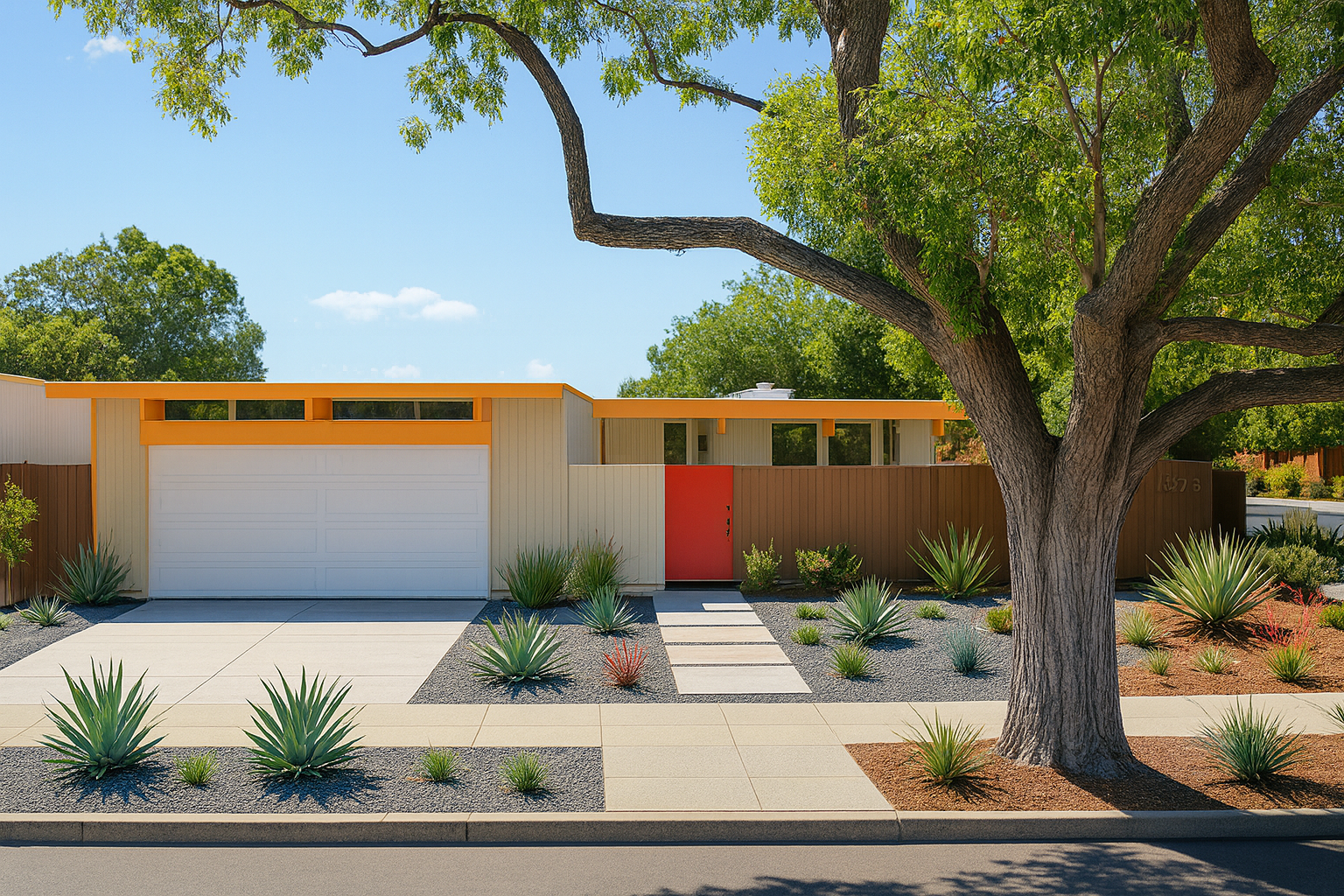
Design and architectural innovation: Eichler homes broke the mold of tract housing. Hallmarks of an Eichler include post-and-beam construction with exposed wood beams, open floor plans, and extensive use of glass that blurs the line between indoors and outdoors. Many Eichler models featured an atrium – an open-air courtyard at the center of the house, enclosed by glass walls – which served as a dramatic entry and a private outdoor room. Floor-to-ceiling glass sliders and clerestory windows flooded interiors with natural light, while Philippine mahogany paneling and radiant heating embedded in the concrete slab floors offered a then-futuristic living experience. Eichler exteriors were unapologetically modern and minimalist: flat or low-pitched roofs with broad eaves, clean lines with little ornamentation, and facades that often presented a blank face or very few windows to the street for privacy. Early Eichler tracts had open carports instead of garages (emphasizing simplicity and informality), though later models added garages as consumer tastes evolved. In comparison to the typical 1950s ranch house, which might have a picture window and brick chimney on the street side, Eichler houses turned their focus inward to their atriums and backyards – a philosophy of “bringing the outside in” that was rare in mainstream developments of the time. As one account noted, “Eichler houses were airy and modern in comparison to most of the mass-produced” homes of the era, which made them stand out to buyers seeking something fresh.
Who were Eichler homes built for? Primarily, Eichler targeted young middle-class families – often professionals or tech industry workers – who were entering the housing market during the booming 1950s. These were homes for teachers, engineers, scientists, and businesspeople looking for affordable modern design. Eichler’s communities were not luxury enclaves; they were priced competitively with other tract homes, making high design “modernism for the masses” rather than a highbrow indulgence. In fact, Joseph Eichler’s social vision was as progressive as his architecture. He believed in inclusivity at a time when housing discrimination was rampant. Eichler Homes maintained a pioneering non-discrimination policy, openly selling to buyers of any race or religion – a stance that sharply contrasted with the racially restrictive covenants common in mid-century suburbia. In 1958, Eichler famously quit the National Association of Home Builders when the organization would not support an anti-discrimination rule. This egalitarian ethos meant Eichler neighborhoods in the 50s and 60s quietly challenged prevailing social norms; for example, some Eichler developments welcomed African-American and Asian-American families who might have been excluded elsewhere. Eichler’s vision of community also included shared amenities: certain tracts (like Palo Alto’s Greenmeadow in 1954) were built around parks, greenbelts, pools, and community centers to “foster a sense of belonging” among neighbors eichlerhomesforsale.com. Greenmeadow’s community center and pool, for instance, became a social hub, reflecting Eichler’s intent to create not just houses but wholesome neighborhoods eichlerhomesforsale.com.
Growth and geographic spread: Eichler homes first appeared in the late 1940s in the Peninsula area (one early Eichler tract was University Gardens in Palo Alto, built 1949–50). In the 1950s, Eichler expanded aggressively in Silicon Valley, capitalizing on the valley’s booming job market and the availability of flat orchard land on the outskirts of towns. Eichler subdivisions took root in South Palo Alto (the Green Gables and Greenmeadow tracts), Mountain View (e.g. the Monta Loma area, which also had Mackay homes), Sunnyvale (the Fairbrae tract and others in the 94087 ZIP code, which became an Eichler hub), Cupertino (the Fairgrove tract near present-day Apple campus), and San Jose (the Willow Glen area’s Fairglen tract, and other pockets in Cambrian Park and Almaden). Smaller clusters even reached into adjacent counties (Eichler built in San Mateo and Marin counties, and a few in the East Bay and Southern California). These neighborhoods were often located near the new industrial parks and defense plants of the era – for instance, Sunnyvale’s Eichlers were a short drive from Lockheed and NASA Ames, while Palo Alto’s were near Stanford’s burgeoning tech incubator. The placement was not coincidental: Eichler Homes strategically bought land where new freeways or expressways would provide access (such as Palo Alto’s tracts along the then-new Oregon Expressway and near Highway 101). The developments themselves usually followed contemporary suburban design principles – curvilinear streets and cul-de-sacs that conformed to FHA planning guidelines – but Eichler’s architects (notably Robert Anshen & Steve Allen, and later Jones & Emmons and Claude Oakland) gave them a unique twist. For example, Palo Alto’s Fairmeadow tract (1955) is famous for its “cul-de-sac circles” layout, a series of circular courts that is both a traffic-calming design and a mid-century modern aesthetic statement.
By the mid-1960s, Eichler’s operation faced headwinds. The cost of land in Silicon Valley was rising sharply as the region prospered, and Eichler Homes sometimes struggled to maintain profitability while upholding design standards. Joseph Eichler attempted to expand into higher-density projects (such as Eichler apartment complexes and even a proposed high-rise in San Francisco), but not all were successful. In the face of these challenges, Eichler Homes built its last major Bay Area tract in the early 1970s. Joseph Eichler passed away in 1974, marking the end of the Eichler era proper. However, by then he had left an indelible legacy on Silicon Valley’s landscape: dozens of modernist neighborhoods and thousands of gleaming post-and-beam homes that would age into mid-century icons.
Architectural Comparisons: Eichler Homes vs. Other Mid-Century Housing
Eichler was not the only player in Silicon Valley’s mid-century housing scene. A handful of other developers and builders also embraced modernist principles in tract development, creating homes that looked a bit like Eichlers even if they weren’t part of Eichler’s company. At the same time, the majority of tract homes remained conventional ranch-style or “builder modern” (a hybrid of traditional and modern elements). Here we compare Eichler homes with some of their contemporaries – including Mackay Homes, Gavello Homes, Alliance Homes, and Brown & Kaufman – as well as the typical ranch houses of the period, to highlight what made Eichler neighborhoods distinct.
Typical Ranch Tract Homes (1940s–1960s): The baseline for comparison is the ordinary tract house of the mid-century. These were usually single-story ranches or split-levels with simple hip/gable roofs, wood or stucco siding, and a few standard decorative features (shutters, brick accents). Floor plans tended to be traditional: a formal living room at front, closed-off kitchen, a hallway to small bedrooms – efficient but not open-concept. Many had large picture windows facing the street and smaller windows in back. Socially, many subdivisions of the early ’50s were built with exclusionary covenants (only white buyers) until those practices were outlawed in 1948 and beyond – a stark contrast to Eichler’s inclusive policy. While ranch homes provided affordable shelter for millions, from an architectural standpoint they were often cookie-cutter and oriented toward the street and the car (driveways and garages were prominent). Eichler homes, by contrast, were oriented inward (toward private atriums/backyards) and were refreshingly open in layout and appearance. An Eichler’s post-and-beam construction allowed for expanses of glass and a lack of interior walls that a typical ranch’s stick framing could not easily achieve. In short, Eichler offered “airy and modern” where most mass housing was cozy and traditional.
Mackay Homes: John Mackay was perhaps Eichler’s most direct local competitor. In the 1950s, Mackay built several hundred modern tract homes in areas like Santa Clara, Mountain View (the Monta Loma neighborhood), and Palo Alto. These were sometimes nicknamed "Mackay Eichlers" because Mackay actually hired Eichler’s go-to architects, Anshen & Allen, to design many of them. Mackay Homes shared many features with Eichlers: post-and-beam construction, big window walls, and open interiors. Advertisements called them “Mackay Wonder Homes” boasting “panoramic window walls and dramatic glass gables that bring the sunlight into your home… and into your life.” Indeed, some Mackay models even sported forward-thinking designs like A-frame or butterfly rooflines for added flair eichlerhomesforsale.com. However, there were subtle differences. Mackay houses often had a slightly more conventional layout – for instance, many lacked the true central atrium of an Eichler, opting instead for L- or U-shaped floor plans with patios. They also were sometimes built on raised perimeter foundations (crawl spaces) rather than slabs eichlerhomesforsale.com, and by some accounts used a bit more exterior ornament or street-facing “curb appeal” than Eichler’s deliberately blank facades eichlerhomesforsale.com. The American Institute of Architects in the mid-50s praised Mackay’s developments alongside Eichler’s as exemplars of advanced planning – specifically citing the then-novel idea of houses presenting a blank wall to the street for privacy. Over time, Mackay Homes didn’t achieve the same iconic status as Eichlers (many were later remodeled beyond recognition), leading some to call them “lower-cost Eichler knockoffs.” But in well-preserved pockets – such as Santa Clara’s Maywood tract – Mackay neighborhoods have retained their mid-century charm and are now winning new fans.
Gavello Homes: Gavello was a smaller local builder (the Gavello brothers) who, in the mid-1950s, created an enclave known as Gavello Glen in Sunnyvale and a few other spots. Gavello homes also embraced modern styling: low-pitched or flat roofs with broad eaves, open floor plans, and integration of indoor-outdoor spaces. Some Gavello designs are noted for distinctive A-frame entrances or dramatic glass gables that echo Eichler and Mackay touches. They tended to be on larger lots with big backyards, and while they didn’t have atriums, they offered expansive patios. In essence, Gavello tracts were a “gem of Bay Area MCM architecture”, albeit an underappreciated one. Because Gavello built fewer homes, these are rarer to find, but in places like Sunnyvale’s Ponderosa Park area, Gavello’s mid-century designs still stand out for their clean lines and “relaxed, suburban feel” blending modernism with a traditional neighborhood vibe.
Alliance Homes: The Alliance Construction Company produced what one might call “Eichler cousins.” Alliance built around 200 mid-century modern houses in the early 1950s, most famously in the Terra Linda area of Marin County. While not in Santa Clara Valley, Alliance Homes are often compared with Eichlers due to their similar look. They featured post-and-beam construction, open layouts, and even radiant-heated slab floors like Eichlers, but usually on a smaller scale. Notably, Alliance homes were a bit smaller and more affordable than Eichlers of the same era. They also lacked atriums, instead using efficient L-shaped plans with private courtyards or patios. One distinguishing feature: Alliance models often included a covered patio off a bedroom designed as a children’s play area – a unique, family-friendly twist on the indoor/outdoor concept. In architectural guides, Alliances are praised as “authentic mid-century modern homes” with thoughtful design, just scaled-down. Though Alliance didn’t build in Silicon Valley proper, the mere existence of these Eichler-like homes in the Bay Area underscores that Eichler’s ideas were influential and spurred imitations (or homages) in the region.
Brown & Kaufman Homes: In the 1960s, builders Brown & Kaufman added another wrinkle to Silicon Valley’s housing fabric. They developed tracts in Cupertino (Monta Vista), parts of Sunnyvale, and Los Altos that are sometimes mistaken for Eichlers at first glance. Brown & Kaufman homes embraced many mid-century modern elements: vaulted open-beam ceilings, large glass panes, and open floor plans with plenty of wood and brick textures inside. They were generally a bit larger and more generously sized than Eichlers (often 4-bedroom layouts and bigger living areas). The key difference is that B&K did not hew as strictly to the minimalist ethos; their homes blended modern features with some conventional touches. For example, a Brown & Kaufman house might have a higher-pitched roof or an attic space (blending post-and-beam with standard framing for practicality). Exteriors might sport more traditional trim or materials – they are sometimes described as less pure than Eichlers in design, but still clearly mid-century in spirit. Many B&K homes have wood paneled walls, indoor-outdoor connectivity, and other “Eichler-esque” traits, yet they often came with a bit more curb appeal and variation in facade. In sum, Brown & Kaufman provided a bridge between the avant-garde Eichler look and the mainstream ranch: their houses incorporated modernist principles (open plans, beam ceilings) in a slightly more mainstream package. Today, well-kept Brown & Kaufman neighborhoods are appreciated by MCM enthusiasts, though the brand is less famous than Eichler. In some areas, these homes have been updated extensively – for instance, local architects like Klopf Architecture have remodeled Brown & Kaufman houses to enhance their mid-century features for 21st-century living.
Others (Streng, Stern & Price, Bahl Patio Homes): Silicon Valley’s mid-century landscape included a few other notable developers, though mostly outside the immediate Santa Clara Valley or in niche markets. The Streng brothers built Eichler-like modern tract homes in the Sacramento area (not Silicon Valley, but worth noting for their similar aesthetic). George Bahl built “Bahl Patio Homes” in the late 1960s–early 70s, which were ultra-modern cubes with private inner courtyards and no street-facing windows – an experiment in privacy and zero-lot-line design mainly seen in Sunnyvale and Santa Clara. And Stern & Price were local contractors who did boutique custom-modern homes in the late 50s–70s around San Jose and Campbell, blending post-and-beam design with ranch practicality on a lot-by-lot basis eichlerhomesforsale.com. Each of these contributed to the diverse palette of Silicon Valley architecture, but in terms of volume and impact, none rivaled Eichler in leaving a lasting modernist mark on entire neighborhoods.
Big picture: Eichler’s influence on Silicon Valley was such that even his competitors often followed his lead. Many “Eichler-esque” tracts sprung up, ensuring that the Valley today isn’t just a sea of generic ranch houses, but rather a patchwork of interesting mid-century modern pockets. Joseph Eichler proved that there was a market for bold architecture in the suburbs – a point that contemporaries like Mackay and Brown & Kaufman validated by borrowing elements of his formula. While each builder had their tweaks – whether it was Mackay’s slight traditionalism, Alliance’s smaller scale, or Bahl’s patio-centric daring – all shared a willingness to break from the cookie-cutter colonial ranch mold. This mid-century period, roughly 1947–1970, can rightly be called Silicon Valley’s Modernist Housing Era, and Eichler was its central protagonist.

1970s–1990s: Suburban Sprawl, Backlash, and Change
By the late 1960s, Silicon Valley’s basic suburban form was largely set. The orchards had given way to an expanse of tract housing and a new network of freeways (101, 280, 85) and expressways stitching the towns together santaclaraca.gov. The 1970s through 1990s continued the trend of suburban growth, but with notable shifts in scale, style, and policy:
Continued expansion and “filling in”: Through the 1970s and 80s, remaining open land in Santa Clara Valley was rapidly built out. South San Jose’s hills and former ranch lands were developed into neighborhoods like Almaden Valley and Santa Teresa; North San Jose and Santa Clara saw orchards replaced with business parks and new housing tracts. What had been small farm towns on the valley periphery, such as Cupertino, Saratoga, and Milpitas, evolved into affluent suburbs as subdivisions climbed into former foothills and cherry orchards. By the 1980s, virtually all the valley floor’s agricultural land had been developed or set aside – the physical metamorphosis from the “Valley of Heart’s Delight” to “Silicon Valley” was complete savingplaces.org. Notably, tech campuses and tilt-up office parks were now dotting the landscape, often adjacent to residential areas, reflecting the region’s economic shift from defense and electronics manufacturing to computer technology. The built environment of this era featured larger homes than the 1950s tracts – two-story houses became common, and architectural styles diversified (ranging from late mid-century “California contemporaries” in the 70s to more eclectic Neo-Mediterranean or pseudo-Victorian styles in the 80s and 90s). The era of the small 1,200 sq ft bungalow was over; new homes grew in size as land values increased and buyers demanded more space.
Architectural and social shifts: By the 1970s, pure mid-century modernism fell out of favor in mainstream production housing. The international and modernist style was often criticized as too plain or cold. Homebuyers showed renewed interest in historical styles and more traditional comforts. As a result, Eichler’s aesthetic influence waned in new construction – few, if any, large developers were building atrium-centric, flat-roof modern homes anymore. Instead, “neo-eclectic” became the trend: builders mixed elements from Spanish, Tudor, Craftsman, or other styles onto modern floor plans, creating the blend seen in many 1980s Silicon Valley subdivisions. Inside, however, the open-plan concept did stick around. Great rooms and vaulted ceilings – pioneered in tract form by Eichler and his peers – reappeared in 1970s and 80s homes, though often with rustic or traditional dressings (exposed rough-hewn beams, sunken living rooms, etc.). Culturally, the valley’s population was diversifying through immigration and the rise of the tech workforce, and the housing market stratified: entry-level homes were often older 1950s tract houses, while new construction catered to move-up buyers and executives.
The slow-growth movement and land-use backlash: The unfettered growth of the post-war decades began to encounter resistance in the 1970s. The very success of California’s development led to congested freeways, smog, and concern over “thousands of identical houses” consuming the landscape. Across California, including Silicon Valley, citizens pushed back through environmental and anti-growth initiatives. They opposed rezoning open spaces, fought high-density infill projects, and lobbied for preservation of what remained of the valley’s natural beauty. This resulted in stricter land-use controls and zoning laws that slowed the pace of development. For example, Palo Alto in 1971 famously adopted an urban growth boundary to protect the foothills, and San Jose developed its “Greenline” policy to limit spread into Coyote Valley. Height limits, lot size minimums, and lengthy approval processes became more common. In 1978, California voters passed Proposition 13, which not only capped property taxes but also, as a side effect, “reduced the government’s ability to fund services, and locked in the low-growth culture” that had taken root. Prop 13 made cities more wary of approving housing (which could strain budgets due to limited tax revenue), reinforcing NIMBY (“Not In My Backyard”) sentiments. By the 1980s, Silicon Valley had a paradoxical situation: a booming tech economy fueling demand for housing, but a political climate much less favorable to large-scale home building than in Eichler’s day. As historian Peter Schrag quipped about mid-60s California, there had been a “cheerful willingness” to accommodate growth and a pride in expansive development – but by the late 70s, that enthusiasm had cooled. Local governments that once bent over backwards to help builders found themselves balancing growth with quality-of-life pressures. (Ned Eichler, Joe’s son, observed that in the 1950s it was “rare” for his father to lose a zoning fight, as city councils felt it was patriotic to support builders. After 1970, that dynamic shifted: builders increasingly faced “Not so fast” from planning commissions.)
Impact on Eichler neighborhoods: During the 70s and 80s, Eichler homes themselves were aging into their second or third decade of life. Many original owners stayed put, raising families and maintaining their homes, while some Eichler neighborhoods went through generational turnover. In the 1980s, these houses were not yet the prized mid-century gems we consider today – in fact, some people saw them as dated or modest. Their single-story layouts and 1950s kitchens needed updates, and a number of Eichler houses were unfortunately subjected to ill-conceived remodels during this time (e.g. Spanish-style clay tile roofs or ornate front doors that clashed with the modern lines). A few Eichlers were even torn down in hot real estate markets and replaced with larger, more contemporary houses, since the land had become quite valuable. However, even as some original Eichler features were lost, a nascent appreciation for mid-century design was brewing. Architecture enthusiasts and preservation-minded buyers began to recognize the “high style” pedigree of these tract homes. By the late 1980s and into the 90s, books like “Eichler Homes: Design for Living” and organizations like Palo Alto Stanford Heritage (PASHeritage) brought attention to Eichler’s work, framing these neighborhoods as worthy of respect and care. Thus, while the late 20th century brought challenges (energy crises, need for insulation upgrades, etc.), Eichler neighborhoods quietly persisted as desirable, livable communities – often with great locations in the heart of Silicon Valley.
2000s to Today: Tech Boom, Housing Crunch, and Eichler Preservation
The 21st century has further altered Silicon Valley’s landscape, driven by explosive tech industry growth and a resulting housing affordability crisis. Yet amid rapid change, Eichler homes and neighborhoods have not only survived – many have thrived as beloved architectural treasures. This era is defined by two parallel narratives: intensifying development pressure (and efforts to increase housing supply), and strong movements to preserve mid-century character in the face of that pressure.
Tech expansion and housing demand: Since around 2000, Silicon Valley’s big tech companies (Google, Apple, Facebook, and others) have expanded dramatically, adding tens of thousands of high-paying jobs. This “second tech boom” (after the dot-com wave of the late 90s) brought an influx of new residents and wealth, which in turn sent home prices skyrocketing. With most of the valley already built out, the increased demand led to extreme competition for existing homes and creative approaches to add housing units. Older commercial or industrial sites have been rezoned for apartments and townhomes; cities like San Jose, Mountain View, and Redwood City have encouraged dense mixed-use developments near transit. In some suburban neighborhoods, individual lots sprouted second units or got subdivided if zoning allowed. Yet, overall, housing construction fell far short of job growth, leading to a well-publicized housing shortage. By the mid-2010s, median home prices in Santa Clara and San Mateo counties were among the highest in the nation. In this seller’s market, even the once-humble mid-century ranchers (Eichlers included) turned into multi-million-dollar properties. For example, an Eichler in Sunnyvale or Palo Alto that might have sold for a few hundred thousand in the 1990s could fetch $1.5–3 million in the 2020s, depending on size and condition (one five-bedroom Eichler in Los Altos sold for $3.5M in 2018). The intense land values meant homeowners faced temptations to expand or rebuild homes to maximize equity – posing a challenge for preserving the original look of Eichler communities.
Eichler neighborhoods under threat and the response: Recognizing the unique architectural value of Eichler tracts, residents and city planners in several Silicon Valley communities took action to protect them from insensitive alterations or McMansion teardowns. The City of Palo Alto, home to around 2,700 Eichler homes (the highest concentration anywhere, comprising roughly 17% of Palo Alto’s single-family housing), led the charge. Beginning in the 2000s, Palo Alto pioneered the use of Single-Story Overlay (SSO) zoning in Eichler tracts – a special regulation that prohibits second-story additions in designated neighborhoods. As of 2018, eleven different Eichler subdivisions in Palo Alto had voted to adopt SSO districts, ensuring they would remain exclusively one-story. This was driven by concerns that looming two-story new builds would destroy the privacy and mid-century modern aesthetic (since Eichler homes were designed with private rear yards and lots of glass – a tall neighbor could easily peer in). With a supermajority of residents’ support, areas like Fairmeadow (the “Circle” tract) and Green Gables gained this protection, meaning the city will not approve any new second floors in those areas. Palo Alto also developed Eichler-specific design guidelines in 2018, offering renovation advice to homeowners so that changes (even on one-story projects) respect the Eichler style – e.g. encouraging flat or low-pitched roofs, vertical wood siding instead of stucco, and discouraging ornament that clashes with modern simplicity. Furthermore, two Palo Alto Eichler tracts – Greenmeadow and Green Gables – were listed on the National Register of Historic Places in 2005, formally recognizing their historic and architectural significance eichlerhomesforsale.com. This designation not only honors Eichler’s legacy but can also offer some protection or at least prestige that bolsters preservation efforts.
Other cities followed suit in adapting policies for Eichler areas. Sunnyvale, which has several large Eichler tracts built in the late 1950s and early 1960s, implemented its own Eichler Design Guidelines in 2009. Sunnyvale’s guidelines similarly regulate second-story design (requiring step-backs and low roof profiles if a second floor is added) and ensure any modifications are in harmony with original aesthetics. Sunnyvale also embraced single-story overlay zoning; since enabling SSO in 2001, the city approved multiple overlay districts covering Eichler enclaves – by 2016 at least seven Eichler neighborhoods in Sunnyvale had one-story protection. In Cupertino, where Eichlers are fewer but still present, residents petitioned for and achieved similar height limits in certain tracts by the late 2010s. Even in San Jose (which has Eichler pockets like Willow Glen’s Fairglen), interest grew in historic designation: the Fairglen Eichler tract was added to the National Register in 2019, and local advocates formed groups to raise awareness of the value of preserving Eichler homes’ “cohesive architecture.” In short, a robust preservation movement now surrounds mid-century modern neighborhoods in Silicon Valley. Neighbors trade tips on period-appropriate materials, cities streamline permits for Eichler-friendly renovations, and real estate agents market Eichler homes as a lifestyle for design enthusiasts rather than just an old house.
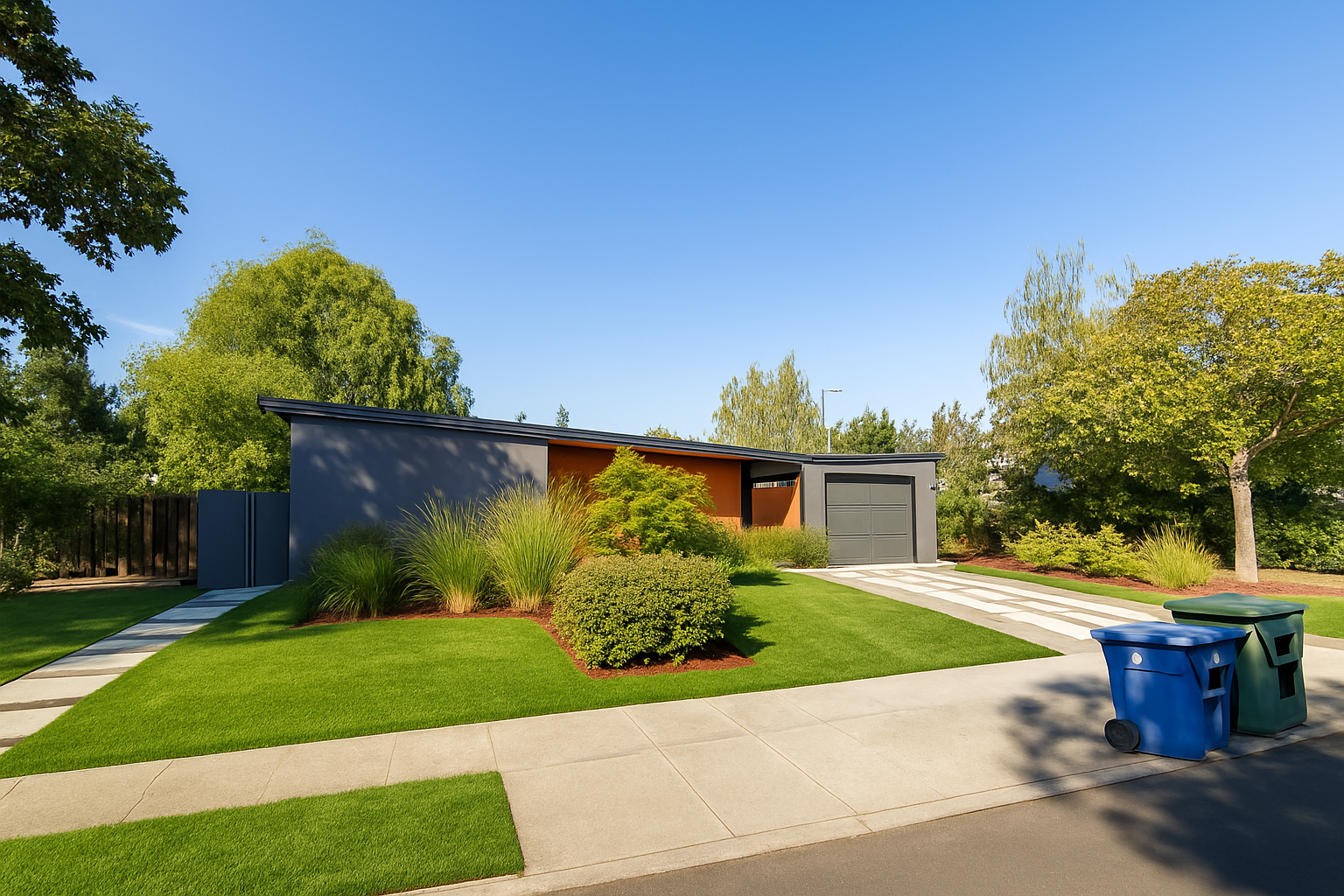
How Eichler neighborhoods have aged: Decades on, Eichler homes present an interesting duality. On one hand, many have been updated with 21st-century comforts: energy-efficient foam roofs replaced the old tar-and-gravel, dual-pane windows stand where single-pane glass once did, and remodeled kitchens boast modern appliances while often retaining the iconic globe lights and mahogany cabinets. On the other hand, a significant number of Eichlers remain remarkably intact, thanks to owners who lovingly preserve original features (sometimes even restoring elements that previous owners removed). In neighborhoods with strong preservation ordinances, the streetscapes look much as they did in the 1950s: flat rooflines, vertical siding, and carports create a time-capsule uniformity. These areas have become meccas for mid-century architecture fans. For instance, walking through Palo Alto’s Greenmeadow or Sunnyvale’s Fairbrae tract, one can appreciate the “high-integrity MCM environment” that has been maintained eichlerhomesforsale.com. Of course, not every Eichler community has fared the same. In some less protected areas, you’ll find a handful of original Eichlers juxtaposed with outsized two-story replacements – a jarring contrast that often spurs remaining neighbors to seek stronger rules. Yet, overall, Eichler neighborhoods have shown a resilience that many post-war tract areas have not: rather than being universally rebuilt or heavily altered, a good portion have essentially been curated by preservation-minded residents. It helps that Eichlers, once considered quirky, are now trendy – part of the larger mid-century modern revival in popular culture. Magazines and websites celebrate Eichler interiors and gardens, and Eichler owners form online groups to share restoration advice. The homes that were once just affordable modern houses for GIs have become architectural historic artifacts in their own right.
Integration into a changing urban landscape: Modern Silicon Valley is a place of contrasts – glass office towers and dense apartments are rising in pockets (like downtown San Jose, Mountain View’s North Bayshore, or along the El Camino Real corridor) even as vast swaths of the valley remain suburban in form. Eichler tracts, being single-story and low-density, sometimes attract attention in debates about land use: should these centrally located neighborhoods be preserved as-is, or redeveloped to add housing? So far, the consensus in places like Palo Alto and Sunnyvale has been to preserve them, recognizing their cultural value and the fact that they provide a distinct character amid the region. In planning discussions, Eichler communities are often held up as examples of “gentle density” – though single-family, their open space, parks, and communal feel are assets to the city. Additionally, some Eichler neighborhoods are exploring creative ways to contribute to housing needs without sacrificing character, such as encouraging Accessory Dwelling Units (ADUs) that are designed in Eichler-compatible style (e.g., low-profile backyard cottages that don’t interfere with sight lines). Zoning policies are gradually adjusting to allow these small additions, aligning with California’s push for ADUs, and architects have even drawn up Eichler-inspired ADU plans. This way, Eichler districts can incrementally add a bit more housing (for in-laws, renters, etc.) while the primary homes and overall look remain intact.
Market and community in present day: For entry-level homebuyers, Eichler neighborhoods can be both alluring and challenging. Alluring, because they offer light-filled spaces, a sense of community, and undeniable “cool” factor with their retro-modern vibe. Challenging, because they often carry premium prices and sometimes come with extra responsibilities (maintaining an old radiant heating system or complying with design guidelines). Preservation groups and Eichler homeowner associations have stepped in to assist, providing newcomers with resources on everything from finding era-appropriate globe lighting to choosing the right paint colors (many recommend a palette of earth tones or bright doors to honor Eichler’s original schemes). Local historical societies even host Eichler home tours to educate the public – these tours frequently sell out, indicating widespread interest. In real estate terms, Eichler homes have shifted from niche to mainstream desirability; it’s not uncommon for a well-presented Eichler to attract multiple offers from buyers who might write personal letters about their appreciation for the architecture. Realtors specializing in mid-century homes (like the Eichler-focused teams at some brokerages) underscore the “soul” and authenticity of these residences, contrasting them with generic new houses. As one modernist architecture expert put it, mid-century homes “offer something that many newer homes don’t: a sense of soul… their use of space, light, simplicity, and honesty in materials continues to resonate with today’s homebuyers.” Silicon Valley, with its design-savvy and techie population, has arguably embraced this ethos more than most regions – preserving and restoring Eichlers better than nearly anywhere else in the country.
Conclusion: Eichler’s Enduring Legacy in Silicon Valley Architecture
Tracing the timeline from pre-war orchards to the present, it’s clear that Silicon Valley’s residential fabric has evolved in tandem with its economic and cultural growth. Each era left its mark: the early 20th century gave us the quaint downtowns and bungalows, the post-war boom blanketed the valley in much-needed housing (and freeways) at the cost of its agricultural past, the Eichler era injected a bold modernist DNA that set the valley apart from generic suburbia, and the late 20th century both sprawled further and then pulled back, grappling with the consequences of growth. Today, in the 21st century, we see a mature Silicon Valley striving to balance innovation with heritage – building upward and inward to house its workforce, while cherishing enclaves like the Eichler neighborhoods that connect the region to an optimistic mid-century moment when modern design and social idealism went hand in hand.
Eichler homes and their fellow mid-century modern tracts are now celebrated touchstones of Silicon Valley’s architectural identity. They remind us that this high-tech region has a domestic side to its history – one of progressive housing experiments, community-building, and aesthetic daring. The story of Eichler neighborhoods is more than just one developer’s legacy; it encapsulates themes of inclusivity, design excellence, and the ever-shifting American dream of home. From the time Joseph Eichler opened his first model homes (promising “modern living for everyone”) to the current homeowners fighting to preserve that vision, Eichler neighborhoods have been and continue to be integral threads in the fabric of Silicon Valley. In a place synonymous with cutting-edge change, the timeless appeal of Eichler architecture proves that sometimes the most innovative path is the one that builds a bridge between people, nature, and community – a lesson as relevant today as it was in the 1950s.
Sources:
Santa Clara County Historic Context – rapid postwar suburbanization santaclaraca.gov; orchard lands converted to subdivisions (1950s–60s) fortheloveofapricots.com
Construction Physics by B. Potter – California housing boom & scale of 1950s development; pro-growth attitudes vs. later restrictions; anti-growth reaction & Prop 13
Joseph Eichler bio – Eichler Homes built ~11,000 houses (1949–1966); Eichler’s modernist and inclusive vision
Eichler-focused publications – Eichler design features and innovations; comparisons with contemporaries (Mackay, Alliance, etc.); community planning in Eichler tracts eichlerhomesforsale.com
Boyenga Team mid-century guide – key traits of Mackay, Gavello, Brown & Kaufman homes; resurgence of interest in mid-century homes
City preservation resources – Palo Alto & Sunnyvale Eichler preservation measures (single-story overlays, design guidelines, historic districts) eichlerhomesforsale.com.
.