
The Compass Nerd Lab: How Data-Driven Agents Decode Eichler Pricing Better Than Algorithms
The Challenge of Pricing Eichler Homes
Eichler homes are not typical tract houses – they are mid-century modern icons with unique features and a cult following. Accurately pricing an Eichler is a nuanced art and science, often beyond the scope of standard automated valuation models (AVMs). Traditional AVMs (like generic price-per-square-foot algorithms) can misfire on Eichlers because they ignore architectural quirks and current buyer sentiment. Instead, Compass agents act like data “nerds” in a lab, leveraging advanced tools and deep architecture knowledge to decode true value. The result? Compass’s data-driven agents consistently outperform algorithms in pinpointing the right price for Eichler homes – balancing market analytics with an appreciation for beams, glass, and atriums that algorithms simply don’t grasp eichlerhomesforsale.com.
Advanced Compass Tools vs. Standard AVMs
Compass has equipped its agents with a suite of innovative tools that give them a pricing edge over one-size-fits-all AVMs. These tools transform market data into actionable insights, allowing agents to craft smarter pricing strategies specifically tuned for unique properties like Eichlers:
AI-Powered CMA (Comparative Market Analysis): Compass’s digital CMA tool uses artificial intelligence to find the most relevant comparables and even suggest price adjustments based on differences between homes compass.com. Agents can generate polished, data-rich pricing presentations in minutes. This AI-backed CMA simplifies complex market data into clear charts and recommendations, instilling confidence that the pricing strategy is rock-solid compass.com. Unlike an AVM that blindly averages nearby sales, the Compass CMA lets agents fine-tune comps (for example, adjusting for an Eichler’s restored atrium or upgraded foam roof) to arrive at the smartest pricing strategy in the industry compass.com.
“Likely-to-Sell” Predictive Analytics: Compass’s platform even helps agents anticipate future Eichler listings. An AI-driven Likely-to-Sell tool in the Compass CRM analyzes tons of data (homeownership tenures, market trends, etc.) to flag which contacts or homes are most likely to hit the market in the next 12 months. This means a Compass agent might know, for instance, that a particular Eichler owner in Palo Alto is statistically likely to sell soon – enabling early outreach. While this doesn’t directly set a price, it gives Compass agents a head-start to prepare a tailored pricing strategy before a home ever hits Zillow. In short, the agent arrives informed and ready, whereas an algorithm only reacts after a home is listed. As Compass puts it, Likely-to-Sell recommendations focus attention on the contacts “with the highest likelihood of selling their homes in the next 12 months,” so agents can engage proactively.
Micro-Market Comps & Hyper-Local Data: Rather than relying on broad metro-wide averages, Compass agents drill down into micro-market comparables. Successful pricing requires identifying a home’s true peer group – and for Eichlers, that means comparing Eichler to Eichler, not to generic houses. Compass agents define precise micro-markets by location and property type: for example, they’ll compare a Joseph Eichler home only to other mid-century moderns in similar Eichler tracts, same school districts, and with comparable design attributes. This beats an AVM that might lump an atrium Eichler with a 1970s ranch down the street. As one Eichler brokerage explains, “Eichlers are a niche market and comparing them to local, traditional home sales to determine price just won’t work”. Instead, Compass agents review the unique features of the specific Eichler (floor plan, architect, roof type) and follow Eichler-specific demand in that neighborhood to set an accurate price. By zeroing in on micro-market data – recent Eichler-only sales, neighborhood-specific trends, active Eichler buyer interest – they capture nuances an AVM misses.
Real-Time Buyer Demand “Heatmaps”: A standout Compass innovation is the Buyer Demand tool, which functions like a real-time heatmap of buyer interest. This proprietary feature shows agents exactly how many serious buyers are actively searching for a home like theirs (by price range, location, and property type) within the Compass network. It pulls from millions of saved searches and buyer views to visualize demand across price points compass.com. Why is this a game-changer? Because it lets agents gauge current market appetite before setting a price. For instance, if the Buyer Demand data reveals dozens of buyers seeking a 4-bedroom Eichler in Sunnyvale around $2.5–$3M, the agent can price confidently at the higher end of that band, knowing demand is there. AVMs have no insight into real-time buyer activity – they rely on past sales, which might be weeks or months old. Compass’s tool replaces guesswork with up-to-the-minute demand curves, helping agents and sellers make data-backed pricing decisions. As Compass’s CEO Robert Reffkin noted, “Buyer Demand gives our professionals the ability to walk into a listing appointment with real-time visibility into serious buyers… allowing home sellers to see exactly how much interest exists for their home at specific price points.”. This means pricing an Eichler isn’t just about looking at yesterday’s comps – it’s about responding to today’s buyers.
Together, these tools form a Compass “Nerd Lab” of sorts – an integrated platform where human agents and AI data work in tandem. Compass Insights, as one team calls it, synthesizes local market trends, comp sales, and buyer demand in real time. Equipped with these insights, Compass agents can set competitive yet realistic asking prices, predict how quickly a home might sell at different price points, and adjust strategy on the fly based on live market feedback. In contrast, a generic algorithm might spit out a value based on an outdated formula and static data. The Compass approach is dynamic and consultative – agents interpret the data and apply it strategically, something an AVM just can’t do.
Why Human Insights + Tech Beat Automated Valuations
All these advanced tools ultimately serve one goal: outsmarting the standard AVMs when it comes to pricing Eichler homes. AVMs like Zillow’s Zestimate or Redfin’s estimate are essentially one-size-fits-all models – they crunch numbers on square footage, number of bedrooms, recent nearby sales, etc., to arrive at a value. That might work for cookie-cutter subdivisions, but Eichlers defy this approach. “Eichlers don’t fit the traditional price-per-square-foot model of valuation,” notes one Eichler specialist, “An Eichler’s worth is based on design integrity, condition, location, and market trends – not just math.” eichlerhomesforsale.com. In other words, the context and character of the home change the equation – and that’s where human, data-informed insight wins out.
Consider how an AVM versus a Compass agent might evaluate an Eichler:
Generic Algorithm’s View: A 1,800 sq ft Eichler in Sunnyvale might be algorithmically compared to any 1,800 sq ft ranch in Sunnyvale that sold recently. The AVM might adjust for basic features (3 bed vs 4 bed, lot size) but it won’t know if one house is an Eichler with a pristine atrium and the other is a 1980s tract home. If Eichlers in that area tend to command, say, a 20% premium due to their design cachet, a naive model could seriously undervalue the home. Likewise, AVMs don’t account for real-time buyer enthusiasm – if there’s a buzz in the mid-century community about a certain Eichler neighborhood, or if Eichler inventory is at a historic low driving up competition, a purely data-last-sold model misses it.
Compass Agent’s View: The Compass agent, by contrast, will isolate Eichler-specific comparables (perhaps recent sales of Eichlers in that tract or nearby cities) and note differences: e.g. this one has the original mahogany walls and globe lights intact (design integrity high), that one had its atrium enclosed (integrity compromised). They’ll check Buyer Demand data – maybe 50+ Compass clients are currently searching for Eichlers under $3M, indicating high likely competition. They’ll also factor in market velocity: is the local Eichler market so hot that recent sales all went 10% over asking? With all this intelligence, the agent might confidently price the home at $3.1M even if a Zillow-style estimate (blind to these nuances) would have pegged it at $2.7M. In essence, the agent’s data-driven strategy aims to capture the full value of the Eichler’s allure, whereas the AVM would have left money on the table.
The limitations of AVMs in niche markets are well documented. Even Zillow’s CEO has admitted Zestimates have a median error that can be significant (and that’s for standard homes). For unique properties like Eichlers, the error can be larger because the model doesn’t “see” architectural pedigree or current demand spikes. In fact, Compass argues that blindly trusting an algorithm can backfire: Zillow’s site might show a Zestimate that’s wildly off (and include other info like a high climate risk score) which “gives buyers leverage and hurts the seller” if taken at face value boyengarealestateteam.com. Compass’s approach is to use technology to augment human expertise, not replace it. The agent remains the analyst in the loop – they can override or adjust the AI recommendations when on-the-ground knowledge (like a pending Eichler sale not yet in the records, or a known issue with a particular house) calls for it. This synergy of AI + human insight leads to pricing precision that AVMs simply can’t replicate, especially for an unconventional asset like an Eichler home.
Architectural Nuances That Impact Eichler Value
One reason pricing Eichlers accurately is so complex is that their architectural nuances dramatically influence value. Compass agents are attuned to these factors – things an algorithm might overlook – and they incorporate them into what we might call an “Eichler Value Matrix.” This matrix considers both market data and the integrity of the home’s mid-century design when assessing price. Here are some key Eichler features that can swing value, and how Compass agents account for them:
Exposed Beams & Post-and-Beam Integrity: Eichler homes feature distinctive post-and-beam construction with exposed beams that run from inside to out. The condition of those beams is crucial. Savvy agents inspect for sagging or dry rot at the beam ends, knowing that structural repairs could be costly and deter buyers. A few small rotten spots can be fixed easily, but widespread beam rot will drag down the home’s value until addressed eichlerhomesforsale.com. Healthy, straight beams aren’t just structural – they’re part of the Eichler aesthetic. An agent who notices well-preserved original beams (or a recent professional restoration) will emphasize that as a value booster. Conversely, if beams have been cut or compromised in a past remodel, a Compass agent might adjust the pricing strategy (or recommend fixing it pre-listing via Compass Concierge) because compromised beams are a big red flag for Eichler buyers and inspectors eichlerhomesforsale.com. In short, beam integrity = value in an Eichler, and human experts make sure it’s factored in.
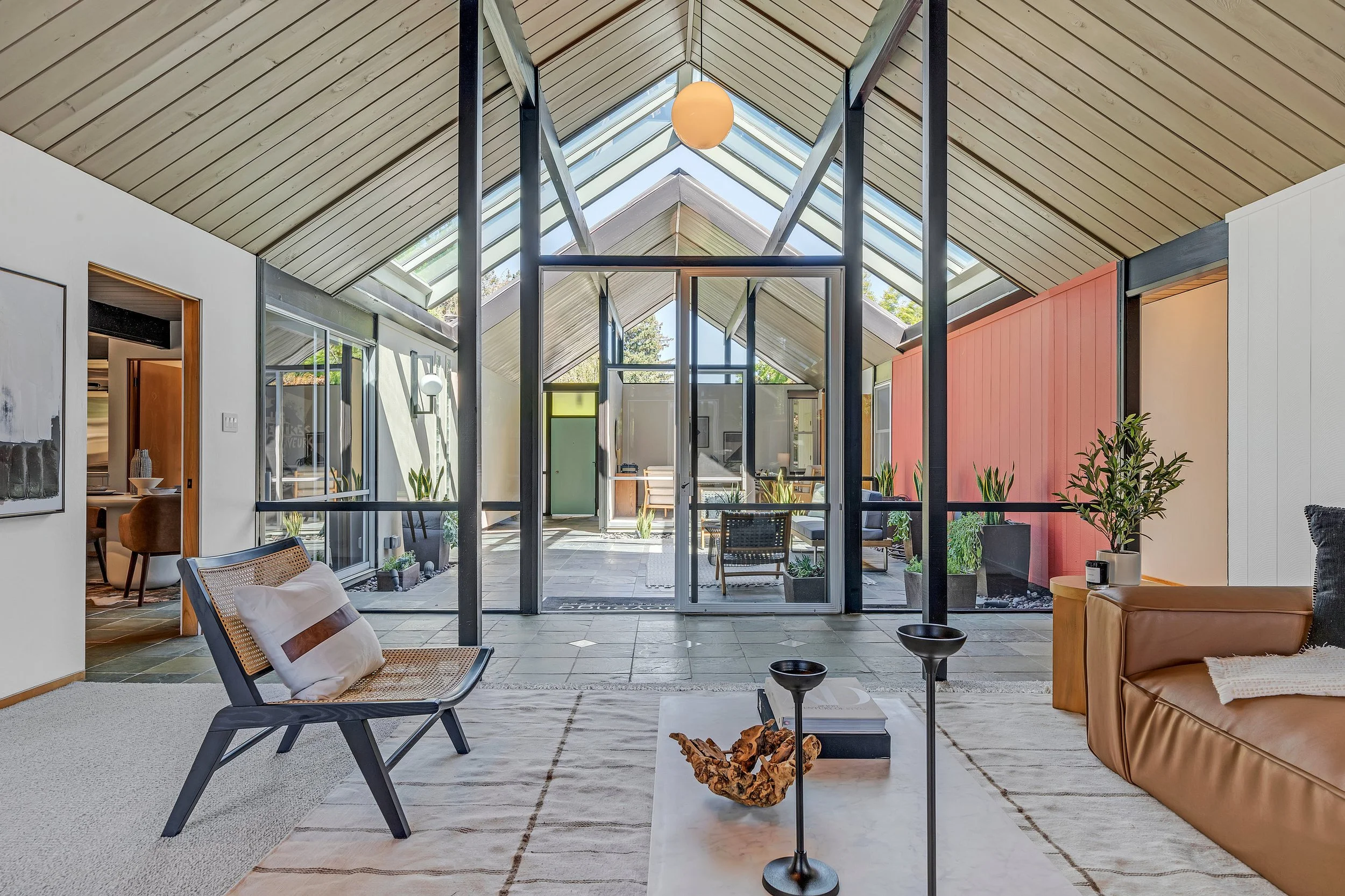
Atrium Presence and Integrity: The central atrium is arguably the heart of an Eichler home – an open-air courtyard bringing light and nature inside. Eichler purists place tremendous value on an intact atrium that remains open to the sky, as originally designed. Preserving the atrium as an open-air space (rather than enclosing it for more interior square footage) “adds tremendous appeal and value” in the Eichler market eichlerhomesforsale.com. Compass agents know this. An Eichler with its atrium still in full glory – maybe with original aggregate flooring and plants – is positioned as a premium property, often commanding higher offers. In fact, across Silicon Valley Eichlers, homes with atriums consistently sell for more than those without eichlerhomesforsale.com. Buyers often bid 10–20% over list for well-preserved atrium models because they represent the quintessential Eichler experience eichlerhomesforsale.com. On the flip side, if an atrium was poorly enclosed or if there are drainage issues (atriums must be well waterproofed), agents will account for that. They might adjust the price or frame the marketing to target more renovation-tolerant buyers. But the ideal scenario? Highlight the atrium as a private oasis that literally and figuratively puts a premium on the home. (Many Eichler listings will lead with a photo of the gleaming atrium for this reason.)
Percentage of Original Glass and Design Features: Eichler homes are famous for their floor-to-ceiling glass walls and sliding doors that blur indoor/outdoor boundaries. The extent to which an Eichler still has its original design elements can affect value. For example, large single-pane glass panels provide the authentic mid-century look; if they’ve been replaced with modern dual-pane units, there’s a trade-off. On one hand, new dual-pane glass improves comfort and energy efficiency (a plus for many buyers). On the other, original floor-to-ceiling glass (and the accompanying mahogany wall paneling, original tar-and-gravel roof, etc.) appeals to mid-century enthusiasts who pay a premium for authenticity eichlerhomesforsale.com. As the Eichler experts at Boyenga Team note, original features that are intact and well-kept can boost an Eichler’s appeal and value significantly for MCM enthusiasts eichlerhomesforsale.com. A Compass agent will assess how much of the home’s original character remains: things like original globe pendant lights, unpainted wood ceilings, original closet sliders, and yes, the “percentage of original glass” still in place. They then match that to the likely buyer pool. If the target buyers are Eichler aficionados, those original details become selling points to market and monetize. If the home has been heavily remodeled in a way that strays from Eichler’s aesthetic (say, vinyl windows or altered façades), an agent might adjust by targeting a different audience or suggesting selective restorations. In essence, the Eichler Value Matrix gives weight to design integrity – preserving Joseph Eichler’s vision tends to support a higher price, while insensitive changes can hurt value if they turn off the core buyer base eichlerhomesforsale.com.
Orientation and Privacy: The orientation of an Eichler – which direction it faces and how it’s sited on the lot – significantly affects its livability and can influence price. Thanks to their walls of glass, Eichlers are extremely sensitive to sun exposure. A south-facing Eichler that soaks up winter sun can feel bright and warm, effectively extending living space into the outdoors, and buyers love that. Good orientation can even lower energy costs and boost comfort, making the home more desirable (one study found optimal orientation can reduce heating needs by up to 20% through passive solar gain) eichlerhomesforsale.com. Homes with superior solar orientation and abundant natural light command higher resale values in today’s market eichlerhomesforsale.com. Privacy is another aspect: Eichlers typically achieve privacy by having almost no windows on the street side and by enclosing the backyard with fences or an atrium. If an Eichler is oriented such that its big glass walls face a lush backyard or internal atrium – not a neighbor’s window – it’s effectively a serene “private oasis ringed by glass” rather than a fishbowl eichlerhomesforsale.com. That setup is a selling point agents emphasize. Conversely, if an Eichler backs onto a two-story house that peeks in, or if a corner lot Eichler has more exposure, agents might encounter buyer hesitation. A Compass agent will highlight any privacy features (e.g. mature landscaping, frosted Mistlite panels that Eichlers often used to diffuse views eichlerhomesforsale.com) to assure value. In short, how an Eichler is oriented – for sunlight and for privacy – is part of the value equation that a knowledgeable agent will calibrate. An algorithm might know the lot size, but it doesn’t know that House A’s master bedroom gets a beautiful dose of morning light and total privacy, whereas House B feels dark or exposed – but a human buyer certainly will notice, and so will a good agent.
Maintenance of Core Systems (Roof, Heating, etc.): Mid-century Eichlers have some unique systems like in-floor radiant heating and flat or low-pitch roofs. Their condition matters immensely to value. For instance, a functioning original radiant heat system (with no leaks) is a prized feature – it’s silent, cozy, and integral to Eichler design. Eichler agents know to obtain pressure tests or confirm if the radiant heat works, because a failed system means expensive repairs (jackhammering slab) or unsightly baseboard heaters as replacement. A working radiant system can add value when properly marketed (it’s a luxury feature today) eichlerhomesforsale.com, whereas a broken one is a price-negotiation point. Similarly, the condition of the roof – many Eichlers use tar-and-gravel or foam roofs – is scrutinized. A new foam roof with insulation can make an Eichler far more livable and is a selling perk, while an old leaky roof is a value drag that diminishes the home’s value and safety eichlerhomesforsale.com. Compass agents leverage tools like Compass Concierge to help owners fix or improve these items pre-sale (e.g. mend the roof, repair beam rot, or refinish concrete floors), thereby boosting the sale price. They understand which upgrades yield ROI in an Eichler (fix structural and water issues first) and which original elements to preserve for maximum appeal eichlerhomesforsale.com.
These architectural and condition nuances are integral to the “Eichler Value Matrix.” This concept is essentially a framework that Compass agents use (even if not by that name) to combine market data + architectural integrity for pricing. The matrix might look like this: Market factors (recent Eichler sale prices, current supply vs demand, seasonality) on one axis, and Architectural factors (design integrity, condition of beams/atrium/roof, orientation privacy advantages) on the other. By evaluating a home across both sets of variables, an agent can position the price more accurately than any algorithm that ignores half of those variables. It’s a holistic approach. As an example, the Boyenga Team (leading Compass Eichler agents) explicitly states that pricing an Eichler right requires balancing all these elements – original details vs. updates, condition, location in an Eichler tract, and current buyer competition eichlerhomesforsale.com. This nuanced balancing act is something they have down to a science (and an art).
The Eichler Value Matrix in Action: A Case Study
To see how Compass’s data-driven, detail-oriented approach outperforms an AVM, let’s look at a real-world scenario:
Case Study – Sunnyvale Atrium Eichler vs. The Algorithm: The Boyenga Team (Compass agents and Eichler specialists) recently listed a classic Eichler home in Sunnyvale. It featured a sought-after open-air atrium and many original mid-century details. A generic algorithm might have valued this 4-bedroom, ~1,800 sq ft home based on the city’s average price per square foot – perhaps around $2.7 million – not accounting for its architectural pedigree. The Compass agents, however, did their homework. They used the Buyer Demand tool and saw robust interest for Eichlers in that price range, and they knew from micro-market comps that atrium models were fetching premiums. They strategically staged the home to emphasize indoor-outdoor flow and listed it at an aggressive yet data-justified price. The result? Multiple offers poured in, and the home ultimately sold for about $350,000 over the asking price boyengarealestateteam.com. In fact, the intense emotional demand from Eichler enthusiasts drove the sale price well above what any “logical” algorithm would predict boyengarealestateteam.com. This kind of outcome demonstrates the power of human-centric, data-enhanced pricing. The agents decoded that this particular property had intangible value – the atrium “wow factor” and move-in-ready Eichler authenticity – that would ignite a bidding war. They were right. An AVM lacking those context clues would have undervalued the home, potentially leaving significant money on the table.
Case Study – Los Altos Eichler, Turning Data into a Record Sale: In another instance, a dated Eichler in Los Altos needed work, and an algorithm might have discounted it heavily. The Compass team saw opportunity instead. Using the Compass Concierge program, they advised the sellers to invest in key improvements (refinishing the tongue-and-groove ceiling, repairing some siding, updating landscaping) with no upfront cost. They tapped into their “Eichler lab” of insights – knowing that in Los Altos, Eichler inventory is scarce and buyer appetite is high. After strategic updates and targeted marketing, the home was launched through Compass’s three-phase coming-soon strategy to build buzz. The outcome: the once-dated Eichler transformed into a record-breaking sale for its neighborhood boyengarealestateteam.com. It sold above its expected price, validating that the right renovations and pricing strategy can far outperform an algorithmic baseline. A Zillow Zestimate or generic model could not have foreseen how the market would react post-renovation – but the Compass agent’s data-driven foresight made it happen.
These examples underscore a broader point: Compass agents treat every Eichler like a unique experiment, formulating a hypothesis on value by analyzing data and property specifics, then executing a marketing plan to prove that hypothesis. They function like “nerd lab” scientists in the best way – testing pricing strategies with coming-soon phases, adjusting based on real-time feedback (e.g., how many buyers “heart” the listing in the Compass platform), and nimbly adapting. By the time an Eichler officially hits the open market, the Compass agent has a finely tuned pricing strategy in place – one that often beats the pants off a static algorithm. And if an AVM misprices an Eichler (which happens frequently due to those misunderstood features), the Compass approach not only catches it but leverages it: for instance, if Zillow’s estimate is low, the agent uses their own buyer demand data to justify a higher ask and can educate buyers on why the home is worth more (“Note the original atrium and high-end period restoration – features that generic estimates don’t account for”). If Zillow’s estimate is unrealistically high, the agent has the credibility of data to set a more realistic price, preventing a listing from stagnating due to overpricing.
Data-Driven Agents Deliver Superior Results
Pricing an Eichler home is far too important to leave to simplistic algorithms. These homes are architectural gems that require a keen eye for design and a deep dive into hyper-local data. Compass’s “nerd lab” philosophy – arming agents with AI-powered CMAs, predictive analytics, micro-market comp analyses, and real-time buyer heatmaps – has proven to be a winning formula. It reinforces the role of the agent as a trusted, data-driven advisor rather than just a salesperson. Compass agents can walk into an Eichler listing presentation with hard evidence in hand – showcasing how many buyers are out there for this home, what premium atrium models fetch, and which features will drive the price. This approach not only yields more accurate pricing, it builds trust with sellers (who feel confident they’re not leaving money on the table or overreaching).
Meanwhile, the Eichler Value Matrix – weighing market metrics alongside architectural integrity – ensures that the soul of the Eichler is valued, not ignored. It’s a holistic strategy that no off-the-shelf AVM can match. As seen in case studies, when a Compass agent’s pricing strategy goes head-to-head with an algorithm, the data-informed human strategy wins – in sale speed, in price achieved, or both. In a world where tech is often touted as replacing humans, Compass flips the script: they use cutting-edge tech to empower humans (agents and their clients) to make smarter decisions. Nowhere is this more evident than in the successful decoding of Eichler home pricing.
In summary, the Compass Nerd Lab approach means Eichler sellers get the best of both worlds: the precision of data analytics and the nuance of human expertise. It’s how a mid-century modern masterpiece finds its true market value in 2025’s market – not by what a generic algorithm says, but by what the informed agent knows. And that difference can be hundreds of thousands of dollars. When it comes to pricing Eichler homes, Compass’s data-driven agents really do decode it better than any algorithm, proving that the smartest “machine” is still the one with a human at the helm, guided by great data boyengarealestateteam.com.
Sources: Connected research from Compass press releases, Eichler market experts, and real estate technology reports have been used to support this article’s insights. Notable references include Compass’s official announcements of its AI-driven tools (Compass CMA and Buyer Demand), blog analyses by leading Eichler-specialist Realtors on how Eichler features affect value eichlerhomesforsale.com, and case study information from the Boyenga Team at Compass, who have documented their Eichler pricing successes boyengarealestateteam.com. These sources reinforce how a targeted, informed approach outperforms generic pricing algorithms in the unique arena of Eichler homes.