
The Fairglen Effect: Why San Jose’s Historic Eichler Neighborhood Still Feels Like the Future
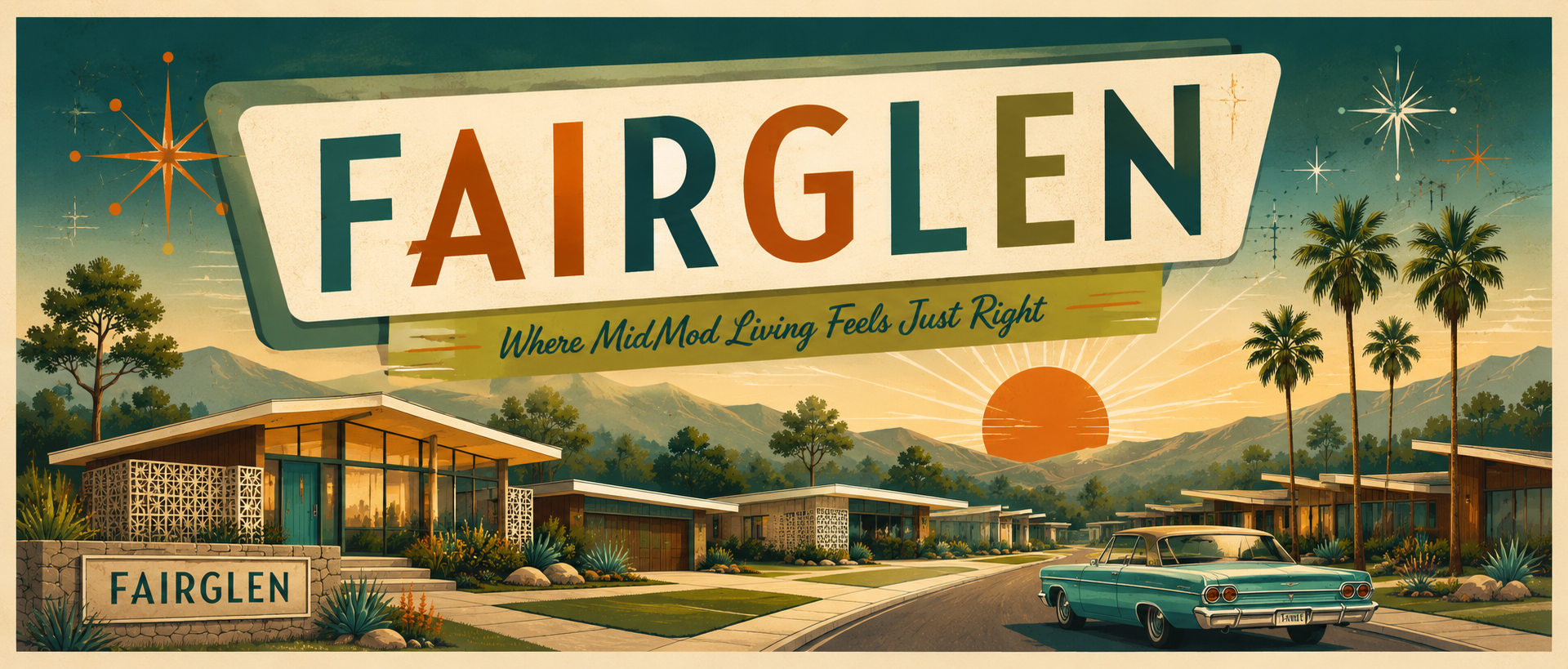
A buyer does not always understand Fairglen immediately.
At first, they see what any Eichler buyer sees from the street: a low roofline, a carport, a modest façade, maybe a privacy fence, maybe a mature tree, maybe a front elevation that gives away almost nothing. Fairglen does not shout from the curb. It is not trying to impress with columns, gables, turrets, or ornamental drama. It is quieter than that.
Then the buyer steps inside.
The house opens.
The atrium appears. The glass catches the garden. The ceiling plane stretches across the room. The slab feels grounded. The public street disappears. The home becomes private, bright, calm, and strangely current — even though the original design language is more than half a century old.
Then the buyer walks back outside and notices something else.
The neighboring homes are speaking the same language.
Not identical. Not frozen. Not museum pieces. But related. One roofline answers another. One carport sets up the next. One garden wall protects another atrium. The street feels like a composition, not a random collection of remodels.
That is the Fairglen Effect.
And the Property Nerd question is:
Why does this neighborhood feel so good before you even open the front door?
The answer is not one thing. It is the overlap of many maps: architecture map, preservation map, community map, street map, landscape map, buyer-demand map, and seller-preparation map.
Fairglen works because all of those maps reinforce each other.
Fairglen Is Not Just a Tract. It Is a Living Eichler Ecosystem.
Some neighborhoods have Eichler homes.
Fairglen still feels like an Eichler neighborhood.
That distinction matters.
A single Eichler can be beautiful, but an Eichler neighborhood creates something bigger: a repeated architectural rhythm, a shared language of privacy, a landscape pattern, a street experience, and a community culture that makes the homes feel connected to one another. Fairglen’s magic is not only inside the homes. It is in the way the entire neighborhood holds the Eichler idea together.
The Fairglen neighborhood site describes the tract as a community of 200+ historic homes in southwest Willow Glen, built by Joseph Eichler between 1960 and 1962, and emphasizes that the neighborhood remains tight-knit and lively, with residents regularly gathering to share and connect. EichlerHomesForSale.com also identifies Fairglen as the most well-known San Jose Eichler community in Willow Glen, noting that it contains over 250 Eichler homes and remains remarkably intact today.
That word — intact — is important.
In a neighborhood like Fairglen, value is not just about one house. It is about the strength of the larger pattern. The homes do not need to be identical, and they do not need to be preserved like museum objects. But they need to remember what they are.
Fairglen remembers.
That is why buyers feel it.
The Architecture Map: Why the Streets Still Make Sense
Fairglen is charming, but not by accident.
The neighborhood has an architectural grammar. Once you learn to read it, the streets become more interesting.
There are low rooflines. There are carports and garages integrated into the front elevations. There are modest public façades that protect private interiors. There are atriums, courtyards, and garden-facing glass walls. There are post-and-beam structures, slab foundations, radiant heat histories, clerestories, and indoor-outdoor relationships that make the homes feel larger and more open than their square footage alone might suggest.
The National Park Service’s asset record for Fairglen Additions Units 1, 2, and 3 identifies the district under the multiple-property listing Housing Tracts of Joseph Eichler in San Jose, 1952–1963, with architecture/engineering significance and mid-century modern California tract-style architecture.
That formal recognition matters, but the buyer does not need to read an NPS asset record to feel the effect. They feel it when they walk the block.
A Property Nerd sees it this way:
Fairglen is not charming because the homes are old. Fairglen is charming because the streets still hold the original design logic.
The front of the house is often quiet. The private life happens behind the threshold. The architecture protects the street side, then opens dramatically inward. That repeated pattern gives the neighborhood its calm. It is one of the reasons Fairglen does not feel like a generic subdivision with a few cool houses sprinkled in.
It feels like an idea that was built at neighborhood scale.
The Preservation Map: Historic Status With Real-World Meaning
Fairglen is not merely “historic-feeling.” It has a real preservation story.
The City of San José says its Eichler Neighborhood Objective Design Standards are intended to accommodate growth and change in San Jose’s Eichler neighborhoods while guiding alterations and maintaining historic character. The City also states that the standards currently apply to properties in the Fairglen Additions historic district, a National Register Historic District listed in the San José Historic Resources Inventory.
This is where the neighborhood becomes especially interesting from a real estate perspective.
For buyers, Fairglen is not only a place to buy an Eichler. It is a place where architectural continuity is being actively considered.
For sellers, the historic context means the home should not be marketed like a generic Willow Glen ranch. The neighborhood’s identity is part of the value.
For owners, preservation does not mean freezing the past. It means future changes should understand the original design. A thoughtful remodel can absolutely belong in Fairglen. But a remodel that ignores the roofline, façade, carport rhythm, exterior materials, or atrium logic can weaken more than one property. It can weaken the street.
In Fairglen, preservation is not about saying “no” to change.
It is about asking change to have manners.
The Community Map: Why Fairglen Feels Like More Than Real Estate
Fairglen has something many neighborhoods try to create but few actually sustain: a recognizable community identity.
The Fairglen neighborhood site describes the area as tight-knit and lively, with neighbors regularly gathering and connecting. Eichler Network has also written about Fairglen’s strong neighborhood culture, including the Fairglen Art Festival that began in the early 1960s, neighborhood block parties, and “Joey Awards” recognizing exemplary restorations and improvements.
That is not fluff.
That is social infrastructure.
A great Eichler neighborhood is not only a set of houses. It is a group of owners who understand that the value of each home is strengthened by the care of the whole tract. Fairglen’s community culture matters because Eichlers are relational architecture. One owner’s front façade, roofline, fence, carport, landscape, and second-story decision can affect the way the whole street reads.
Fairglen’s strongest amenity may be that the neighbors understand what they have.
That does not mean every owner agrees on every design choice. It means the neighborhood has a shared vocabulary. People know what an atrium means. They know why the front elevation is restrained. They know why carports matter. They know why glass needs privacy. They know why rooflines are not random. They know why a sensitive update feels different from a generic remodel.
That collective awareness is part of the Fairglen Effect.
The Willow Glen Layer: Location Without Losing the Eichler Feeling
Fairglen also benefits from being in Willow Glen.
That matters because buyers are often searching at multiple levels at once. They are not only searching “Eichler.” They are searching San Jose, Willow Glen, 95125, schools, commute access, neighborhood feel, parks, downtown proximity, and long-term lifestyle. EichlerHomesForSale.com describes 95125 as part of San Jose’s desirable Willow Glen area and identifies the Fairglen tract as one of the prominent Eichler communities in the ZIP code, highlighting its post-and-beam construction, open floor plans, and floor-to-ceiling glass walls connecting interiors to private atriums and gardens.
Fairglen gives buyers a rare combination:
Eichler architecture.
Willow Glen neighborhood appeal.
San Jose convenience.
Silicon Valley access.
Historic recognition.
Community identity.
Residential calm.
That combination is hard to duplicate.
Many buyers can find a home in San Jose. Fewer can find a true Eichler. Fewer still can find an Eichler in a cohesive neighborhood where the broader design language still reads clearly from the street.
Fairglen gives buyers something that is increasingly scarce: a true Eichler neighborhood inside one of San Jose’s most beloved residential areas.
The Street Experience: Why Fairglen Feels Calm
Fairglen curb appeal is different from conventional curb appeal.
A conventional home may try to impress from the sidewalk. It may show off its entry, windows, ornament, porch, façade, and front yard all at once.
An Eichler often does the opposite.
The street façade is restrained. The home may look private, even quiet. The carport or garage is part of the composition. The entry may be recessed, hidden, or softened by a screen. The real reveal happens inside.
That restraint is not a lack of curb appeal. It is Eichler curb appeal.
Fairglen works because many of its streets still understand this idea. The homes do not need to shout. They create curiosity. The buyer wants to know what happens behind the privacy plane, beyond the carport, past the gate, or inside the atrium.
A Property Nerd would say:
Fairglen curb appeal is not about showing everything from the sidewalk. It is about making the buyer curious enough to step inside.
The best Fairglen homes do not overperform at the street. They protect the reveal.
That is one of the reasons the neighborhood feels so calm.
The Atrium-and-Garden Map: Why Fairglen Homes Live Bigger Than Their Square Footage
In Fairglen, square footage is measured in county records, but daily life is measured through the glass.
That is true of many Eichlers, but Fairglen expresses it beautifully because the neighborhood’s homes are deeply tied to atriums, patios, private gardens, side yards, and indoor-outdoor living.
A Fairglen Eichler may not be huge by modern Silicon Valley standards. But a well-preserved Eichler can live much larger than its measured square footage because the garden becomes part of the room. The atrium becomes part of the daily circulation. The glass extends the living space visually. The side yard becomes a utility corridor, privacy buffer, bike route, or garden edge. The backyard becomes an outdoor room rather than a leftover lawn.
This is where Eichler value becomes emotional.
A buyer walks into a conventional 1,600-square-foot home and sees rooms.
A buyer walks into a 1,600-square-foot Fairglen Eichler and sees a relationship between rooms, sky, garden, slab, roofline, and light.
That relationship is the premium.
The home is not just the interior.
The home is the controlled connection to the outdoors.
The Buyer Demand Map: Why Fairglen Stands Out in San Jose Eichler Searches
Fairglen buyers are rarely looking for only a house.
They are looking for a story.
A true Eichler tract. Historic context. Willow Glen location. Architectural coherence. Indoor-outdoor living. Preserved original details. Design-sensitive remodel potential. Community identity. Scarcity. A sense that the neighborhood itself understands the homes.
That is why Fairglen can stand out in search traffic and buyer psychology. A buyer may begin with “San Jose Eichler homes,” then narrow to “Willow Glen Eichler,” then discover Fairglen, then realize that not all Eichler neighborhoods feel the same.
EichlerHomesForSale.com has also documented strong Fairglen buyer interest through specific sales coverage, including the sale of 1642 Andalusia Way in Fairglen for $2.625 million, which the site described as a record-breaking sale in the neighborhood and evidence of continued desirability for Willow Glen Eichlers.
That does not mean every Fairglen home will perform the same way. Condition, architecture, lot, timing, presentation, pricing, and market conditions matter. But it does show why Fairglen should be marketed with Eichler-specific care.
Fairglen demand is not just about rarity.
It is about rarity that still feels coherent.
The Fairglen Buyer Walk: How to Evaluate the Neighborhood Like a Property Nerd
A buyer should not only tour the home.
A buyer should walk the tract.
That is the Property Nerd way to understand Fairglen.
Start with the street. Do the rooflines still read as a neighborhood? Are the homes mostly one story? Are carports and garages still part of the rhythm? Are front façades restrained, or have they been overworked? Does the landscaping support the architecture? Do privacy screens feel integrated? Do exterior materials feel sensitive to the neighborhood?
Then walk the property. Does the home preserve its atrium or courtyard logic? Does the glass open to private outdoor space? Does the side yard function? Does the carport feel architectural or cluttered? Do updates respect the ceiling plane, beams, roofline, and indoor-outdoor flow? Is the home a preserved Eichler, a sensitive remodel, or a generic remodel wearing an Eichler roofline?
Then ask the future-project questions. Could exterior changes be affected by design standards? What records exist? Are roof, radiant heat, pest, permit, and sewer documents available? Does the home’s condition support the buyer’s plans? Are the buyer’s remodel ideas compatible with Fairglen’s historic and architectural context?
Do not just tour the Fairglen home.
Walk the tract.
The neighborhood is part of the value.
The Seller’s Fairglen Strategy: Market More Than the House
A Fairglen seller is not just selling a home.
They are selling membership in one of San Jose’s most legible Eichler stories.
That means the marketing strategy should not treat the property like a generic single-story home in Willow Glen. A Fairglen listing should explain the home, the tract, the architecture, the preservation context, the community identity, the indoor-outdoor lifestyle, and the buyer emotion.
Seller preparation matters. The atrium should be clean, calm, and intentional. Glass should be polished. The carport should feel architectural, not logistical. The side yard should be cleared. Roof, radiant heat, pest, permit, and sewer records should be organized where available. Original or restored details should be highlighted. Generic staging that fights the architecture should be avoided. Photography should show the home’s relationship to garden, light, and roofline — not just interior finishes.
A Fairglen seller should also be careful with remodel language. Buyers who care about Eichlers can sense the difference between “updated” and “understood.” A new kitchen may be beautiful, but does it preserve the ceiling? A new entry may be clean, but does it respect the façade? A new landscape may be attractive, but does it support the glass-wall living experience?
In Fairglen, architecture is not just an aesthetic.
It is the market position.
What Not to Do in a Fairglen Eichler
Fairglen deserves more than generic remodel advice.
The fastest way to weaken a Fairglen Eichler is to remodel it as if the neighborhood does not matter.
That means owners should be cautious about erasing atriums, overbuilding front façades, installing heavy traditional materials, blocking clerestories, ignoring carport composition, treating side yards as junk zones, painting or replacing original materials without strategy, or marketing the home as a generic Willow Glen ranch.
This does not mean Fairglen homes should never change. They must change. Homes need new roofs, new systems, updated kitchens, better energy performance, improved drainage, safer electrical panels, modern bathrooms, solar, heat pumps, and daily-life upgrades.
The question is how they change.
A good Fairglen remodel asks:
Does this preserve the roofline rhythm?
Does this protect the atrium logic?
Does this improve the home without making it generic?
Does this exterior change understand the historic district context?
Does this material belong here?
Does this addition respect the neighborhood scale?
Does this upgrade support daily life while keeping the Eichler soul?
A generic remodel may add cost.
A sensitive remodel can add value.
A Property Nerd knows the difference.
The Fairglen Preservation Premium
There is a quiet premium in coherence.
Buyers may not always describe it clearly, but they feel it. They know when a neighborhood has retained its pattern. They know when a home’s exterior still belongs to the street. They know when the atrium still works. They know when the carport is clean. They know when the remodel did not fight the house.
That feeling can support buyer confidence.
It can also help sellers explain value. A Fairglen home is not just competing against square footage. It is competing through architecture, neighborhood identity, scarcity, and emotional clarity.
The preservation premium is not automatic. A poorly maintained home still needs work. A bad remodel still hurts. A roof still needs records. A pest report still matters. Historic status does not magically repair systems.
But when the home is prepared, documented, staged, and marketed correctly, Fairglen’s larger story can support the listing.
The buyer is not only buying the address.
They are buying into the Fairglen Effect.
The Fairglen Seller Checklist
Before listing a Fairglen Eichler, a seller should think beyond ordinary staging.
The goal is to prepare the home so buyers see both the individual property and the neighborhood story.
A smart Fairglen preparation plan may include:
Cleaning and staging the atrium as an outdoor room.
Cleaning glass walls, sliders, and clerestories.
Organizing roof, radiant heat, pest, sewer, permit, and remodel records.
Editing carport storage so the front elevation reads cleanly.
Clearing side yards so utility spaces feel maintained.
Trimming landscaping to reveal architecture, not hide it.
Highlighting preserved beams, ceilings, paneling, atrium features, and original design elements.
Avoiding staging that makes the home feel generic.
Using photography that captures indoor-outdoor living and the Fairglen context.
Explaining historic district relevance accurately.
Pricing with Eichler-specific comparable sales, not just generic single-story comps.
A Fairglen listing should feel like architecture with a story.
Not just a house with square footage.
The Fairglen Buyer Checklist
A Fairglen buyer should combine emotion with due diligence.
The emotional part is easy. These homes are easy to love.
The due diligence part is where the Property Nerd brain helps.
A buyer should ask:
Is the atrium intact?
Are the roofline and façade sensitive to the neighborhood?
Are the glass walls and indoor-outdoor relationships preserved?
Are exterior changes compatible with the Fairglen context?
What design standards or historic district considerations may apply?
What records exist for roof, radiant heat, pest, sewer, permits, solar, electrical, HVAC, and remodel work?
Are original details preserved or erased?
Are upgrades sensitive or generic?
Does the side yard function?
Does the carport support daily life?
Would future remodel plans respect the historic and architectural setting?
Is the home priced like a generic ranch or like an Eichler with neighborhood value?
A Fairglen buyer should love the house.
Then read it.
Then walk the block.
Then decide.
That is the Property Nerd sequence.
How the Boyenga Team at Compass Helps Fairglen Buyers and Sellers
Fairglen is exactly the kind of neighborhood where Eichler expertise matters.
A generic agent might see a Willow Glen listing.
A Property Nerd sees roofline rhythm, atrium integrity, historic context, buyer psychology, preservation standards, remodel sensitivity, and the invisible premium of neighborhood coherence.
EichlerHomesForSale.com describes the Boyenga Team as Compass’s #1 real estate team in Silicon Valley and identifies Eric and Janelle Boyenga as trusted Eichler Home Sales Experts with specialized knowledge in mid-century modern and restorative construction. The site also notes that the Boyenga Team is known throughout the real estate industry as “Property Nerds” for its data-driven approach, digital technology, strategic marketing, pre-listing project management, and client care.
For buyers, the Boyenga Team can help evaluate whether a Fairglen home has preserved its best features, whether remodels are sensitive, whether the historic context may affect future plans, and whether the home’s condition supports the buyer’s goals.
For sellers, Eric and Janelle Boyenga can help position the home beyond square footage. That may include architectural storytelling, pre-listing preparation, staging, photography, documentation, and Eichler-specific pricing strategy. In Fairglen, the listing should not simply say “Willow Glen home.” It should explain why this particular Eichler belongs to a rare, historically recognized neighborhood pattern.
The Boyenga Team understands that Fairglen value lives in both the home and the neighborhood.
A Fairglen Eichler is not just glass, beams, and an atrium.
It is part of a San Jose Eichler story that buyers can feel from the street.
Work With Fairglen Eichler Experts
Thinking of buying or selling in Fairglen? Work with Eric and Janelle Boyenga of the Boyenga Team at Compass — Eichler real estate experts who understand Fairglen’s architecture, historic status, preservation culture, Willow Glen lifestyle, buyer demand, and mid-century modern value.
Whether you are preparing a Fairglen Eichler for market or searching for the right home in this historic San Jose neighborhood, the Boyenga Team helps clients make thoughtful, design-sensitive, data-informed decisions.
Fairglen is not great because it has Eichlers.
Fairglen is great because it still feels like the Eichler idea became a neighborhood.
FAQ: Fairglen Eichlers in Willow Glen
Where is Fairglen?
Fairglen is located in the southwest portion of the Willow Glen neighborhood in San Jose, California, within the 95125 ZIP code. The neighborhood is known for its concentration of Joseph Eichler homes and strong mid-century modern identity.
When was Fairglen built?
The Fairglen neighborhood site states that the Fairglen Eichler tract was built by Joseph Eichler between 1960 and 1962. The National Park Service asset record for Fairglen Additions identifies the related district under the Housing Tracts of Joseph Eichler in San Jose, 1952–1963 multiple-property listing.
Is Fairglen historically recognized?
Yes. The City of San José states that the Fairglen Additions historic district is a National Register Historic District listed in the San José Historic Resources Inventory, and that San José’s Eichler Neighborhood Objective Design Standards currently apply to properties in that district.
Why do buyers like Fairglen?
Buyers are often drawn to Fairglen because it combines Eichler architecture, Willow Glen location, historic context, community identity, indoor-outdoor living, mature landscaping, and neighborhood-scale architectural coherence.
What makes Fairglen different from a single Eichler outside a tract?
A single Eichler can be beautiful, but Fairglen offers a larger neighborhood pattern: repeated rooflines, carports, privacy façades, atriums, gardens, and a community culture that reinforces the original Eichler design idea.
Are Fairglen Eichlers good candidates for remodeling?
They can be, but remodels should be sensitive to the architecture and neighborhood context. Buyers and owners should understand the home’s original features, historic district considerations, roofline, atrium, carport, exterior materials, and design standards before planning major exterior changes.
What should Fairglen sellers prepare before listing?
Fairglen sellers should organize roof, radiant heat, pest, sewer, permit, remodel, solar, and system records where available. They should also stage the atrium, clean the glass, edit carport and side-yard clutter, highlight preserved original details, and market the home as part of a historic Eichler neighborhood rather than a generic Willow Glen property.
Why work with Eichler specialists in Fairglen?
Fairglen homes require specialized understanding of Eichler architecture, historic context, buyer psychology, preservation-sensitive marketing, and system-specific issues such as flat roofs, radiant heat, glass walls, atriums, and carports. Eric and Janelle Boyenga of the Boyenga Team at Compass specialize in Eichler and mid-century modern homes.
This article is for general educational purposes only and should not be treated as legal, historic-preservation, land-use, construction, appraisal, tax, insurance, inspection, or real estate advice for a specific property. Historic district standards, design review, remodel feasibility, disclosure obligations, valuation, and market conditions vary by property and jurisdiction. Fairglen buyers, sellers, and homeowners should consult qualified real estate professionals, local planning officials, inspectors, contractors, architects, appraisers, attorneys, tax advisors, and appropriate local agencies before making property-specific decisions.