
Mackay Mid‑Century Homes in Mountain View’s Monta Loma and Oakwood
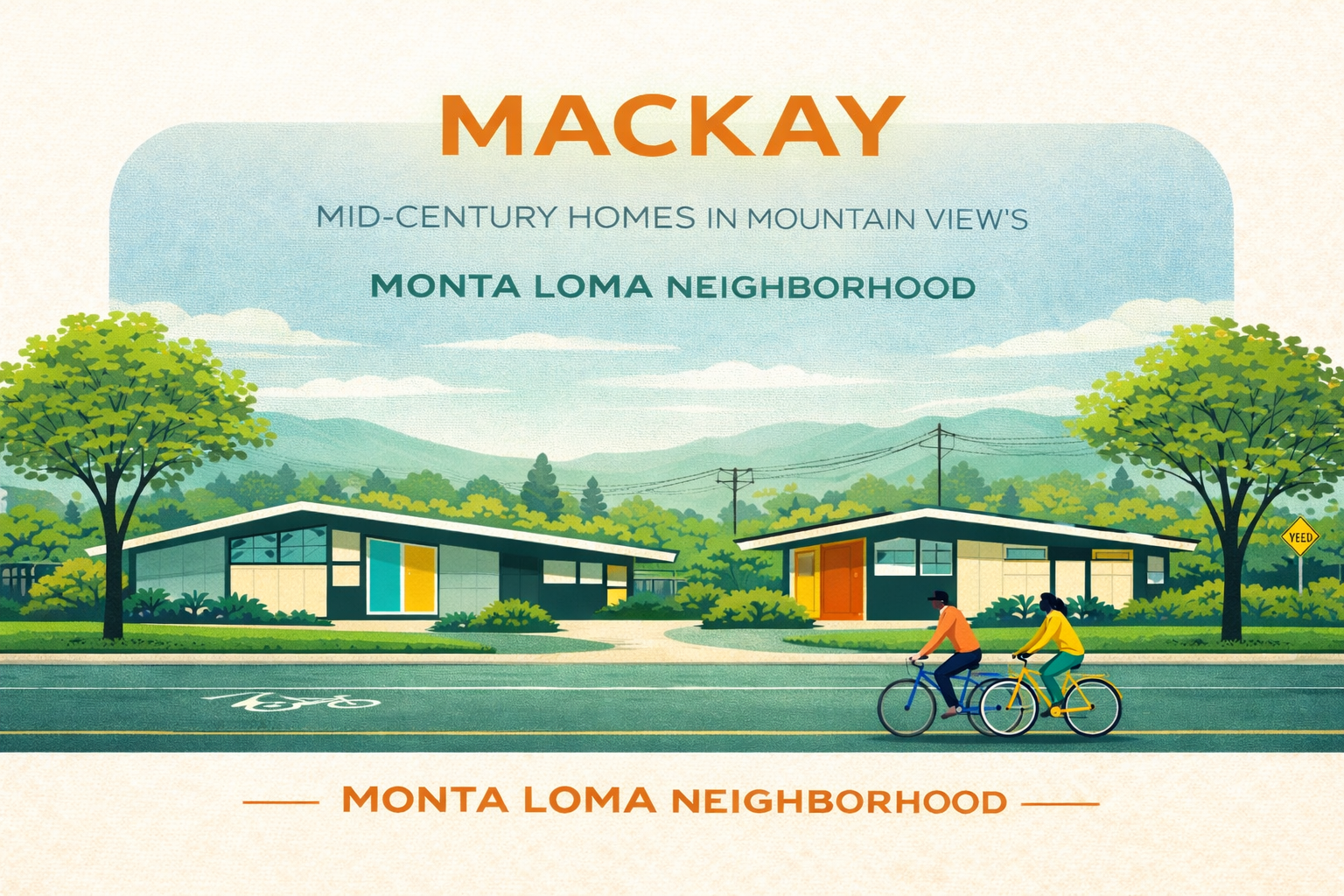
Mountain View’s Monta Loma neighborhood is one of the most concentrated, best-documented places to study Mackay’s version of “California Modern” tract housing—because Mackay, Eichler, and Mardell all built within the same neighborhood footprint in the mid‑1950s.
Within Monta Loma, Mackay’s original tract name was “Oakwood”, and local neighborhood researchers describe Mackay’s build-out as “over 200” compact “flattop” contemporaries across 1955–1956, with meaningful model variation (including both slab and raised-perimeter construction). That combination—scale + variation + side‑by‑side builder comparability—creates unusually strong analytical leverage for (a) architectural identification, (b) remodeling strategy, and (c) pricing and negotiation strategy.
From a market standpoint, Redfin’s neighborhood-level housing-market reporting shows Monta Loma’s median sale price at $1,737,000 (Feb 2026) with very fast market velocity, while the broader Mountain View median is $1,822,500 (Feb 2026)—and Palo Alto’s city median is $3,208,000 (Feb 2026), underscoring why design-forward buyers often see Monta Loma as a “relative value” corridor for mid-century inventory.
Developer history and design lineage
John Calder Mackay (developer) founded Mackay Homes in 1950, after earlier work that included building the first commercial building on Santa Cruz Avenue in Menlo Park. Stanford’s alumni obituary notes that he also constructed “the Villages” in San Jose and went on to build approximately 15,000 apartments and office parks in the Bay Area and 13 other states, reflecting a developer profile that extended well beyond single‑family tracts.
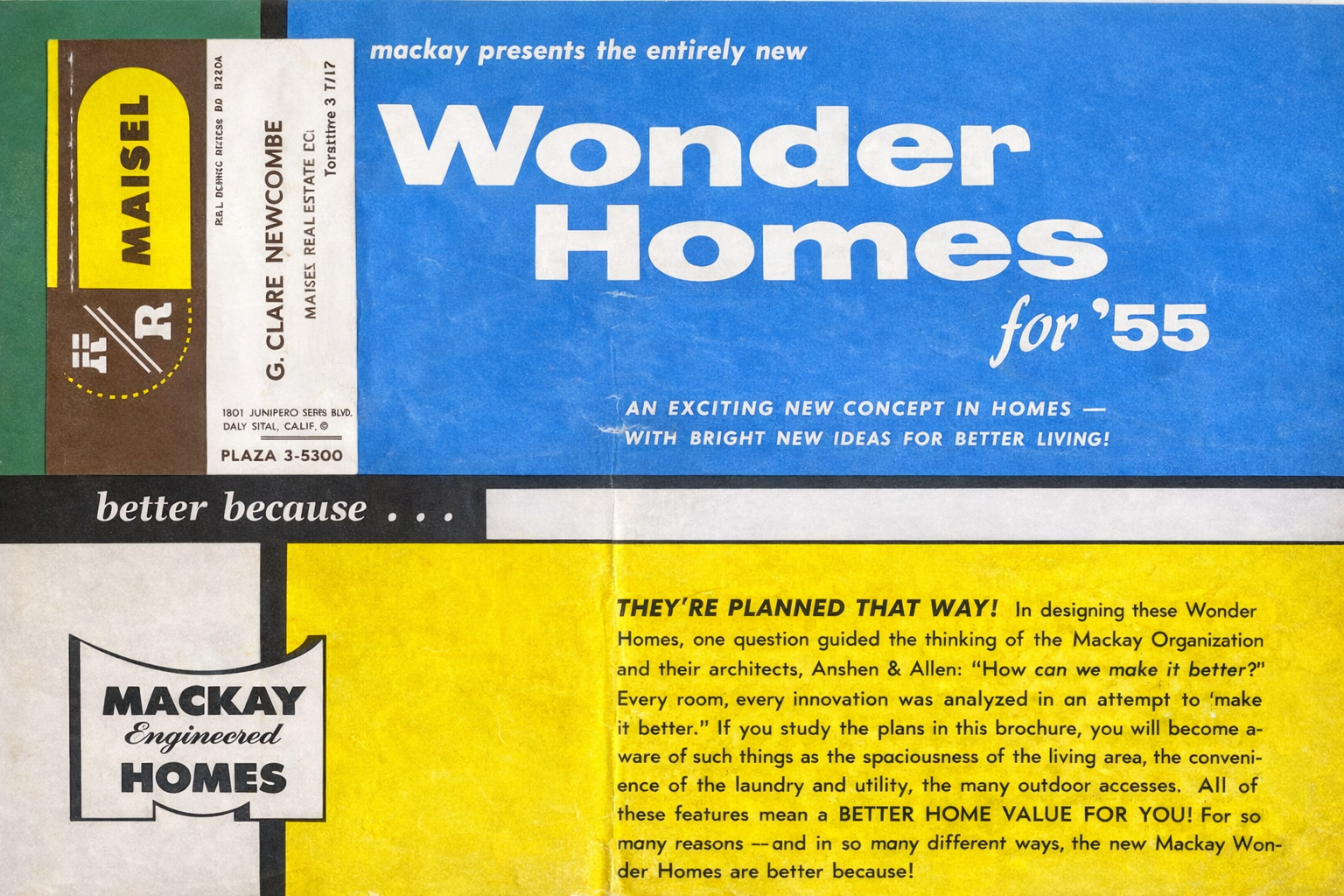
For Monta Loma/Oakwood specifically, two sources anchor the architectural lineage. First, Eichler Network frames Mackay as an Eichler rival whose houses were designed by Anshen & Allen and marketed as “Wonder Homes.” Second, the Oakwood “Wonder Homes for ’55” brochure itself explicitly credits Mackay’s architects as “Anshen & Allen,” positioning the tract as an intentionally-designed, brand-led “new concept in homes” rather than generic builder product.
Monta Loma and Oakwood development context
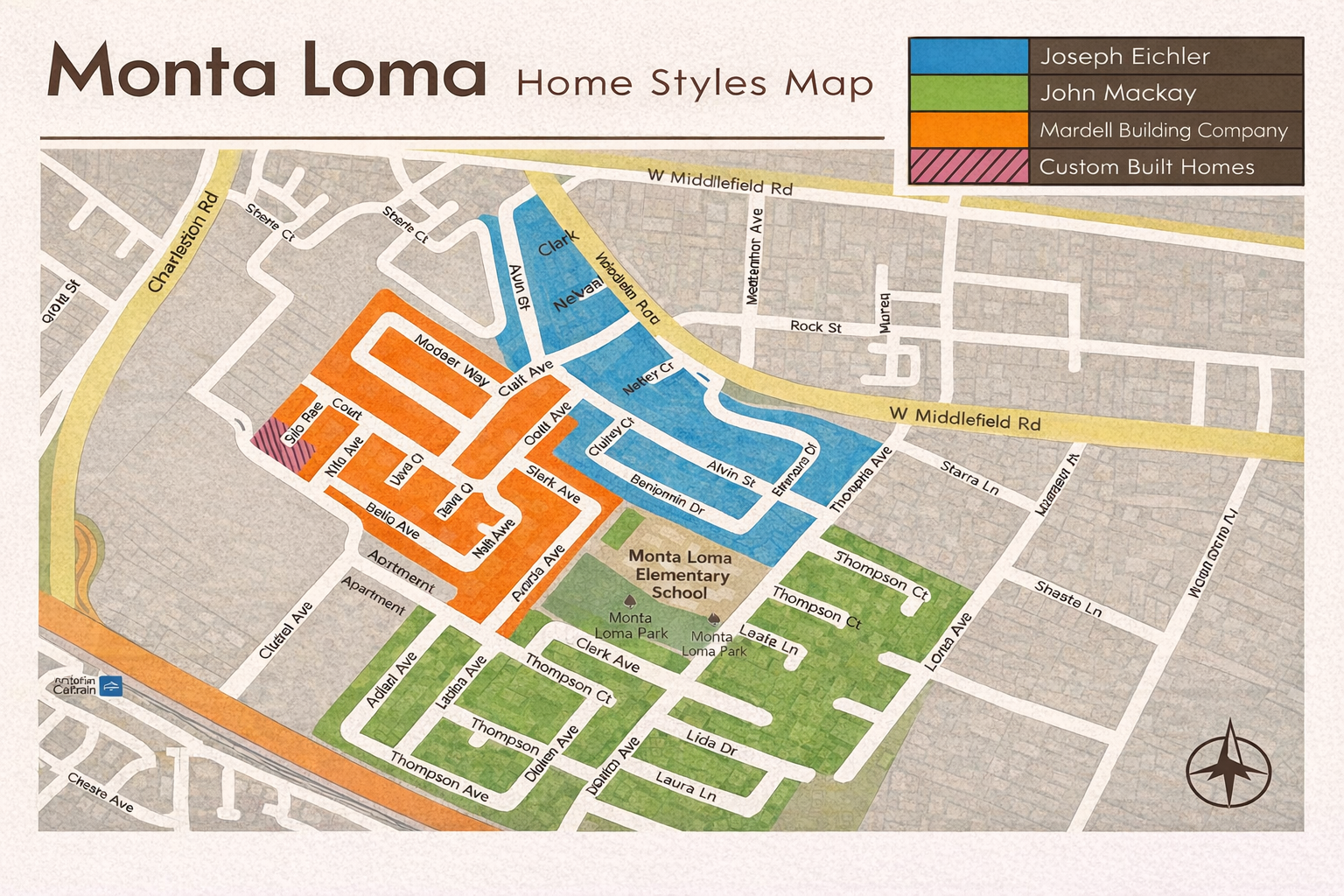
Monta Loma is defined locally as the portion of Mountain View bordered by San Antonio Road, Central Expressway, Rengstorff Avenue, and Middlefield Road, described as one of the city’s older neighborhoods and a place where many 1950s-era homes (Eichlers, Mardells, Mackays) express “California Modern” design. The neighborhood association also reports a community scale of about 1,008 households and provides parcel maps intended to help residents navigate its street layout.
Tract timeline and scale
Local Monta Loma “home styles” analysis and the neighborhood’s historical notes converge on a three‑builder story:
Eichler built over 200 homes in 1954 in a tract called “Fairview.”
Mackay entered “in a big way” in 1955–56, leaving over 200 3/2 “flattops,” with almost half on slab and additional raised-perimeter contemporaries.
Mardell Building Company built 234 raised-perimeter contemporaries; “Mardell Manor” is described as 1955–1959, and the homes are “indistinguishable” from Eichlers and Mackays to casual observers.

The “three competing homebuilders” narrative—Joseph Eichler, John Calder Mackay, and the Mardell Building Company—along with the tract names Fairview, Oakwood, and Mardell Manor, is also explicitly recorded in Monta Loma’s neighborhood “fun factoids,” reinforcing that “Oakwood” is not a retro nickname but an original builder identity.
Tract counts and years table
Mackay (Oakwood)
Foundation: Slab or concrete perimeter
Heating: Wall furnace or forced air
Ceiling: Celotex panels (typically painted)
Walls: Sheetrock
Layout Cue: “Family kitchen” orientation
Key Field Risk:
Mixed foundation types → remodel and flooring constraints vary by model
Eichler (Fairview)
Foundation: Slab
Heating: Radiant (steel pipes in slab)
Ceiling: Wood plank (classic tongue-and-groove look)
Walls: Wood paneling (often Philippine mahogany)
Layout Cue: Open living/dining great room concept
Key Field Risk:
Radiant slab → plumbing, leak repair, and heating upgrades can be complex
Mardell (Mardell Manor)
Foundation: Concrete perimeter
Heating: Forced air
Ceiling: Wood plank
Walls: Sheetrock
Layout Cue: Dining room or “family kitchen” layout
Key Field Risk:
Can visually resemble others → requires records/systems to confirm builder
Quick Comparison Takeaways
Mackay: Most variability → depends on specific model and foundation
Eichler: Most architecturally pure → but highest system sensitivity (radiant)
Mardell: Most conventional → easiest systems, hardest to visually identify
Micro‑locations with Mackay concentrations
A key, actionable micro‑location insight comes from Eichler Network: in Monta Loma, Mackays are described as clustered around Monta Loma Park south of Middlefield Road, and “can be enjoyed on many streets,” with a specific list that includes Thompson Avenue, Fay Way, Jewell Place, Heather Court, Craig Court, and Diablo Avenue.
The Oakwood brochure’s own location graphics reinforce how Mackay marketed “Oakwood” as a peninsula-commuter-friendly place tied to nearby shopping and rail commute infrastructure, and its map frames Oakwood in relation to Middlefield Road, Alma Street, Rengstorff, and San Antonio corridors.

What the Oakwood brochure reveals
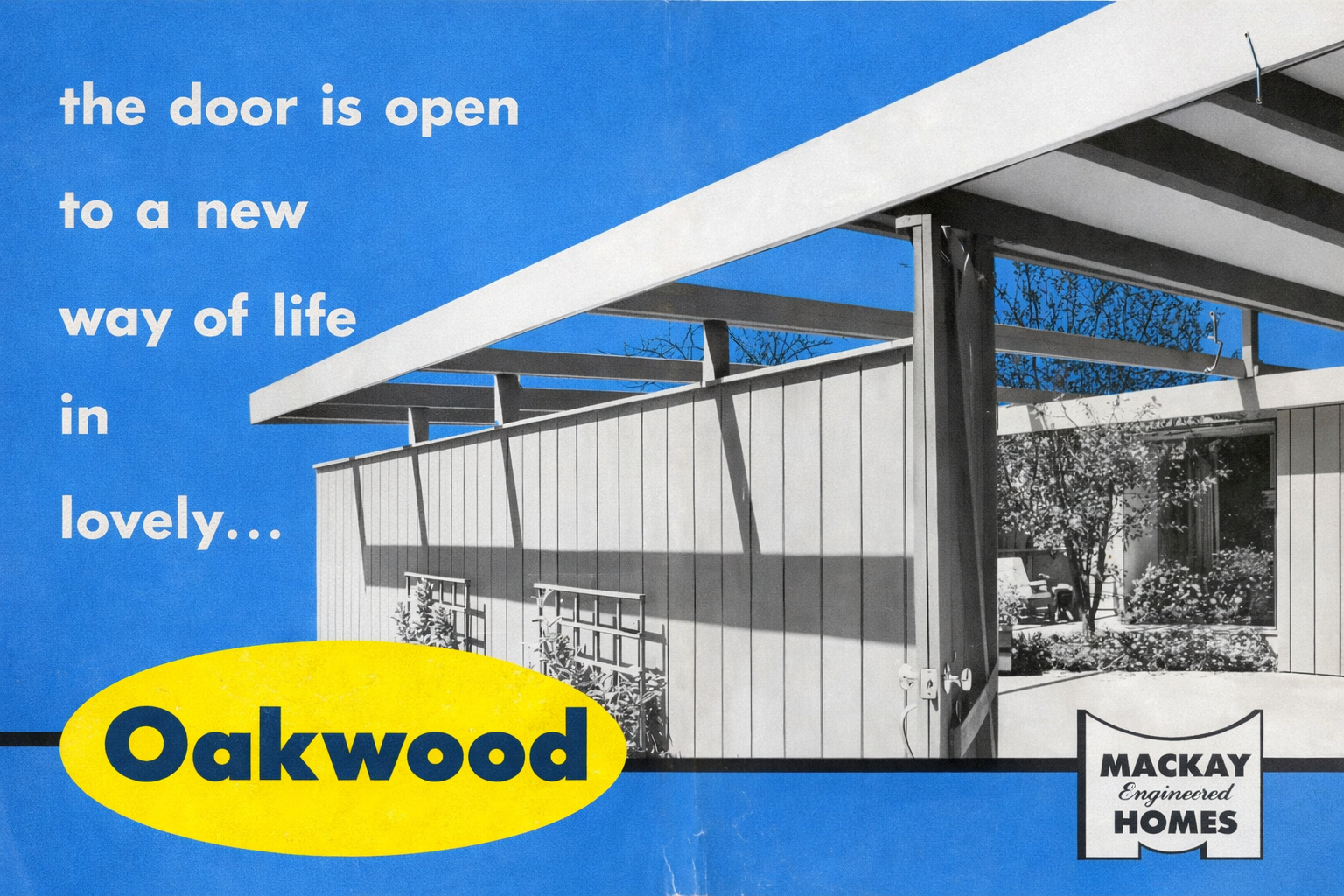
Unlike many tract developments where marketing is generic, the Oakwood “Wonder Homes for ’55” brochure is unusually specific about design intent and feature-level differentiation. It positions the homes around an “outdoor living privacy” concept called the California Courtyard, framing it as a practical, family-centered outdoor room connected through “glass walls.”
The California Courtyard and named plan models
One brochure spread highlights “The Bel Aire” plan and defines the California Courtyard as an enclosed patio area that serves as an outdoor living room, emphasizing multiple exterior access points as a lifestyle feature. Another spread spotlights “The Eldorado,” emphasizing a free-flowing plan and a large living‑room scale as a selling point (including the explicit “40‑foot living room” headline).
Feature claims that matter for today’s buyers and remodelers
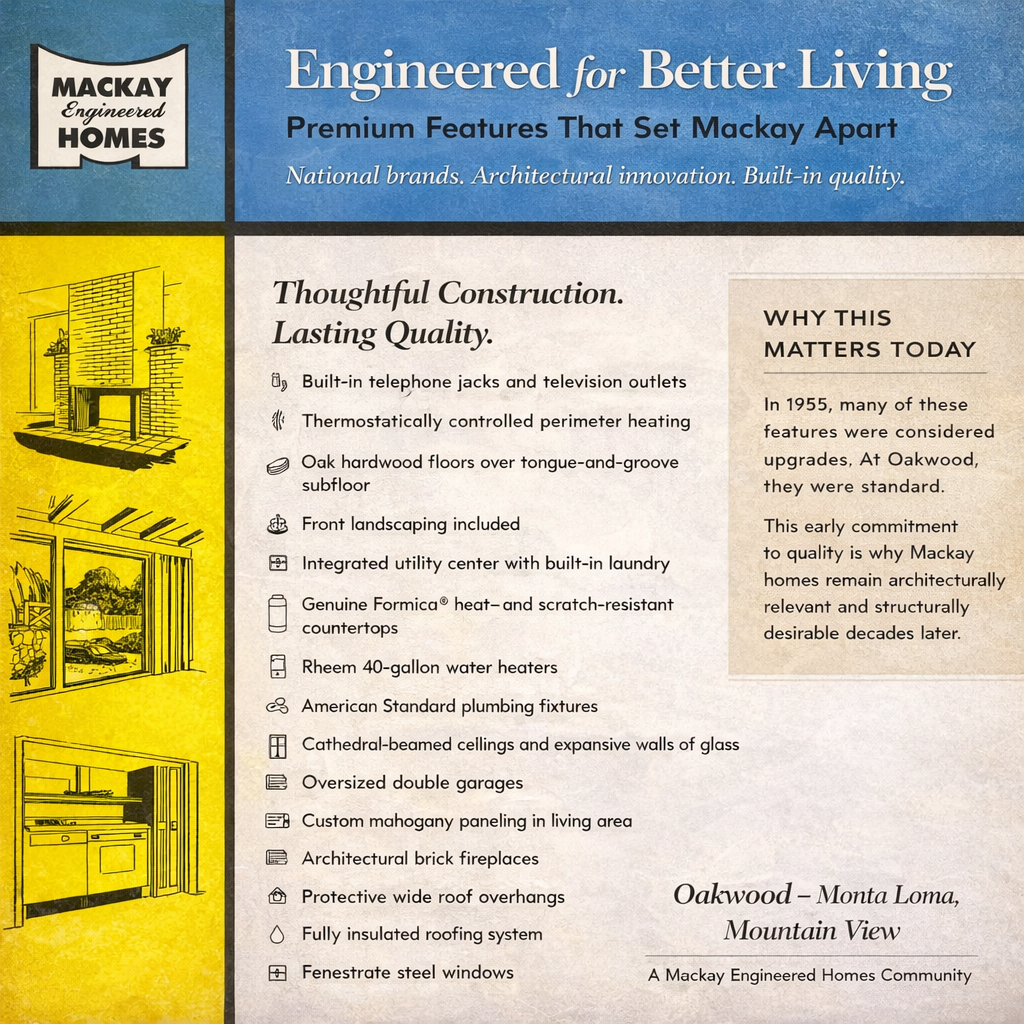
A single brochure checklist page is especially useful as a modern “ID decoder” because it bundles structural and material claims that often survive remodels in some form, including:
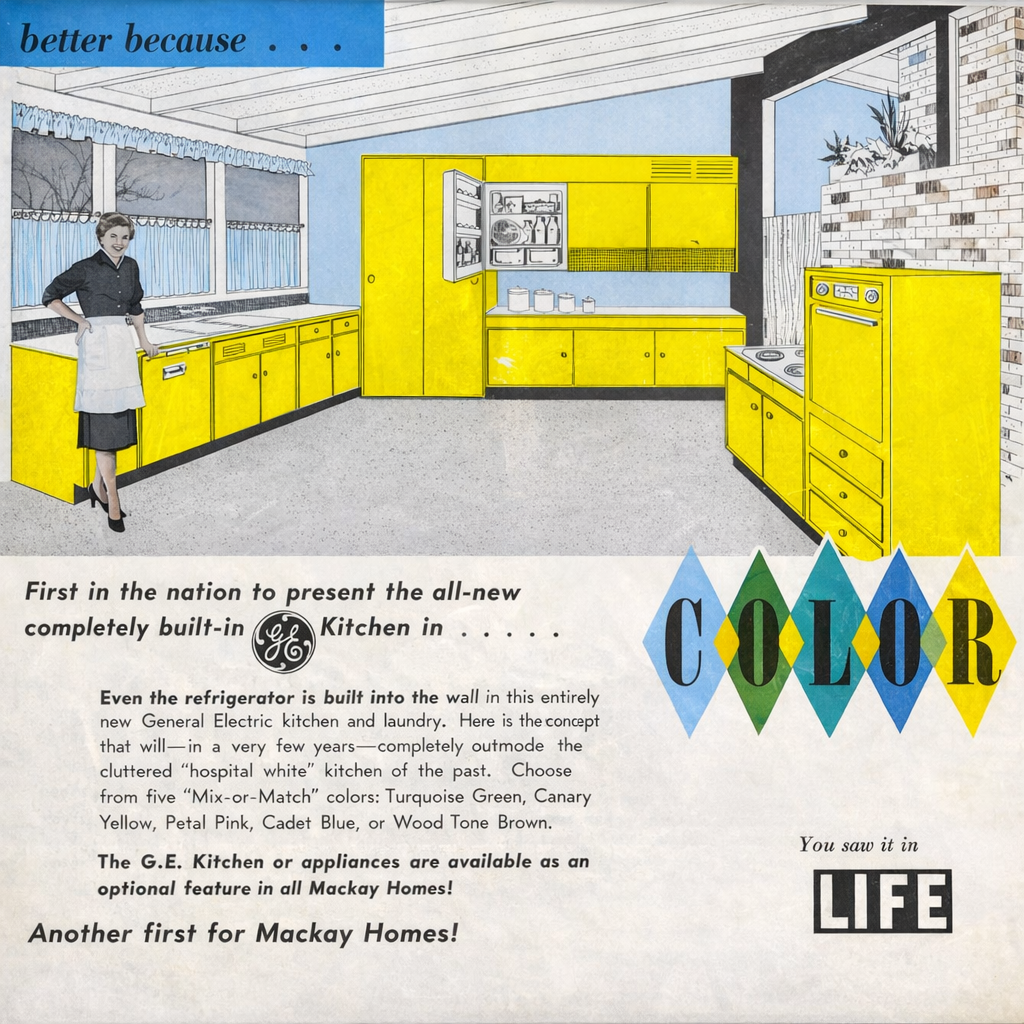
“Cathedral beamed ceilings — walls of glass” (signature volume + glazing language).
“Fenestra steel windows” (a very specific fenestration brand cue).
“Handsome, protective wide overhangs” (mid-century environmental shading logic).
“Built-in telephone jacks and TV outlet” (period modernization telling you Mackay marketed “systems”).
Importantly, that same checklist includes heating language (“thermostatically controlled perimeter heating”) that signals Mackay’s emphasis on conventional comfort systems—consistent with local Monta Loma analysis that typically classifies Mackay heat as wall furnace or forced air, and distinguishes it from Eichler’s radiant-steel-pipe systems.
Architectural identification and comparison
Monta Loma’s own “home styles” research bluntly warns that Mardell Manor homes can be indistinguishable from Eichlers and Mackays to casual observers—which is why rigorous identification should combine (1) tract location probability, (2) construction/system tells, and (3) documentary verification.
Practical architectural ID checklist for Mackay in Monta Loma
The checklist below synthesizes the most reliable cues repeatedly cited in (a) local Monta Loma research, (b) the Oakwood brochure, and (c) MLS/Redfin listing metadata where the builder is explicitly recorded.
A Monta Loma Mackay is more likely when you see several of these together:
Ceiling material cue: Mackays are identified locally as having painted Celotex ceilings, unlike Eichler/Mardell wood plank ceilings.
Heating cue: Mackay heat is locally categorized as wall furnace or forced air (vs Eichler radiant).
Foundation cue: Mackays can be slab or concrete perimeter, unlike Eichler’s slab-only simplification in local charts and unlike Mardell’s concrete perimeter-only classification.
Courtyard cue: The Oakwood brochure’s California Courtyard concept—and modern listings describing “courtyard” layouts—can be a strong pattern match.
Fenestration cue: Brochure language emphasizes “walls of glass” and specifically names Fenestra steel windows; modern listings often retain the same “floor‑to‑ceiling windows” language even after remodels.
Documentary cue (best single proof): Some MLS/Redfin property detail feeds explicitly state “Builder Architect: MACKAY.”
Feature comparison table: Mackay vs Eichler vs Mardell
Mackay (Oakwood)
Foundation: Slab or concrete perimeter
Heating: Wall furnace or forced air
Ceiling: Celotex panels (typically painted)
Walls: Sheetrock
Typical Program Cue: “Family kitchen” layout
Key Field Risk:
Mixed foundation types → remodel constraints vary depending on the specific model
Eichler (Fairview)
Foundation: Slab
Heating: Radiant (steel pipes in slab)
Ceiling: Wood plank
Walls: Wood paneling (often Philippine mahogany in local references)
Typical Program Cue: Living/dining combo (open concept)
Key Field Risk:
Radiant slab → plumbing access and heating modifications can be complex and costly
Mardell (Mardell Manor)
Foundation: Concrete perimeter
Heating: Forced air
Ceiling: Wood plank
Walls: Sheetrock
Typical Program Cue: Dining room or “family kitchen” layout
Key Field Risk:
Can resemble other builders → identification requires verification via systems, records, or permits
Quick Cross-Comparison Takeaways
Foundation:
Mackay = variable
Eichler = slab-only
Mardell = perimeter
Heating:
Eichler = radiant (most unique / most risk-sensitive)
Mackay + Mardell = more conventional systems
Design Identity:
Eichler = most architecturally distinct
Mackay = hybrid mid-century + traditional
Mardell = most conventional, hardest to visually confirm
Preservation and renovation implications
Preservation and remodel realities in Monta Loma
Monta Loma’s own historical notes emphasize that the neighborhood’s story is not a static museum piece: even the widely-cited cultural footnote—Steve Jobs living in Monta Loma as a child—includes a preservation reality check, noting that the Diablo Avenue house has been remodeled.
At the same time, Eichler Network reports that Monta Loma/Oakwood is large and “in large part the homes appear intact,” suggesting that buyers can still find meaningful architectural continuity—especially in the streets clustered near Monta Loma Park.
Systems implications for renovation: slab vs raised perimeter, radiant vs forced air
Local Monta Loma research is explicit that Mackay homes in Oakwood span both slab and raised (concrete perimeter) foundation types, which means renovation feasibility is not uniform across “Mackay” as a category. One practical implication is that raised-perimeter houses can, in many cases, provide more routing flexibility for mechanical and plumbing changes than slab-only homes (an inference based on typical construction access patterns), while slab homes require more careful planning for under‑slab interventions.
For Eichlers, the systems constraint is well documented: Palo Alto’s Eichler neighborhood design guidelines describe slab foundations containing radiant heating pipes and note that both plumbing and radiant heating were placed within the concrete slab foundation, which can be difficult to repair without invasive work. Monta Loma’s local comparison table also identifies Eichler heat as radiant with steel pipes and contrasts it with Mackay’s wall-furnace/forced-air classification.
For Mackays, MLS/Redfin property-detail data can sometimes surface system confirmation directly—e.g., a Diablo Avenue example with “Builder Architect: MACKAY” also lists forced air heating and a concrete perimeter reference in the building information feed. That kind of listing metadata is especially valuable because it bridges architecture with underwriting and renovation planning: it tells you what systems you actually have, not what the façade resembles.
Market dynamics, investment thesis, and verification
Market dynamics: supply, comps, and median pricing
Redfin’s Monta Loma housing market reporting (Feb 2026) characterizes the neighborhood as “most competitive,” with a median sale price of $1,737,000, a median 9 days on market, and 3 homes sold during that month. At the city level, Redfin reports Mountain View’s median sale price at $1,822,500 in Feb 2026, with homes selling in around 8 days on average. For comparative context (especially relevant when buyers cross-shop mid-century inventory on the Peninsula), Redfin reports Palo Alto’s median sale price at $3,208,000 in Feb 2026.
Recent Sale Examples Identified as Mackay (MLS / Boyenga Team Data)
355 Fay Way (Monta Loma)
Sale Date: April 2024
Sale Price: $2,270,000
Relevance:
Listing remarks explicitly identify the property as a “Beautiful updated Mackay home”
Source tied to MLSListings, reinforcing credibility of builder attribution in public records
2405 Laura Ln (Monta Loma)
Sale Date: June 2025
Sale Price: $2,000,000
Relevance:
Remarks include “This original Mackay home…” language
Sale data and pricing sourced from MLSListings-backed property feed, confirming traceable attribution
2381 Adele Ave (Monta Loma)
Sale Date: September 2025
Sale Price: $2,000,000
Relevance:
Listing highlights “Iconic Mackay design” with signature features (beam ceilings, expansive windows, patio integration)
MLS-linked sale record supports consistent identification of Mackay architecture in market data
Key Takeaway (Property Nerd Angle)
Mackay attribution does show up directly in MLS remarks, not just secondary sources
Language like “original Mackay,” “updated Mackay,” or “iconic Mackay design” is a repeatable pattern in agent remarks
This creates a data-backed pathway to track Mackay premiums across Monta Loma—not just anecdotal labeling
Investment thesis: why Monta Loma Mackays can be strategically mispriced
The investment argument for Monta Loma Mackays is less about “secret inventory” (the neighborhood is well known) and more about identification and comparability:
Because Monta Loma contains three visually similar mid-century builders—and because at least one of them (Mardell) is described locally as hard to distinguish at a casual glance—misidentification risk is real. When the market treats homes as interchangeable “mid‑century ranches,” the buyer (or listing agent) who can correctly document builder lineage + systems reality gains leverage in both directions: (a) buyers can avoid overpaying for “vibes” that don’t match construction realities, and (b) sellers can avoid leaving money on the table when a home is genuinely a well-preserved or well-updated Mackay with intact design value.
Buyer and seller strategies grounded in the tract’s realities
For buyers, the highest-return diligence is to treat “Mackay” as a hypothesis to verify, not a label to trust. Monta Loma’s own comparative chart gives you field criteria (ceiling material, heating type, foundation type) that can usually be validated during inspections, while MLS data sometimes provides direct builder attribution.
For sellers, the strategic upside often comes from telling the right story with proof: when a listing can document Mackay lineage (architectural language, courtyard plan logic, retained ceiling form/glazing structure) and connect it to modern upgrades without erasing the core mid-century DNA, it becomes easier to position the home against Eichlers and higher-renovation-cost peers.
FAQ: How to verify a Mackay home
How do I verify that a house is actually a Mackay (not “Eichler-like”)?
Start with a layered approach:
Micro-location probability: Focus on the Mackay-heavy street clusters around Monta Loma Park, as documented by Eichler Network (Thompson, Fay, Jewell, Heather, Craig, Diablo).
Ceiling + systems field check: Monta Loma’s “home styles” guidance says Mackays have painted Celotex ceilings and typically wall-furnace/forced-air heat—different from Eichler’s plank ceiling + radiant classification.
Documentary confirmation: Use neighborhood parcel maps (the association explicitly points residents to detailed parcel maps) plus MLS/property-feed fields when available.
Listing-language corroboration: In recent sales, public MLS-backed remarks sometimes explicitly identify the “original Mackay home” and describe signature elements such as vaulted/slightly vaulted ceilings, floor-to-ceiling windows, and indoor-outdoor connection.
What’s the single best “proof line” if I can find it?
A property feed that explicitly states “Builder Architect: MACKAY” is the cleanest documentary confirmation when present.
The Boyenga Team at Compass—led by Eric Boyenga and Janelle Boyenga—bring detailed Mid‑Century Modern and Modern architectural knowledge, staging/home-prep expertise, and contract negotiation depth to buyers and sellers across Silicon Valley. They’re also featured by Eichler Network for their Eichler-focused marketing and negotiation approach, an edge that translates directly to “Eichler-adjacent” Mackay homes where proof, positioning, and buyer education can materially change outcomes.