
Why Eichler Homes Are Strengthening in a Tight Luxury Market

In San Francisco and Los Altos, standout Eichler sales are not just “keeping up” with the luxury market; in several cases, they are outperforming it on the metrics that matter most in a thin, high-stakes environment: over-ask spread, speed to contract, and price per square foot. The clearest examples are 1027 Duncan St in Diamond Heights, which closed on March 16, 2026 at $3.8 million after listing at $2.495 million, and 1694 Clay Dr in Los Altos, which closed on April 5, 2026 at $5.25 million after listing at $4,988,888. Public-source chronology also shows 1694 Clay moved to contingent status within days of listing, even though portal-reported “days on market” vary materially by site.
The pattern is not random. In a broader market constrained by limited inventory and elevated financing costs, the Bay Area’s upper tier has been buoyed by renewed tech wealth, return-to-office pressure in some sectors, and a scarcity premium for distinctive housing. In that setting, the best Eichlers behave less like commodity housing and more like design-forward, low-supply collectibles. In my selected Los Altos sample, Eichlers averaged about 9.6% over ask and roughly $1,892 per square foot, versus about 5.6% over ask and roughly $1,868 per square foot for nearby non-Eichler luxury comps; in the San Francisco sample, the Eichler set averaged about 43.3% over ask and roughly $1,855 per square foot, versus about 24.3% over ask and roughly $1,490 per square foot for nearby high-end non-Eichler or non-Eichler-branded comps. These are my calculations from the transaction set below.
Market Context
This outperformance is happening inside a market that is simultaneously tight and selective. Nationally, existing-home sales weakened in March 2026 and inventory remained below pre-pandemic norms, according to National Association of Realtors and Reuters; locally, however, upper-end Bay Area demand has sharpened, especially in architecturally distinctive housing. The San Francisco Chronicle reported that San Francisco’s single-family median reached a record $2.15 million in March 2026 and that luxury momentum has been amplified by AI-driven wealth and limited supply. Redfin’s Los Altos market page similarly describes a very competitive market where average homes sell above list and go pending in roughly 10 to 11 days.
That context matters because Eichlers are not competing in a vacuum. They are competing against renovated view homes, newly built luxury product, and estate inventory that is often larger and more expensive. Yet the public data repeatedly show that when an Eichler is either historically important, meticulously restored, or both, buyers compress decision time and widen bidding spreads. In other words, scarcity plus identity plus story is beating size alone.
Transaction Evidence
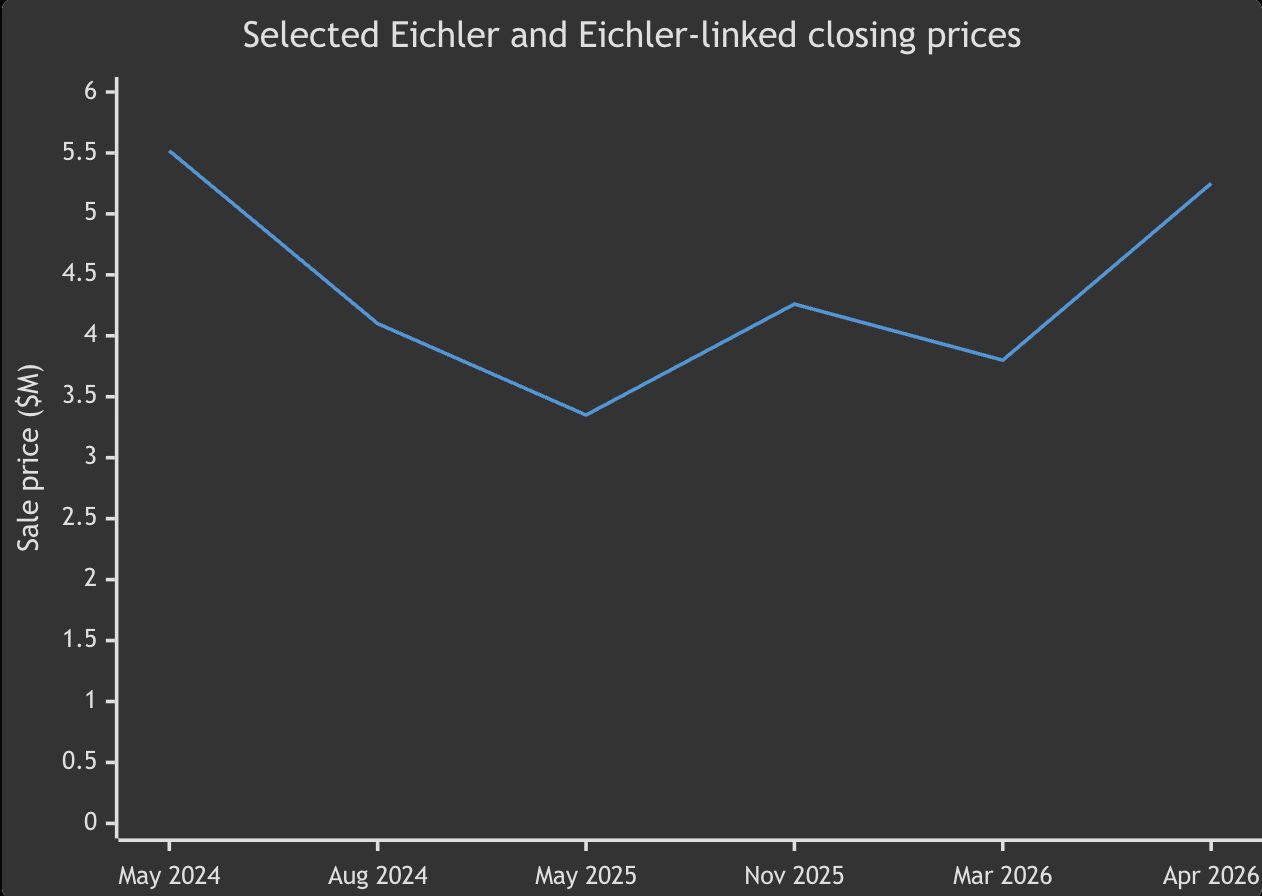
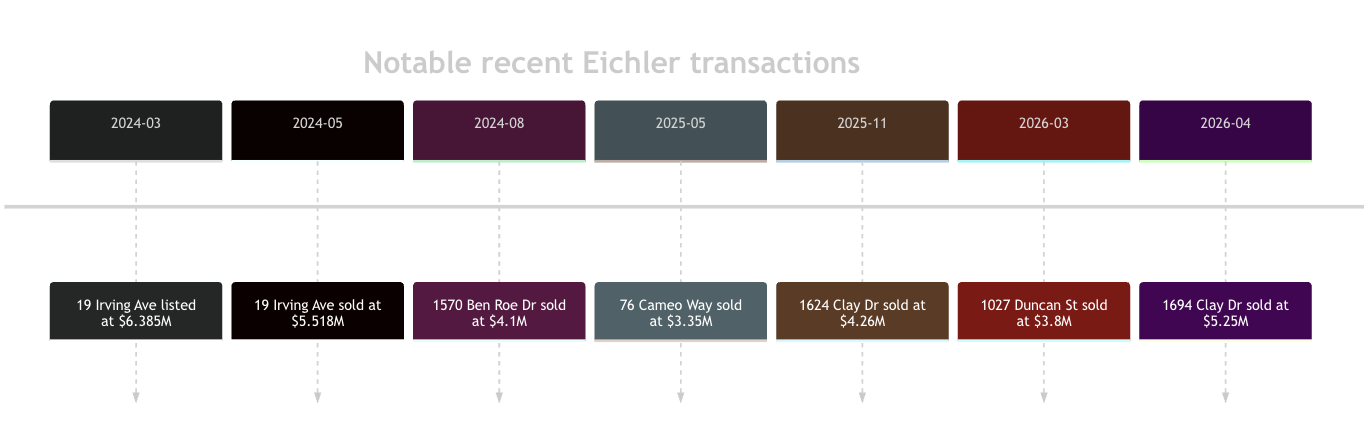
The recent headline-making deals are strong enough that they should be read as signal, not anecdote. SFGATE described 1027 Duncan St as a San Francisco Eichler that sold after 11 offers and roughly 17 days of exposure, while MLS-derived portals show a $2.495 million list and $3.8 million close. At the higher end of the Peninsula, 1694 Clay Dr crossed the $5 million threshold and closed at $5.25 million; public portal history shows it listed on March 5, 2026, turned contingent on March 8, went pending on March 10, and recorded sold on April 5. In Atherton, 19 Irving Ave — the custom home built for Joseph Eichler himself — sold in May 2024 after the Boyenga listing campaign repositioned it from an original $6.385 million ask to a $5.5 million revised ask, then closed at $5.518 million.
May 22, 2024 – 19 Irving Ave, Atherton
Type: Custom Eichler / Joseph Eichler residence
List Price: $6,385,000 original; $5,500,000 revised
Sold Price: $5,518,000
Over/Under Ask: +$18,000 vs. final ask; -$867,000 vs. original
DOM / Exposure: 44 days on Compass
Price per Sq Ft: $1,491
Sources: Compass, Zillow, Redfin, local news
Aug. 23, 2024 – 1570 Ben Roe Dr, Los Altos
Type: Eichler
List Price: $3,500,000
Sold Price: $4,100,000
Over/Under Ask: +$600,000
DOM / Exposure: 2 days on Compass (Homes.com shows 1)
Price per Sq Ft: $1,780
Sources: Compass, Homes.com, Redfin, Realtor
May 29, 2025 – 76 Cameo Way, San Francisco
Type: Eichler
List Price: $2,495,000
Sold Price: $3,350,000
Over/Under Ask: +$855,000
DOM / Exposure: 10 days
Price per Sq Ft: $1,669
Sources: Zillow, Homes.com, Redfin
Nov. 14, 2025 – 1624 Clay Dr, Los Altos
Type: Eichler
List Price: $3,998,000
Sold Price: $4,260,000
Over/Under Ask: +$262,000
DOM / Exposure: ~6 days (list to pending)
Price per Sq Ft: $1,851
Sources: Zillow, Redfin, Compass, Realtor
Mar. 16, 2026 – 1027 Duncan St, San Francisco
Type: Eichler
List Price: $2,495,000
Sold Price: $3,800,000
Over/Under Ask: +$1,305,000
DOM / Exposure: —
Price per Sq Ft: —
Sources: —
Apr. 5, 2026 – 1694 Clay Dr, Los Altos
Type: Eichler
List Price: $4,988,888
Sold Price: $5,250,000
Over/Under Ask: +$261,112
DOM / Exposure: —
Price per Sq Ft: —
Sources: —
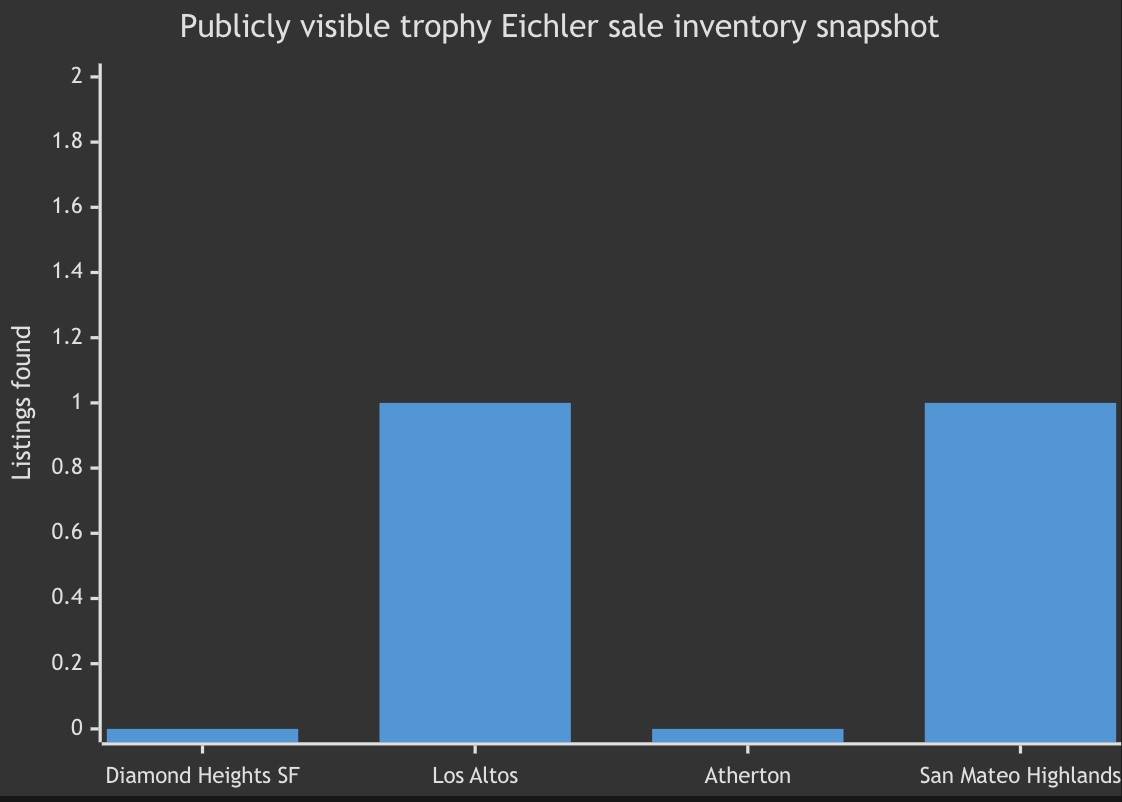
Two active and highly visible listings reinforce the inventory side of the story. I found one major public Eichler offering in Los Altos — 1765 Fallen Leaf Ln, active at $4.498 million after roughly 43 days on market — and one singular coming-soon Peninsula trophy, the Eichler X-100 at 1586 Lexington Ave in San Mateo, listed by the Boyenga Team at $4.498 million. I did not identify an equivalently prominent for-sale Diamond Heights trophy Eichler in the public portals reviewed after 1027 Duncan closed. That is not a complete MLS census, but it is directionally consistent with the scarcity thesis.
The selected-closing timeline below shows how the recent standout sales have clustered. The chart is based on the transaction set above.
Comparative Performance
For comparison, I paired the Eichler sales above with nearby luxury non-Eichler or non-Eichler-branded sales in the same or immediately adjacent micro-markets. In South Los Altos, the cleanest public non-Eichler set is 1808 Fallen Leaf Ln at $7.0 million after listing at $6.49 million, 1881 Alford Ave at $6.575 million on a same-price close, and 1130 Suffolk Ct at $4.78 million after listing at $4.388 million. In the San Francisco sample, 131 Turquoise Way closed at $3.35 million after listing at $2.488 million and 636 28th St closed at $4.425 million after listing at $3.885 million.
Los Altos Eichlers (1570 Ben Roe, 1624 Clay, 1694 Clay – Los Altos)
Avg. Sold-to-List: 109.6%
Avg. DOM / Exposure: 3.7 days*
Avg. $/sf: $1,892
Takeaway:
Extremely fast absorption
Slight premium on price per foot vs. nearby luxury comps
Consistent competitive bidding, but not extreme overbids
Los Altos Non-Eichler Luxury Comps (1808 Fallen Leaf, 1881 Alford, 1130 Suffolk)
Avg. Sold-to-List: 105.6%
Avg. DOM / Exposure: 25.3 days
Avg. $/sf: $1,868
Takeaway:
Strong overall market conditions
Slower velocity vs. Eichlers
Less aggressive bidding environment
San Francisco Eichlers (76 Cameo, 1027 Duncan – San Francisco)
Avg. Sold-to-List: 143.3%
Avg. DOM / Exposure: 11.5 days
Avg. $/sf: $1,855
Takeaway:
Exceptional buyer response
Significant overbids tied to architectural identity
Strong premium for “design-forward” inventory
San Francisco Non-Eichler Luxury Comps (131 Turquoise, 636 28th)
Avg. Sold-to-List: 124.3%
Avg. DOM / Exposure: 9.5 days
Avg. $/sf: $1,490
Takeaway:
Competitive market, still producing strong over-ask results
Noticeably lower $/sf vs. Eichlers
Smaller bid spreads despite similar exposure timelines
Quick Read (Property Nerd Lens)
Eichlers are outperforming on price efficiency ($/sf) in both markets
In Los Altos, the edge shows up in speed + slight pricing premium
In San Francisco, the story shifts to emotional bidding + major over-ask spreads
Non-Eichler luxury homes still perform—but lack the same scarcity-driven demand curve
*For the Los Altos Eichler set, the DOM figure uses public list-to-contract chronology for 1624 Clay and 1694 Clay because portal-reported DOM is inconsistent across sites. The conclusion is therefore directional rather than MLS-definitive.
The practical implication is that the Eichler premium is showing up in two places at once. First, buyers are often willing to pay more relative to the ask. Second, they are often willing to pay roughly comparable or better dollars per square foot than they pay for larger, newer, or more conventional luxury homes nearby. The 1027 Duncan result is the clearest example: at about $2,041 per square foot, it exceeded both 131 Turquoise’s roughly $1,408 per square foot and 636 28th’s roughly $1,572 per square foot, while also producing the strongest over-ask spread in the San Francisco comparison set.
The inventory chart below is intentionally narrow. It is not a full MLS census; it is a public-web snapshot of notable, trophy-level Eichler for-sale supply that I could verify as of April 16, 2026. Even with that caveat, the message is straightforward: the supply of headline-grade Eichlers is extremely thin.
Demand Drivers
The first demand driver is architecture itself. Eichlers still occupy a rare middle ground between serious design pedigree and livable family housing. Dwell notes that Eichlers are among the most celebrated tract homes in the United States and associates them with glass walls, post-and-beam construction, and indoor-outdoor living; the Society of Architectural Historians’ Archipedia describes the X-100 as a breakthrough experiment in steel-frame residential modernism; and the Eichler Network places statewide surviving supply at roughly 11,000 homes. In a luxury segment filled with increasingly interchangeable product, that level of formal identity matters.
The second driver is scarcity. The statewide stock is finite, and the truly best examples are a subset of that finite stock: original or architecturally legible homes, on good lots, in strong school districts, renovated without erasing their character. That scarcity is amplified in niche enclaves. Public marketing around Los Altos Eichlers repeatedly emphasizes how few exist there, and current public-sale inventory reflects just how episodic that supply can be. When one of the “A” properties comes up, buyers are not comparing it to a broad pool of substitutes; they are comparing it to waiting indefinitely.
The third driver is buyer profile. Recent NAR data show the typical buyer is older than in prior cycles, while repeat buyers remain financially stronger than first-time purchasers. The median buyer age reached 59 in the 2025 NAR profile, and the age of first-time buyers hit a record 40. That matters because the Eichler buyer in today’s upper bracket is often not stretching into a starter home; they are a wealthier repeat buyer purchasing taste, story, and lifestyle. That buyer is more capable of paying a preservation premium, underwriting tasteful upgrades, and competing aggressively in a low-supply bidding process.
The fourth driver is work pattern and the ongoing demand for flexible domestic space. The Federal Reserve Bank of Philadelphia has found that as work from home expands, households demand more residential space for offices and amenities, pushing up housing demand and prices; its work on remote-work migration also finds that higher-income households were disproportionately likely to move because of remote work. Modernized Eichlers map unusually well onto that demand: atriums become usable daily extensions of interior space, family rooms double as offices or media rooms, and single-level or semi-single-level plans remain attractive for multigenerational and hybrid-work households.
The fifth driver is renovation potential. The best recent closings were not untouched museum pieces; they were updated homes that preserved the original architectural thesis. 1027 Duncan was marketed as a remodeled Eichler that respected the original vision. 1694 Clay was positioned as a “modern-day sanctuary” with restored period character and new systems. The X-100 listing emphasizes restoration that honored original design intent. Dwell’s renovation coverage, likewise, frames Eichler upgrades as a way to support contemporary living without sacrificing design DNA. That combination — authenticity plus functionality — is exactly what luxury buyers are rewarding.
Boyenga Team Positioning
On the credential question, the evidence supports a specialized Eichler profile rather than a generic luxury one. The Boyenga Team’s Compass profile says Eric and Janelle Boyenga have led the team since 1996, are founding partners at Compass, and operate with a 12-person group representing more than a century of combined experience and 14 languages. Their own About page describes them as a top-producing husband-and-wife team focused on Silicon Valley luxury real estate; their Eichler-focused sites and press page put that niche front and center.
The most concrete evidence of Eichler specialization is transaction-specific. The Boyenga Team was the listing side on 19 Irving Ave in Atherton — the custom residence built for Eichler himself — according to MLS repostings and Compass property details, and Eric Boyenga was quoted in press coverage explaining the architectural significance of the home. That is stronger evidence than a brand claim because it ties expertise to an actual landmark-caliber assignment.
The current X-100 assignment is similarly probative. The Boyenga Team, Eric Boyenga, and Janelle Boyenga are all named as listing agents for 1586 Lexington Ave in San Mateo — the Eichler X-100 prototype — at $4.498 million. The listing itself states that the home was commissioned by Eichler, designed by A. Quincy Jones and Frederick Emmons, and is on the National Register of Historic Places. The National Park Service confirms X-100’s National Register listing under NRIS #16000381. Representing that property requires fluency not only in salesmanship but in architectural provenance, preservation, and collector psychology.
This matters for the market thesis because Eichlers are unusually sensitive to representation quality. A conventional luxury listing pitch can sell square footage, schools, and finishes. An outstanding Eichler campaign also has to sell authorship, tract significance, preservation choices, restoration philosophy, and lifestyle imagery. The Boyenga Team’s public positioning is built around exactly that storytelling stack, and their assignments at 19 Irving and the X-100 are the strongest external proof points I found.
Methodology And Data Gaps
This report prioritizes MLS-derived public portals and reputable local coverage. The transaction tables rely mainly on Redfin, Zillow, Compass property pages, Trulia, Homes.com, and local news coverage that clearly references listing history or public record. Where county-record details were visible through those portals, I used recording dates or public-record references shown on the page. I did not have direct broker-backend MLS access or direct recorder downloads, so this should be treated as a high-quality public-source reconstruction rather than a closed-MLS export.
The biggest data gap is days-on-market consistency. Some sites count public exposure to contract, some appear to count broader marketing windows, and some neighborhood-market snippets report the final DOM attached to a closed record. The most conspicuous discrepancies are 1027 Duncan and 1694 Clay. For 1027 Duncan, I found 13 days on Compass, 16 days in a Redfin neighborhood snippet, and 17 days in SFGATE coverage. For 1694 Clay, I found 1 day on Compass, a March 5 to March 8 list-to-contingent chronology on Zillow, and 31 days in a Redfin neighborhood feed. I therefore normalized those properties by noting the discrepancy rather than pretending the sources are identical.
A second gap is non-Eichler comparison purity, especially in Diamond Heights, where public portals do not always tag architectural lineage cleanly. For San Francisco, I therefore use “nearby high-end non-Eichler or non-Eichler-branded” as the most honest comparator category. For Los Altos, the distinction is cleaner because the comparison set includes obvious new or more conventional luxury product. Finally, the inventory bar chart is a public-web snapshot of notable, trophy-level listings found during research, not a full active-MLS count. It is intended to show scarcity, not to substitute for a brokerage-side inventory audit.
The bottom-line conclusion remains robust despite those caveats: in a luxury market where buyers are selective and inventory is constrained, the best Eichlers are strengthening because they combine hard-to-replicate architecture, famously low supply, strong lifestyle alignment with modern buyer preferences, and increasingly sophisticated marketing that frames them as design assets rather than merely houses. The transactions at 1027 Duncan, 1694 Clay, and the Boyenga-linked assignments at 19 Irving and the X-100 are not isolated curiosities; they are evidence that architectural identity is converting into pricing power.
At Compass, the Boyenga Team has established itself as one of Silicon Valley’s leading authorities on Eichler and mid-century modern homes. Eric and Janelle Boyenga bring a rare combination of deep market analytics, architectural fluency, and high-level negotiation strategy—a blend that consistently positions their clients ahead in competitive situations.
Their track record speaks directly to this specialization:
Represented the sale of Joseph Eichler’s personal residence in Atherton
Currently marketing the iconic Eichler X-100, one of the most historically significant modernist homes in the country
Decades of experience advising both buyers and sellers within the Eichler niche
What sets Eric and Janelle apart is how they approach each property:
For sellers: precision pricing, design-forward presentation, and strategic exposure to maximize competition
For buyers: access, insight, and negotiation expertise in a highly specialized and emotional market
In a segment where architecture drives value and storytelling drives demand, working with true Eichler experts isn’t optional—it’s a competitive advantage.