
Brown & Kaufmann Homes of Los Altos and Silicon Valley: The Complete Property Nerd's Guide to One of California's Most Influential Builders
The public record does not point to two separate Silicon Valley housebuilding firms named Brown and Kaufmann. It points, instead, to one joint enterprise, usually styled Brown & Kauffmann, Inc., founded by Wayne Randolph Brown and Samuel H. Kauffmann. The best high-confidence sources place the firm’s start in the 1952–1953 window, show it headquartered in Palo Alto, and credit it with building more than 6,000 homes across Northern California before the company was absorbed in the mid-1970s, after a 1970 Potlatch Forests stock-swap plan for 80% of the company was publicly reported.
For a Los Altos–focused real-estate reader, the key point is geographic rather than semantic: Brown & Kauffmann’s strongest surviving documentation clusters immediately around Los Altos rather than squarely inside it—especially in Palo Alto, Sunnyvale, San Jose, and Los Gatos. That matters because those tracts sit in the same postwar growth belt that transformed orchard land into family neighborhoods during the 1950s and 1960s, the very era Los Altos History Museum describes as central to the incorporation of Los Altos and the growth of its neighborhoods. In other words, Brown & Kauffmann belongs in the same regional story that shaped Los Altos housing culture, even when the parcel-level paper trail is stronger one city over.
Architecturally, Brown & Kauffmann sits in an intriguing niche. Early on, the firm was a mass-housing producer, but not a purely commodity builder. Trade-journal coverage and surviving listings show careful plan work, attached garages, wood paneling, separate family rooms, formal dining areas, courtyards, vaulted ceilings, and later named model lines such as Monterey, Pebble Beach, and Del Monte. The result is best understood as upper-end tract and move-up housing, with a later pivot toward more ambitious master planning, especially at Rinconada Hills in Los Gatos.
Company history and the people behind the name
Two alumni memorials are the backbone of the firm’s corporate biography. Stanford Magazine’s obituary for Samuel H. Kauffmann states that he partnered with Wayne Brown, ’48, MBA ’50, to co-found Brown & Kauffmann Inc., and says the company built more than 6,000 homes in Palo Alto, Sunnyvale, San Jose, Oakland, Merced, and Modesto between 1952 and the mid-1970s. Stanford Magazine’s obituary for Wayne Randolph Brown separately confirms that Brown co-founded the firm and that it built thousands of homes in the Bay Area. Princeton Alumni Weekly likewise remembers Kauffmann as the founder of a Palo Alto property-development company that became highly successful in mass housing in Northern California.
The founding year is slightly messy, which is common with private builders. The strongest alumni source says 1952, while a California appellate decision discussing Kauffmann’s finances says the relevant partnership was operating in 1953 and had become very successful by 1961. I would therefore treat 1952–1953 as the documented founding window, not a single uncontested incorporation date.
Public records also show Wayne Brown acting as a front-facing developer in early Palo Alto entitlement matters. Palo Alto City Council minutes from July 9, 1956 describe Brown & Kauffmann as the developers of the Meadowpark subdivision, and specifically record Wayne Brown addressing the council about the alignment of Louis Road through Meadowpark Unit No. 5. Separate Palo Alto records from December 10, 1956 discuss Brown & Kauffmann’s claim for reimbursement related to Adobe Creek work through Meadow Park, with the city attorney noting “constructive acceptance” of the creek segment through the tract. Those dry administrative records are gold for historians: they place the firm on the ground, in the trench work, in the street geometry, and inside the ordinary mechanics of subdivision building.
Wayne Randolph Brown
Documented role: Co-founder; public-facing developer in Palo Alto city records; street namer in Meadowpark-era tracts.
Representative projects: Meadowpark subdivision; Gailen Ave/Ct; May Court; Nahan Way; Bibbits Drive; joint Brown & Kauffmann tracts in Palo Alto and Sunnyvale.
Era: Documented from 1952/53 into the mid-1970s.
Product type/style: Early one-level ranch tract housing that matured into larger move-up ranches and planned communities.
Documented price context: 1957 one-level attached-garage house at $14,750; representative 2026 Sunnyvale Brown & Kauffmann examples roughly in the mid-$2 millions to mid-$3 millions.
Samuel H. Kauffmann
Documented role: Co-founder; Palo Alto-based developer remembered for large-scale Northern California mass housing and later higher-amenity planned communities.
Representative projects: Joint Brown & Kauffmann output across Palo Alto, Sunnyvale, San Jose, Los Gatos, Oakland, Merced, and Modesto; Donald Blair collaboration; Rinconada Hills.
Era: Documented from 1952/53 until the Potlatch absorption in the mid-1970s.
Product type/style: Mass housing with an increasingly architectural, move-up layer, including named Dry Creek models and townhouse-villa communities.
Documented price context: 1967 San Jose-area house at $37,950; 1967 local ad at $41,000; 1969 Rinconada townhouses at $38,750–$49,500; current representative San Jose and Rinconada products often around $2.4M–$2.65M for Dry Creek single-family homes and roughly $1.5M–$3M+ in Rinconada Hills.
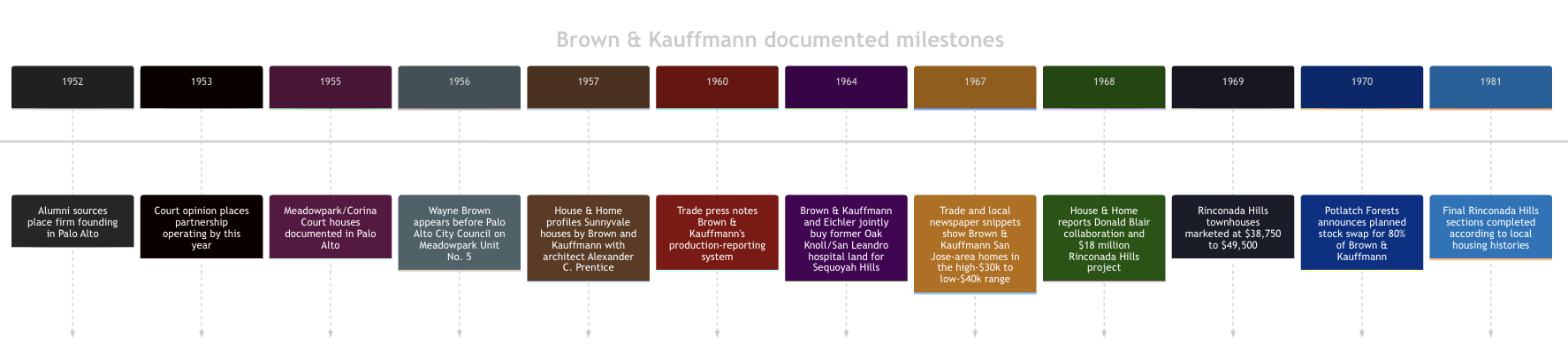
Brown & Kaufmann Timeline
The timeline above synthesizes alumni memorials, court material, Palo Alto municipal records, trade-journal snippets archived by USModernist, Eichler Network reporting, and local housing histories. The key inflection points are the early Palo Alto/Sunnyvale tract years, the late-1960s Donald Blair/Rinconada period, and the Potlatch transaction window that marks the end of the independent firm’s main run.
Where the firm built
If Los Altos is the emotional center of this inquiry, Palo Alto is the earliest high-confidence address book. Palo Alto Stanford Heritage identifies Corina Way and Corina Court as being named for Corina Kauffmann, and records Brown & Kauffmann houses at 3866 Corina Court (1955) and 3874 Corina Court (1955). The same heritage index states that Gailen Avenue and Gailen Court were named by Wayne Brown for his father, and that Brown also named May Court, Nahan Way, and Bibbits Drive for family members; it lists 734 Gailen Avenue (1958) and 771 Gailen Avenue (1957) as Brown and Kaufman houses. In practical real-estate terms, that is excellent evidence that Brown & Kauffmann was not merely building houses in Palo Alto—it was helping author the subdivision vocabulary itself.
Sunnyvale, especially the Cherry Chase / Cherryhill West / Serra Park belt near the Los Altos border, is where Brown & Kauffmann’s suburban ranch identity becomes especially tangible. A 1957 House & Home item identifies Brown and KaufFmann, Inc. as the builder of a Sunnyvale project designed by architect Alexander C. Prentice. Public listing records then show the firm’s long tail in the built environment: 1214 Elderberry Drive, Sunnyvale is identified as Brown & Kauffmann, with 3 bedrooms, 2 baths, 1,472 square feet, a wood/brick/stucco exterior, concrete perimeter foundation, and APN 202-32-030; 1502 Kingsgate Drive is a 1958 Brown & Kauffmann home with 1,872 square feet and APN 323-25-010; 815 Nisqually Drive is likewise tagged Brown & Kauffmann, with stucco exterior and concrete perimeter construction. A 2008 Mountain View Voice real-estate page placed a Brown & Kauffmann home at 834 Remington Avenue in Cherry Chase, showing that the firm’s name retained market recognition fifty years after initial build-out.
San Jose’s Dry Creek / Willow Glen area represents a more mature and slightly more affluent Brown & Kauffmann chapter. Public records and listing archives identify 1884 Kirkmont Drive as a 1968 Brown & Kaufmann house with 2,397 square feet, ranch/traditional styling, and parcel number 442-09-017. Nearby homes document named model lines: 1808 Constitution Court is described as the Pebble Beach model; 2377 Walden Square and 2335 Heritage Court are identified as Monterey models; and 2168 Northampton Drive is identified as a Del Monte model with about 2,800 square feet. These are not stripped-down tract houses. They are designed with larger room counts, more formal spatial hierarchy, and a stronger “move-up family house” program.
Los Gatos’ Rinconada Hills is Brown & Kauffmann’s regional showpiece. The current HOA site says the community contains 394 townhouses ranging from 1,268 square feet to approximately 2,400 square feet plus 40 single-family homes. Local housing histories place construction in five sections between 1968 and 1981 across 107 acres. A CSUN finding aid confirms that Brown and Kauffmann produced a planning document titled “Rinconada Hills: Another Planned Community.” Surviving listing data identifies individual Rinconada homes such as 147 El Pinar and 110 Via Collado as Brown & Kaufmann/Brown & Kauffmann products, tying the paper record back to extant addresses.
The firm’s reach also extended beyond Silicon Valley proper. Eichler Network reports that in 1964 Brown & Kauffmann and Eichler Homes jointly bought about 100 acres of former naval-hospital land that became Sequoyah Hills in Oakland, a mixed community of Eichler and Brown & Kauffmann homes. That matters here because it shows Brown & Kauffmann was not just a neighborhood builder; it had the capital and confidence to participate in major land plays and multi-builder master planning.
Architecture, planning, and construction habits
The firm’s early DNA reads like a polished version of postwar California practicality. A 1957 American Builder snippet shows Brown & Kauffmann marketing a one-level plan with attached garage for $14,750, while a 1957 House & Home snippet references a 3-bedroom, 2-bath, 1,191-square-foot plan. By the late 1950s in Sunnyvale, surviving homes commonly fall in the roughly 1,472- to 1,872-square-foot range, usually with three or four bedrooms and two baths. In San Jose’s later Dry Creek work, the house program scales up further into 1,882- to 2,800-square-foot named models. That progression tells a clear story: Brown & Kauffmann began with efficient, saleable ranch planning and then moved upmarket without abandoning suburban livability.
Spatially, Brown & Kauffmann homes are easy to recognize once you know what to look for. Listing records repeatedly mention separate family rooms, formal dining rooms, eat-in kitchens or breakfast nooks, courtyard entries, double-door formal entries, vaulted or wood-beam ceilings, multiple fireplaces, and attached two-car garages. On the best Dry Creek plans, the primary suite often has a direct sliding-door connection to the yard, which is very much in keeping with the indoor-outdoor California ideal of the 1960s. These are not avant-garde modernist experiments, but they are plans built by people who cared about circulation, privacy, and how a family actually lives.
Materially, the record points to a consistent regional palette: stucco, wood, and sometimes brick exteriors; concrete perimeter foundations on ranch houses and concrete slab construction in the larger townhouse work; shake roofs on many Sunnyvale and San Jose ranches; and tile roofs in Rinconada Hills. Trade-journal snippets also point to wood paneling and a plan that won merit for being “near perfect,” which fits the surviving houses’ emphasis on warmth rather than pure minimalism. Just as interesting, American Builder noted in 1960 that Brown & Kauffmann had devised a tidy system for producing daily reports with minimal paperwork, suggesting a builder that cared about operational discipline as much as floor-plan appeal.
The named architect collaborators are significant. The Sunnyvale project featured Alexander C. Prentice, AIA, while the late-1960s higher-design work is tied to Donald Blair, whom House & Home described as collaborating with “new employers” Wayne Brown and Sam Kauffmann. Blair is also the named architect on the 1969 Rinconada Hills townhouses marketed at $38,750 to $49,500, which helps explain why Rinconada feels like a step beyond conventional tract production. Brown & Kauffmann did not become Eichler, but in Blair-era work it clearly sought a more architectural identity.
Market position and pricing
The fairest way to describe Brown & Kauffmann’s market positioning is “quality mass housing that often edged into move-up territory.” Princeton memorialized Kauffmann as especially successful in mass housing, and Stanford credited the company with a regional quantity measured in the thousands. But the actual houses complicate the stereotype. A builder producing courtyard-entry Monterey models, 2,800-square-foot Del Monte houses, and a 107-acre gated townhouse-villa community was not operating at the bargain-basement end of the tract business. Brown & Kauffmann seems to have lived in that particularly Californian middle ground where a house could be technically production-built yet still feel aspirational.
Because public sources overwhelmingly document Brown & Kauffmann as one firm, not two independent firms, the most honest comparative table is by documented role within the shared enterprise rather than by separate companies.
PrincipalDocumented roleRepresentative projectsEraProduct type and styleDocumented price contextWayne Randolph BrownCo-founder; public-facing developer in Palo Alto city records; street namer in Meadowpark-era tracts. Meadowpark subdivision; Gailen Ave/Ct; May Court; Nahan Way; Bibbits Drive; joint Brown & Kauffmann tracts in Palo Alto and Sunnyvale. Documented from 1952/53 into the mid-1970s. Early one-level ranch tract housing that matures into larger move-up ranches and planned communities. 1957 one-level attached-garage house at $14,750; representative 2026 Sunnyvale Brown & Kauffmann examples can sit roughly in the mid-$2 millions to mid-$3 millions. Samuel H. KauffmannCo-founder; Palo Alto-based developer remembered for large-scale Northern California mass housing and later higher-amenity planned communities. Joint Brown & Kauffmann output across Palo Alto, Sunnyvale, San Jose, Los Gatos, Oakland, Merced, and Modesto; Donald Blair collaboration; Rinconada Hills. Documented from 1952/53 until the Potlatch absorption in the mid-1970s. Mass housing with an increasingly architectural, move-up layer: named Dry Creek models and townhouse-villa communities. 1967 San Jose-area house at $37,950; 1967 local ad at $41,000; 1969 Rinconada townhouses at $38,750–$49,500; current representative San Jose and Rinconada products are often around $2.4M–$2.65M for Dry Creek single-family homes and roughly $1.5M–$3M+ in Rinconada Hills.
The price arc is one of the most revealing parts of the story. Documented examples include a 1957 Brown & Kauffmann one-level house at $14,750, a 1964 newspaper snippet advertising a Brown & Kauffmann Los Altos Hills home at $22,900, a 1967 San Jose-area house at $37,950, a 1967 local-ad figure of $41,000 for a 4-bedroom, 2.5-bath ranch-style home, and 1969 Rinconada Hills townhouse villas at $38,750 to $49,500. By 2008, a Brown & Kauffmann house at 834 Remington Avenue in Sunnyvale was advertised at $898,000. In the current market context, a representative Brown & Kauffmann Sunnyvale house such as 1514 Kingsgate Drive has been estimated in the roughly $2.626 million to $3.509 million band, while automated valuation providers placed 1884 Kirkmont Drive in San Jose near $2.45 million to $2.65 million in April 2026.
Preservation, renovation, and due diligence
The preservation challenge with Brown & Kauffmann houses is not that they are fragile museum pieces. It is that they are easy to underestimate. Their original value often lies in proportion, siting, courtyard sequencing, fireplace walls, paneling, and family-room flow—qualities that can be diluted by poorly scaled additions or by flipping that erases the original hierarchy of rooms. Listing archives show how often these homes have already been remodeled, extended, or reprogrammed: 748 Caribou Court was “built as 4 bdrm” and later altered; 2335 Heritage Court and 2377 Walden Square showcase top-to-bottom upgrades layered onto original Monterey bones; 2168 Northampton Drive was praised for original-owner maintenance and authentic hardwood floors newly revealed after years under carpet.
Townhouse work raises a different preservation profile. In Rinconada Hills, the surviving records point to tile roofs, concrete slab construction, gated entry, exterior-maintenance systems, and a long list of common amenities and HOA obligations. For a buyer, that means the preservation question is not only architectural but also governance-based: exterior changes, roof work, and landscape expression live inside a community framework. That can be a benefit if you value consistency and a liability if you want unruly freedom.
One practical issue deserves special emphasis: the builder’s name appears in public records with several spellings—Kauffmann, Kaufmann, and Kaufman all appear in MLS syndication, archival references, and modern listing databases. For a buyer, seller, historian, or title researcher, that means you should search the builder under all spelling variants and cross-check against APNs, subdivision names, and original street patterns, not just a single modern MLS field.
Buyer and seller takeaway
For buyers, the sweet spot in a Brown & Kauffmann house is usually not novelty but durability plus lot value plus plan logic. In Sunnyvale and San Jose especially, the firm’s surviving homes often offer the trifecta of good schools, larger mid-century lots, and single-level or easy-living layouts. In Los Gatos, the appeal shifts toward amenity-rich planned-community living and a stronger architectural identity. If you are buying one, pay close attention to whether the renovation respected the original organizing idea of the house—courtyard entry, formal-versus-casual zones, indoor-outdoor edge, ceiling volume, and fireplace placement—not just the finish package.
For sellers, “Brown & Kauffmann” is often valuable as micro-market language, but only when it is tied to specifics. The strongest positioning is not “famous builder” in the abstract. It is a more concrete story: original Monterey model, documented Dry Creek pedigree, Cherry Chase Brown & Kauffmann ranch on an 8,000-plus-square-foot lot, Rinconada Hills Brown & Kauffmann townhouse with official HOA context, and so on. In other words, lead with the builder only after you have proved the plan, the neighborhood, and the documentation. That is where the premium lives.
Open questions and limitations
A few points remain genuinely unresolved in the currently accessible public record. I did not locate a fully satisfying set of original Los Altos building permits or assessor cards that definitively ties Brown & Kauffmann to a broad tract inside Los Altos proper, even though the company’s footprint is strong immediately around the city. The firm’s exact founding moment is documented as 1952 in alumni memorials and 1953 in a court source. Public sources also do not cleanly split Wayne Brown’s and Sam Kauffmann’s internal responsibilities, so any sharp division of labor would be overclaiming. Finally, the Potlatch transaction is easy to place in the 1970-to-mid-1970s window, but I did not pin down the exact closing date from the sources reviewed here. Brown & Kaufmann Homes of Los Altos and Silicon Valley: The Complete Property Nerd's Guide to One of California's Most Influential Builders
Introduction: The Builder That Helped Create Modern Silicon Valley
If you drive through Los Altos today, it is easy to become distracted by the extraordinary real estate values. Homes routinely trade for $4 million, $5 million, and sometimes considerably more. New custom estates appear alongside beautifully remodeled ranch homes. Tree-lined streets seem timeless. The schools are exceptional. The quality of life is among the best in the nation.
Yet most residents have little idea that many of these neighborhoods can trace their origins back to one development company whose fingerprints remain visible on the landscape more than sixty years later.
Brown & Kaufmann.
Unlike Joseph Eichler, whose name became synonymous with architectural modernism, Brown & Kaufmann rarely receives public recognition outside of real estate circles. There are no coffee table books devoted exclusively to their work. Few homeowners realize who built their house. Even many longtime residents are unfamiliar with the company.
And yet, if we were to remove Brown & Kaufmann from the history of Silicon Valley, Los Altos would look dramatically different today.
The company helped shape some of the most desirable residential neighborhoods in Northern California. Their developments established planning patterns, lot sizes, streetscapes, and residential environments that continue influencing property values decades later.
For Property Nerds, Brown & Kaufmann represents one of the most fascinating examples of how thoughtful development can create enduring value long after the original homes have aged, expanded, or even disappeared.
To understand their significance, we first need to travel back to a very different Santa Clara Valley.
Chapter One
Before Silicon Valley: When Los Altos Was an Orchard Town
One of the challenges of studying Silicon Valley real estate is that modern residents often see today's landscape and assume it has always existed.
Nothing could be further from the truth.
Throughout the first half of the twentieth century, the Santa Clara Valley was among the most productive agricultural regions in America. Apricot orchards dominated the landscape. Cherry trees flourished. Prunes became one of the valley's most important exports. Seasonal harvests shaped local life.
The area surrounding modern-day Los Altos looked nothing like the residential community we know today.
Large agricultural parcels stretched toward the foothills.
Country roads wound through orchards.
Packing facilities processed fruit destined for markets around the world.
Many current residential streets simply did not exist.
What is particularly fascinating is that traces of this agricultural history remain embedded within many Brown & Kaufmann neighborhoods.
Property Nerds frequently notice unusual lot dimensions, mature heritage trees, irregular parcel boundaries, and neighborhood layouts that reveal the former orchard patterns beneath modern development.
In many ways, Brown & Kaufmann did not erase the agricultural landscape.
They transformed it.
As post-war housing demand accelerated during the late 1940s and 1950s, developers began purchasing orchard land throughout Los Altos and neighboring communities.
The challenge was not simply building houses.
The challenge was creating communities.
That distinction would become one of Brown & Kaufmann's defining strengths.
One of the reasons Brown & Kaufmann remains somewhat mysterious today is that neither Wayne Randolph Brown nor Samuel H. Kauffmann ever achieved the celebrity status of contemporaries such as Joseph Eichler. Yet within development circles throughout Northern California during the 1950s and 1960s, they were among the most active and influential residential builders of their generation.
Wayne Randolph Brown appears frequently in Palo Alto development records during the company's formative years. He was often the public-facing figure associated with new subdivisions and residential planning efforts. His name is tied to several early developments and street naming patterns that still exist today. During a period when entire orchards were being transformed into neighborhoods, Brown helped guide projects that would shape the physical appearance of Palo Alto, Sunnyvale, and neighboring communities for decades.
Samuel H. Kauffmann brought a broader development vision. Based in Palo Alto, Kauffmann became associated with some of the largest post-war housing efforts in Northern California. Under his leadership, Brown & Kauffmann expanded beyond simple tract housing and began creating increasingly sophisticated residential communities. By the late 1960s, the company was developing everything from traditional ranch neighborhoods to townhouse-villa communities and larger planned residential environments.
Together, Brown and Kauffmann occupied a unique position in Silicon Valley history. They were neither custom builders nor purely mass-production developers. Instead, they operated in the space between those two extremes, producing homes that were attainable for middle-class families while creating neighborhoods that would ultimately become some of the most valuable residential environments in California.
Chapter Two
Why Brown & Kaufmann Built Better Neighborhoods
When we analyze residential developments from the 1950s and 1960s, one truth becomes immediately obvious.
Not all subdivisions age equally.
Some feel dated.
Some feel cramped.
Some lose desirability over time.
Others somehow improve with age.
Brown & Kaufmann neighborhoods belong firmly in the latter category.
One reason is that the company appeared to understand something many modern developers struggle with.
People don't actually buy houses.
They buy experiences.
They buy lifestyles.
They buy neighborhoods.
A home may attract a buyer.
A neighborhood keeps them there.
Walk through many Brown & Kaufmann neighborhoods in Los Altos and you notice something unusual.
The streets feel comfortable.
Not oversized.
Not undersized.
Comfortable.
The homes enjoy generous spacing.
The front yards provide visual openness.
The mature trees create shade and scale.
The sidewalks encourage walking.
Children can ride bicycles safely.
Neighbors interact naturally.
These characteristics are not accidental.
They are the product of hundreds of development decisions that continue affecting quality of life decades after construction.
What Brown & Kaufmann understood was that successful neighborhoods must work not only on opening day, but fifty years later when trees mature, families evolve, and architecture changes.
Remarkably, many of their neighborhoods function even better today than when they were originally constructed.
What makes the Brown & Kaufmann story particularly fascinating is that the company evolved alongside Silicon Valley itself.
Their earliest developments emerged during the first wave of post-war housing demand. Families wanted practical homes, modern conveniences, attached garages, and larger lots than could be found in older urban neighborhoods. Brown & Kaufmann responded with efficient ranch-style homes that emphasized livability and affordability.
A typical Brown & Kaufmann home advertised in the late 1950s might sell for approximately $14,750. At the time, this represented an attainable aspiration for a growing middle-class family. Yet even in these early projects, the company made decisions that would prove extraordinarily valuable decades later.
Instead of maximizing density, they often preserved larger lot configurations. Instead of creating tightly packed subdivisions, they provided generous setbacks and meaningful backyard space. Instead of focusing solely on construction costs, they paid attention to the long-term livability of the neighborhood.
In retrospect, those decisions may have been the most profitable investments any homeowner could have made.
Chapter Three
Los Altos: The Perfect Setting for Brown & Kaufmann
Few communities were better suited to Brown & Kaufmann's philosophy than Los Altos.
Even during the post-war period, Los Altos possessed characteristics that distinguished it from surrounding cities.
The schools were strong.
The climate was exceptional.
The proximity to Stanford University created educational and economic advantages.
The foothill views added visual appeal.
The community maintained a semi-rural character despite increasing suburban growth.
For Brown & Kaufmann, Los Altos represented an opportunity to build neighborhoods around space, livability, and long-term value.
This was not high-density development.
This was suburban California at its most optimistic.
Many original Brown & Kaufmann neighborhoods featured lot sizes that seem almost impossible today.
Ten thousand square feet.
Twelve thousand square feet.
Fifteen thousand square feet.
Occasionally even larger.
At the time, these dimensions were considered generous.
Today they represent one of the most valuable real estate assets in Silicon Valley.
The homes may have changed dramatically.
The land remains.
And increasingly, it is the land that drives value.
One of the most fascinating aspects of studying Brown & Kaufmann neighborhoods today is observing how well these large lots have adapted to modern lifestyles.
Some properties remain beautifully preserved ranch homes.
Others have undergone significant expansions.
Many now include ADUs, outdoor entertainment spaces, home offices, pools, and guest houses.
Still others have been replaced by entirely new luxury estates.
Yet despite these transformations, the neighborhoods retain a remarkable sense of cohesion.
That is the hallmark of thoughtful planning.
Great neighborhoods can absorb change without losing their identity.
Brown & Kaufmann neighborhoods have proven exceptionally resilient in that regard.
By the early 1950s, Brown & Kaufmann had begun establishing a development footprint that extended across Palo Alto, Sunnyvale, Mountain View, and eventually into communities throughout the South Bay.
Los Altos was a particularly attractive market because it embodied many of the qualities the company sought when selecting development opportunities. The community offered excellent climate, access to employment centers, proximity to Stanford University, strong schools, and an abundance of former orchard land suitable for residential development.
Unlike some builders that focused on producing identical subdivisions regardless of location, Brown & Kaufmann often adapted their projects to local market conditions. In Los Altos, that frequently meant larger parcels, more spacious neighborhood layouts, and homes designed for upwardly mobile families seeking more than simply basic shelter.
As Silicon Valley's professional class expanded during the 1950s and 1960s, Brown & Kaufmann neighborhoods became increasingly attractive to engineers, educators, researchers, and business leaders who were helping build the region's emerging economy.
Many of those original buyers likely could not have imagined that their modest ranch homes would one day sit on land worth several million dollars. Yet that transformation reflects the extraordinary success of both Los Altos and the neighborhoods Brown & Kauf
Chapter Four
The Architecture: Why Brown & Kaufmann Ranch Homes Still Work Today
One reason Brown & Kaufmann homes continue attracting buyers is that many of their original design principles remain surprisingly relevant.
Unlike highly stylized architectural movements that can feel tied to a specific era, the California Ranch possesses a timeless quality.
The floor plans emphasize functionality.
The circulation patterns make sense.
The connection between indoor and outdoor spaces feels natural.
The homes sit comfortably on their lots.
Large picture windows bring in light while maintaining privacy.
Living areas flow toward patios and gardens.
Bedrooms are generally separated from entertaining spaces.
These may sound like obvious features today.
They were far less common when many of these homes were first built.
Brown & Kaufmann helped normalize design concepts that have since become standard expectations for California living.
The result is that many original floor plans require surprisingly little adaptation to satisfy modern buyers.
Even when homeowners undertake major remodels, they often preserve the fundamental organizational structure because it works so well.
That is perhaps the highest compliment any residential design can receive.
A floor plan that remains functional after sixty years is a floor plan that understood human behavior remarkably well.
One of the most overlooked aspects of Brown & Kaufmann's success is their willingness to evolve architecturally as buyer expectations changed.
Their earliest projects emphasized straightforward California ranch architecture. These homes prioritized functionality, affordability, and family living. Single-story layouts, attached garages, generous yards, and practical floor plans formed the foundation of the company's early success.
However, as Silicon Valley matured and household incomes increased, Brown & Kaufmann began introducing more sophisticated product lines. By the 1960s, developments included larger move-up homes, named floor plans, and increasingly refined community planning concepts.
Projects such as the Dry Creek models and later communities like Rinconada Hills reflected this evolution. Rather than remaining solely a builder of entry-level tract homes, Brown & Kaufmann adapted to the growing affluence of the region they helped create.
This ability to evolve may explain why Brown & Kaufmann neighborhoods remain so resilient today. The company was never tied to a single architectural style. Instead, they focused on broader principles of livability, functionality, and neighborhood quality.
As a result, whether a homeowner preserves an original ranch house, expands it significantly, or replaces it with a custom estate, the underlying framework established by Brown & Kaufmann continues to support exceptional property values.
That is perhaps their greatest legacy. The individual homes may change. The neighborhoods continue to thrive.
Chapter Five
South Los Altos: Where Brown & Kaufmann's Vision Aged Exceptionally Well
If there is one area that best illustrates why Brown & Kaufmann neighborhoods continue to command extraordinary buyer demand, it may be South Los Altos.
Today, South Los Altos is routinely mentioned among the most desirable residential neighborhoods in Silicon Valley. Buyers are drawn by the schools, the location, the tree-lined streets, and the overall quality of life. Yet what many people do not realize is that much of what they love about the neighborhood today can be traced directly back to development decisions made more than sixty years ago.
During the 1950s and 1960s, South Los Altos represented an ideal canvas for post-war residential development. Large orchard parcels could be transformed into neighborhoods while still preserving a sense of openness and suburban tranquility. Brown & Kaufmann recognized this opportunity and helped create residential environments that balanced density with livability.
Walk through South Los Altos today and many of those original planning decisions remain remarkably evident.
The lots are generous.
The streets are comfortable.
The setbacks provide breathing room.
The mature trees create scale and beauty.
The homes enjoy a relationship with the land that feels increasingly rare in modern development.
One of the most fascinating aspects of South Los Altos is how well it has accommodated change. Original ranch homes that once housed young families have become luxury remodels, expanded compounds, and custom estates. Yet despite these transformations, the neighborhood retains its identity.
That resilience is not accidental.
It is the hallmark of a well-planned community.
For Property Nerds, South Los Altos offers a master class in long-term neighborhood performance.
Chapter Six
Woodland Acres: Larger Lots and the Evolution of Silicon Valley Luxury
Woodland Acres represents a slightly different chapter in the Brown & Kaufmann story.
While many post-war neighborhoods were designed around efficiency and affordability, Woodland Acres evolved into a neighborhood where land became the defining asset.
The lots are larger.
The streets feel more spacious.
The landscaping is more mature.
The overall experience is increasingly estate-like.
What makes Woodland Acres fascinating is that it demonstrates how strong neighborhood planning can support multiple generations of housing evolution.
Many original homes have been expanded dramatically.
Others have been replaced entirely.
Yet because the lots were generously sized from the beginning, the neighborhood absorbed these changes without losing its character.
This is one of the reasons Woodland Acres remains so attractive to affluent buyers today.
The neighborhood offers something difficult to replicate in modern Silicon Valley:
Space.
Not just square footage.
Actual breathing room.
Privacy.
Mature landscapes.
And flexibility.
For buyers considering long-term ownership, those characteristics continue to justify substantial premiums.
Chapter Seven
Loyola Corners: Small-Town Character Meets Silicon Valley Convenience
One of the most appealing aspects of Loyola Corners is that it still feels connected to an earlier version of Los Altos.
The neighborhood developed around a village-like commercial core that remains one of the most charming destinations in the city. Residents enjoy a level of walkability that has become increasingly rare throughout suburban California.
Brown & Kaufmann understood the importance of these neighborhood centers.
Successful communities require more than houses.
They require gathering places.
Coffee shops.
Markets.
Schools.
Churches.
Parks.
Loyola Corners benefits from this ecosystem.
The surrounding residential neighborhoods provide many of the same characteristics found throughout Brown & Kaufmann developments: generous lots, ranch-style homes, mature landscaping, and exceptional livability.
Yet the presence of a neighborhood center gives the area a unique identity.
Buyers frequently describe Loyola Corners as feeling both convenient and intimate.
In a region defined by growth and change, that combination remains highly desirable.
Chapter Eight
Mountain View and Sunnyvale: Brown & Kaufmann Beyond Los Altos
Although Los Altos receives much of the attention, Brown & Kaufmann's influence extended throughout Silicon Valley.
The company developed significant projects in Mountain View and Sunnyvale during the decades when both communities were transitioning from agricultural towns into suburban employment centers.
Many of these neighborhoods share familiar characteristics.
Wide residential streets.
Attached garages.
Large front yards.
Practical ranch floor plans.
Strong connections to schools and parks.
In neighborhoods such as Meadowpark and other Brown & Kaufmann tracts, buyers continue to seek homes because the underlying neighborhood design remains attractive even decades after construction.
What is especially fascinating is the price trajectory.
Homes that originally sold for less than $15,000 in the 1950s now frequently command values in the mid-$2 millions to mid-$3 millions depending on location, lot size, condition, and school district.
Few builders could have predicted that level of appreciation.
Yet the neighborhoods themselves explain much of the story.
The lots remain valuable.
The schools remain desirable.
The locations remain strategic.
And the housing supply remains constrained.
Chapter Nine
Brown & Kaufmann Versus Eichler: Two Visions of California Living
No discussion of Brown & Kaufmann would be complete without addressing Eichler.
Both builders helped define post-war California.
Both emphasized indoor-outdoor living.
Both transformed orchard land into neighborhoods.
Both remain highly sought after today.
Yet their philosophies were fundamentally different.
Eichler focused on architecture.
Brown & Kaufmann focused on neighborhoods.
Eichler embraced innovation, post-and-beam construction, extensive glass, atriums, and modernist principles inspired by Frank Lloyd Wright.
Brown & Kaufmann emphasized practicality, flexibility, and broad market appeal.
Eichler homes attract buyers seeking a specific architectural experience.
Brown & Kaufmann homes attract buyers seeking exceptional neighborhoods.
Neither approach is superior.
They simply serve different audiences.
Ironically, many Brown & Kaufmann homes have proven easier to remodel and expand because their conventional construction methods provide greater flexibility.
As a result, Brown & Kaufmann neighborhoods often contain a wider range of housing types today than Eichler neighborhoods.
Chapter Ten
Remodeling Trends: How Brown & Kaufmann Homes Continue to Evolve
One reason Brown & Kaufmann homes remain so relevant is adaptability.
Unlike highly specialized architectural homes, ranch houses lend themselves naturally to expansion and modernization.
Over the years, several remodeling patterns have emerged.
Kitchens have opened to family rooms.
Primary suites have expanded.
Indoor-outdoor living spaces have become more sophisticated.
Energy efficiency has improved dramatically.
ADUs have become increasingly common.
Yet many successful remodels retain elements of the original design.
The single-story layout.
The connection to the backyard.
The emphasis on livability.
The relationship between the house and the lot.
These characteristics remain as relevant today as they were in the 1950s.
Chapter Eleven
ADUs, Expansion Potential, and the Hidden Value of the Lot
One of the greatest advantages of Brown & Kaufmann neighborhoods is something buyers cannot easily create elsewhere.
Land.
Large lots create options.
Options create value.
Many original Brown & Kaufmann homes occupy parcels that can accommodate substantial additions, detached offices, guest houses, swimming pools, outdoor entertainment areas, and ADUs.
California's evolving housing laws have only increased the importance of these opportunities.
What once served as a backyard may now support:
A detached home office.
A multigenerational living arrangement.
A rental unit.
A guest cottage.
A wellness pavilion.
An art studio.
Or future redevelopment opportunities.
The original builders may not have anticipated these uses, but their generous lot planning made them possible.
Chapter Twelve
Why Buyers Continue to Pay a Premium
Ultimately, the market tells the story.
Buyers consistently pay premiums for homes located in Brown & Kaufmann neighborhoods.
The reason is not nostalgia.
It is performance.
These neighborhoods continue delivering qualities that modern buyers value.
Excellent schools.
Large lots.
Mature landscaping.
Walkability.
Privacy.
Flexibility.
Strong community identity.
Convenient access to employment centers.
Exceptional long-term appreciation.
The homes themselves may vary dramatically.
Some remain original ranches.
Others are fully renovated luxury residences.
Some have become custom estates.
Yet the underlying neighborhood framework continues creating value.
That is the true legacy of Brown & Kaufmann.
More than seventy years after their earliest Silicon Valley developments, their neighborhoods remain among the most desirable places to live in Northern California.
For Property Nerds, that is perhaps the most remarkable achievement of all.
The houses changed.
The market changed.
Silicon Valley changed.
The neighborhoods still work.
Chapter Thirteen
The Original Brown & Kaufmann Homes: What Buyers Were Actually Purchasing
One of the biggest misconceptions about Brown & Kaufmann homes is that they were originally considered luxury housing.
They were not.
When many of these homes were built throughout Los Altos, Sunnyvale, Mountain View, Palo Alto, and San Jose during the 1950s and 1960s, they were designed for the rapidly expanding American middle class.
The families buying them were often engineers, educators, researchers, military veterans, small business owners, and young professionals seeking the California dream.
A typical Brown & Kaufmann advertisement from the era emphasized practical benefits rather than luxury amenities.
Attached garages.
Modern kitchens.
Private backyards.
Nearby schools.
Large lots.
Family-friendly floor plans.
What made these homes attractive was not extravagance.
It was value.
The company understood that buyers wanted efficient use of space, functional layouts, and neighborhoods where children could safely play and families could put down roots.
Most original Brown & Kaufmann homes ranged from approximately 1,200 to 2,000 square feet, although larger move-up models appeared as the company matured. Floor plans were typically organized around a central living area, with bedrooms grouped separately for privacy.
Today, these dimensions may seem modest by Silicon Valley standards.
Yet the lots tell a different story.
What buyers were really purchasing was land.
At the time, few people appreciated just how valuable those parcels would become.
Seventy years later, many of those original lots have become the true stars of the story.
Chapter Fourteen
How Brown & Kaufmann Built Their Homes
One reason Brown & Kaufmann neighborhoods have aged so gracefully is that the homes were constructed using conventional building methods rather than experimental systems.
This distinction becomes important when comparing Brown & Kaufmann homes to other Mid-Century builders.
Eichler homes, for example, relied heavily upon post-and-beam construction, slab foundations with radiant heat, tongue-and-groove ceilings, and large expanses of glass. These features created extraordinary architecture but often require specialized knowledge during renovations.
Brown & Kaufmann took a different approach.
Most homes utilized traditional wood-frame construction, raised foundations or conventional slab systems, standard roof framing, and familiar building materials.
This allowed homeowners to remodel, expand, and modernize their properties with relative ease.
As a result, Brown & Kaufmann neighborhoods often evolved more dramatically than many architecturally protected communities.
Throughout Los Altos, it is common to find homes that began as modest ranch houses and gradually expanded over decades.
Family room additions became common in the 1970s.
Kitchen expansions followed in the 1980s and 1990s.
Luxury primary suites emerged in the early 2000s.
Today, some homes have doubled or even tripled their original size.
The fact that these transformations occurred so successfully speaks to the flexibility of the original construction methods.
Brown & Kaufmann may not have been trying to create preservation pieces.
They were creating adaptable family homes.
That adaptability remains one of their greatest strengths.
Chapter Fifteen
A Street-by-Street Look at Brown & Kaufmann's Silicon Valley Legacy
One of the most fascinating aspects of researching Brown & Kaufmann is discovering how many familiar streets can be traced back to the company's development efforts.
In Palo Alto and Sunnyvale, early Brown & Kaufmann activity helped establish neighborhoods that remain highly sought after today.
Historical records connect the company with Meadowpark-era developments and streets including:
Gailen Avenue
Gailen Court
May Court
Nahan Way
Bibbits Drive
These streets may appear ordinary to modern residents.
For Property Nerds, however, they represent physical evidence of the period when orchard land was being transformed into suburban neighborhoods.
Each street tells part of a larger story.
The lot configurations.
The setbacks.
The orientation of homes.
The width of the roadways.
The relationship between houses and schools.
Together, these elements reveal how Brown & Kaufmann approached neighborhood planning.
Throughout Sunnyvale, Mountain View, and portions of Palo Alto, many of the company's original developments continue to display remarkably consistent design principles.
The neighborhoods were intended to feel open.
Homes were not crowded together.
Backyards were meaningful rather than symbolic.
Garages were integrated into residential design.
Children had room to play.
Trees had room to grow.
These decisions continue influencing buyer perceptions today.
When prospective homeowners describe a neighborhood as "comfortable" or "livable," they are often responding to planning choices made decades earlier.
Brown & Kaufmann in Sunnyvale
Sunnyvale contains some of the clearest examples of Brown & Kaufmann's long-term success.
Originally developed as suburban housing for a growing workforce, many of these neighborhoods now occupy some of the most strategically located real estate in Silicon Valley.
What began as housing for aerospace workers, engineers, and young families has become highly sought-after residential property surrounded by some of the world's most influential technology companies.
The remarkable aspect is that the neighborhoods themselves still function extremely well.
The street layouts work.
The lots remain generous.
The schools remain attractive.
The location has become even more valuable.
Many original Brown & Kaufmann homes that sold for less than $20,000 during the 1950s now command prices measured in millions of dollars.
That appreciation is not simply a result of inflation.
It reflects the enduring quality of the neighborhoods themselves.
Chapter Sixteen
How to Identify a Brown & Kaufmann Home Today
One of the questions we hear most frequently from homeowners is:
"How do I know if my home was built by Brown & Kaufmann?"
Unfortunately, the answer is not always simple.
Unlike Eichler homes, which often possess instantly recognizable architectural characteristics, Brown & Kaufmann homes were intentionally designed to appeal to a broad audience.
There is no single defining feature.
Instead, Property Nerds look for patterns.
The first clue is often the neighborhood itself.
Brown & Kaufmann homes tend to appear in clusters rather than as isolated individual houses.
If several neighboring homes share similar construction dates, lot sizes, setbacks, and architectural styles, there is a reasonable chance they originated from the same development effort.
The second clue is timing.
Most Brown & Kaufmann activity occurred between the early 1950s and the mid-1970s. Homes built during this period are more likely to have connections to the company.
The third clue involves lot planning.
Many Brown & Kaufmann neighborhoods feature:
Generous front setbacks.
Wide streets.
Substantial rear yards.
Consistent building placement.
Strong connections to local schools and parks.
A comfortable suburban scale.
Finally, historical records often provide confirmation.
Original subdivision maps, building permits, newspaper advertisements, city planning documents, and title records can frequently reveal whether a property originated as part of a Brown & Kaufmann development.
For Property Nerds, this detective work is part of the fun.
Every neighborhood contains clues.
Every street tells a story.
And every Brown & Kaufmann home represents a small piece of the larger history of Silicon Valley.
The irony is that many homeowners spend years living in these neighborhoods without realizing they are part of one of the most successful residential development stories in Northern California history.
The homes themselves may have changed.
The kitchens have been remodeled.
The garages have been expanded.
The lots may now contain ADUs, pools, and guest houses.
But the underlying vision remains.
A vision created by Wayne Brown and Samuel Kauffmann during the decades when orchards gave way to neighborhoods and the foundations of modern Silicon Valley were quietly being built.
Chapter Seventeen
Brown & Kaufmann Today: Why the Neighborhoods Still Work
The most interesting part of the Brown & Kaufmann story is not that the homes were built.
It is that they endured.
More than seventy years after Wayne Brown and Samuel Kauffmann began transforming orchards into neighborhoods, many of those same streets remain among the most desirable places to live in Silicon Valley. The houses have changed. The prices have changed. The entire economy surrounding them has changed. But the neighborhoods still work.
That is not something every post-war subdivision can claim.
Across America, many mid-century neighborhoods aged unevenly. Some became obsolete. Some were overbuilt. Some lost their original appeal as buyer expectations changed. Brown & Kaufmann neighborhoods followed a different path. In Los Altos, Sunnyvale, Mountain View, Palo Alto, San Jose, and Los Gatos, many of these communities did not decline with age. They matured.
A modest ranch home that once represented practical middle-class housing may now sit beneath a mature canopy of trees on land worth several million dollars. The original kitchen may be long gone. The garage may have been expanded. The family room may have been opened. A detached office, pool house, or ADU may now occupy part of the rear yard. Yet beneath all those changes, the original neighborhood framework remains.
That framework is the secret.
Brown & Kaufmann gave their neighborhoods something modern development often struggles to provide: room to breathe. The lots were generous. The streets felt comfortable. The setbacks created openness. The homes sat naturally on the land rather than feeling squeezed onto it. At the time, these choices may have seemed practical rather than visionary. Land was more available, families wanted yards, and the suburban ideal was built around space.
Decades later, those ordinary decisions became extraordinary advantages.
As Silicon Valley grew into one of the most valuable real estate markets in the world, the land under Brown & Kaufmann homes became increasingly precious. What began as attainable housing for young families, engineers, educators, and professionals became premium residential property. The same qualities that made these neighborhoods pleasant in the 1950s made them exceptional in the 2020s: large lots, strong schools, mature landscaping, privacy, neighborhood cohesion, and access to the economic engine of the Bay Area.
This is where the Brown & Kaufmann story becomes more complicated.
When an original 1,500-square-foot ranch sits on a 10,000- or 12,000-square-foot lot in Los Altos, buyers see different things. One buyer sees history. Another sees a remodel. Another sees an estate site. Another sees an ADU opportunity. Another sees the perfect single-level home to modernize and live in for decades.
That tension is now part of the identity of these neighborhoods.
Some owners choose preservation. They keep the low-slung ranch profile, restore the original character, and update only what modern life requires. Others choose evolution. They expand the kitchen, create a great room, add a primary suite, improve the connection to the backyard, and turn a modest mid-century home into a modern family residence. Still others begin again, replacing the original structure with a custom estate designed for contemporary Silicon Valley living.
What is remarkable is that all three paths can exist in the same neighborhood.
That is one of Brown & Kaufmann’s greatest achievements. Their neighborhoods were not so fragile that they could only survive as museum pieces. They were flexible enough to evolve. The architecture could adapt. The homes could grow. The lots could absorb change. The streetscape could mature without losing its sense of place.
In many ways, Brown & Kaufmann neighborhoods have become a real estate case study in durable design. They were not designed for a single fashion moment. They were designed around fundamentals: land, light, circulation, yards, schools, and community. Those fundamentals outlast trends.
The rise of ADUs has only made this more obvious. A deep backyard that once held a swing set and a vegetable garden may now support a guest cottage, home office, multigenerational suite, rental unit, or wellness studio. The original developers never planned for California’s modern ADU laws, remote work, or multigenerational housing needs. Yet because the lots were generous, the neighborhoods were ready for those changes anyway.
That is the beauty of good planning.
It creates options long after the original moment has passed.
Imagine Wayne Brown and Samuel Kauffmann driving through Los Altos today. They would almost certainly be stunned by the prices. They might not recognize the remodeled kitchens, the Tesla chargers, the glassy new estates, or the backyard ADUs. They could not have imagined that homes once marketed as attainable post-war housing would one day trade for millions of dollars.
But they would recognize the streets.
They would recognize the spacing.
They would recognize the rhythm of the lots.
They would recognize the way the houses relate to the trees, the yards, and the neighborhood.
That is the part that survived.
And that is the part that matters most.
Silicon Valley history is usually told through companies, founders, engineers, and inventions. But the Valley also needed places for people to live. It needed neighborhoods where families could settle, children could go to school, and workers could build lives beyond the office or laboratory.
Brown & Kaufmann helped create that residential foundation.
Their homes sheltered the people who helped transform the Valley of Heart’s Delight into Silicon Valley. Their neighborhoods absorbed decades of economic change, demographic change, architectural change, and market pressure. Through it all, they continued to perform.
For Property Nerds, that is the most compelling part of the story. The original houses matter. The architecture matters. The history matters. But the larger lesson is about the lasting power of good neighborhood design.
A great house can impress for a decade.
A great neighborhood can compound in value for generations.
Brown & Kaufmann built neighborhoods that continue to prove that point every day.