
Carter Sparks and the Eichler-Adjacent Modernism of Northern California
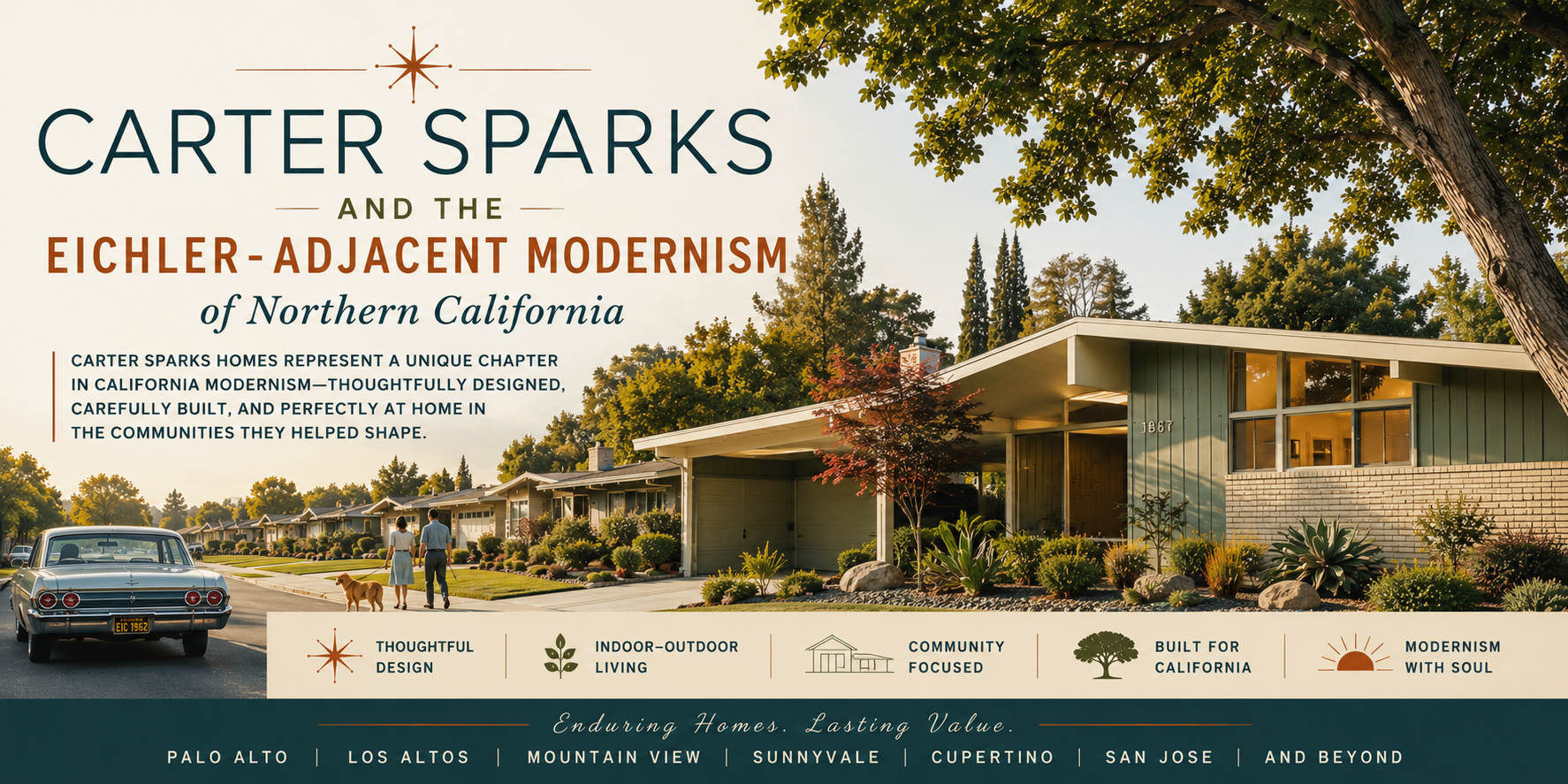
Carter Sparks is one of those architectural names that deserves far more attention than it typically receives. He may not have the instant name recognition of Joseph Eichler, A. Quincy Jones, Claude Oakland, or Richard Neutra, but for anyone who loves Northern California modernism, Sparks belongs in the conversation. His work represents a quieter, more livable branch of the mid-century modern movement — one that was less about architectural drama and more about how real families could live beautifully, comfortably, and intelligently inside modern homes.
The best way to understand Carter Sparks is not to isolate him from the larger movement, but to place him within the ecosystem of postwar California design. After World War II, California was changing rapidly. Returning veterans, expanding families, new industries, and the growth of aerospace and technology created enormous demand for housing. At the same time, modernist architects were questioning the old rules of residential design. Why should homes be dark, formal, and compartmentalized? Why should the backyard feel separate from the house? Why couldn’t a modest family home have the same design intelligence as a custom architectural residence?
This was the world that gave rise to Eichler homes, Mackay homes, Streng homes, and countless modern ranch neighborhoods throughout Northern California. Carter Sparks became especially important through his work with the Streng Brothers, who developed many modernist homes in the Sacramento region. These homes are often compared to Eichlers because they share many of the same ideals: open floor plans, indoor-outdoor living, clerestory windows, private entries, strong rooflines, and a deep relationship between house and garden. Yet Sparks’ work often feels softer and more adaptable than the most iconic Eichlers. His homes are modern, but not severe. They are architectural, but still approachable.
That distinction is important for Silicon Valley homeowners and buyers. Not every great mid-century home is an Eichler. Not every meaningful modernist home has an atrium, radiant-heated slab, or famous Bay Area tract name attached to it. Some homes are important because of how they live. They frame light beautifully. They protect privacy from the street while opening to the backyard. They use simple geometry to create calm. They make daily life feel easier. Sparks helps us understand that modernism was not just a style. It was a way of solving everyday problems with grace.
Compared with Joseph Eichler, Carter Sparks represents a different expression of the same dream. Eichler homes were often bold and unmistakable. The atrium, post-and-beam framing, glass walls, mahogany paneling, and exposed structure created a complete architectural experience. Sparks’ work, especially in Streng homes, often translated similar values into a more flexible package. Instead of feeling like a manifesto, many Sparks-associated homes feel like modernism adapted for everyday life. That does not make them less important. In some ways, it makes them even more useful for understanding how mid-century design became part of ordinary California neighborhoods.
For Silicon Valley, Carter Sparks is valuable as a lens. His work helps explain why certain ranch homes in Sunnyvale, San Jose, Mountain View, Los Altos, and Palo Alto feel more architectural than others. A home may not be a pure Eichler, but it may still share the same design DNA: low rooflines, generous glass, open living spaces, a strong connection to the yard, and a sense of privacy from the street. Once buyers understand this broader modernist language, they begin to see value where others see only an older ranch house.
This is especially relevant in neighborhoods shaped by builders such as Mackay, Brown & Kauffmann, Ponderosa, and other postwar developers. These homes were often more conventional than Eichlers, but many still carried the influence of California modernism. They were built for families who wanted light, space, function, and a connection to outdoor living. Carter Sparks gives us a vocabulary for describing those homes more intelligently. He helps bridge the gap between famous-name architecture and the quieter modernism embedded in everyday Silicon Valley housing.
The remodeling lessons are also important. Sparks-era and Sparks-adjacent homes usually reward restraint. The best renovations do not fight the original architecture. They preserve rooflines, improve natural light, update kitchens and baths, and strengthen indoor-outdoor connections. The worst remodels add heavy traditional details, awkward entry treatments, oversized columns, or generic luxury finishes that erase the home’s original rhythm. With these homes, the goal is not to make them look brand new. The goal is to make them feel like the best version of what they were always meant to be.
That is why Carter Sparks is such a strong topic for a Property Nerds® article. It allows the Boyenga Team to educate readers beyond the usual names. Most agents can identify an Eichler. Far fewer can explain why a non-Eichler modern ranch still has architectural significance. Even fewer can connect that home to a broader Northern California movement involving Streng, Eichler, Oakland, Jones, Mackay, and other builders and architects who helped define postwar living.
For sellers, this knowledge can affect value. A well-positioned mid-century home should not be marketed as merely “updated” or “move-in ready.” It should be positioned around design, light, lifestyle, lot utility, renovation quality, and architectural story. Buyers respond to homes that feel intentional. They respond even more strongly when the marketing helps them understand why the home feels different.
For buyers, this knowledge sharpens the eye. It helps them recognize potential before everyone else does. A home with a simple façade, original roofline, good orientation, and a strong relationship to the yard may be far more valuable than its surface finishes suggest. Carter Sparks teaches buyers to look beyond cosmetics and study the bones, the light, the plan, and the way the house sits on the lot.
In the end, Carter Sparks matters because he represents the next layer of Northern California modernism. He is not the most famous name, and that is exactly why he is interesting. His work reminds us that architectural history is not only written by the biggest personalities. It is also written by the designers who helped make good design more livable, more repeatable, and more accessible.
For Silicon Valley, that lesson is powerful. This region is filled with homes that are more interesting than they first appear. Some are Eichlers. Some are Mackays. Some are Brown & Kauffmann homes. Some are Ponderosa ranches. Some are simply well-designed mid-century houses waiting to be understood. Carter Sparks helps us see them with better eyes.
And once you learn how to see modernist design, you never look at a ranch house the same way again.
Why Carter Sparks Deserves a Place in the Silicon Valley Modernist Conversation
When people talk about mid-century modern housing in Northern California, the conversation usually begins with Joseph Eichler.
That makes sense.
Eichler changed the way Californians imagined suburban life. His homes brought glass walls, atriums, post-and-beam construction, radiant heat, open planning, and indoor-outdoor living into the middle-class housing market. But the broader modernist movement was never the work of one person, one builder, or one architectural office.
It was an ecosystem.
Around Eichler were architects, developers, builders, draftsmen, landscape designers, structural thinkers, and regional modernists who all participated in a shared experiment: how to make modern architecture livable, repeatable, affordable, and emotionally compelling.
Carter Sparks belongs in that conversation.
Although he is not usually listed among Eichler’s primary Silicon Valley architects, Sparks represents something deeply important to the story of Northern California modernism. He helped translate modernist ideas into approachable family homes, especially through his association with the Streng Brothers in the Sacramento region. For Silicon Valley readers, that makes him especially interesting because his work sits in direct conversation with Eichler, Mackay, Brown & Kauffmann, Ponderosa, and the many other builders who shaped postwar California housing.
In other words, Carter Sparks is not simply a footnote.
He is part of the larger design language that made California modernism feel human.
The Property Nerds® Take
Carter Sparks matters because he helps us understand what happened after modernism left the custom architect-designed hillside house and entered the subdivision.
That is the important shift.
The great early modern houses were often custom commissions for adventurous clients. They were beautiful, experimental, and frequently expensive. But by the 1950s and 1960s, a new question emerged:
Could modern architecture become the basis for everyday family housing?
Joseph Eichler answered that question one way.
The Streng Brothers and Carter Sparks answered it another.
Where Eichler homes often leaned into dramatic architectural purity — atriums, exposed beams, slab foundations, radiant heat, glass walls, and intentionally blank street façades — Sparks’ work often feels more relaxed, adaptable, and regionally approachable. His homes shared the modernist desire for light, openness, privacy, and indoor-outdoor living, but they frequently did so with a gentler hand.
That is what makes him such a compelling figure for a Silicon Valley architecture series.
He helps explain the difference between “iconic modernism” and “livable modernism.”
Carter Sparks in the Northern California Modernist Landscape
Carter Sparks is most closely associated with mid-century residential design in Northern California, especially the Sacramento-area modern homes built by the Streng Brothers. These homes are often compared to Eichlers because they share many of the same emotional and architectural goals:
open living spaces, privacy from the street, strong relationships to gardens, simple rooflines, clerestory light, and a feeling that the home should be designed around real family life rather than formal display.
For Silicon Valley homeowners, this is where Sparks becomes relevant.
Even when a home in Sunnyvale, San Jose, Palo Alto, Los Altos, Mountain View, or Cupertino was not designed by Sparks, his work belongs to the same conversation. Buyers who love Eichlers often love Strengs. Buyers who understand Strengs often become more sensitive to the subtler modernism found in Mackay homes, Brown & Kauffmann ranches, Ponderosa neighborhoods, and Horizon-style mid-century communities.
That is the opportunity.
A Carter Sparks article helps educate readers beyond the obvious names. It tells them that Northern California modernism was not one lane. It was a spectrum.
Eichler vs. Sparks: Similar Goals, Different Expressions
The easiest way to understand Carter Sparks is to compare his design world to Eichler’s.
Eichler homes were bold.
They were often unmistakable from the moment you entered. The atrium, the glass walls, the exposed post-and-beam structure, the mahogany paneling, and the radiant-heated slab all created a very specific architectural experience. Eichler was not trying to disguise modernism. He was selling it.
Sparks’ modernism was often less theatrical but highly livable.
Rather than feeling like a manifesto, many Sparks-associated homes feel like modernism adapted for a broader audience. They retain the values of openness, light, privacy, and outdoor connection, but they often feel less rigid than Eichler’s most iconic designs.
This distinction matters in real estate.
An Eichler buyer often wants the full architectural experience. They may be willing to deal with radiant heat repairs, foam roofs, single-pane glass, slab limitations, and preservation-sensitive updates because the architecture itself is the prize.
A Sparks-style buyer may be drawn to the same spirit but prefer slightly more conventional systems, greater remodel flexibility, or a home that feels mid-century modern without requiring museum-level stewardship.
Both buyer profiles are valid.
But they are not identical.
The Design Language of Carter Sparks
A Carter Sparks-inspired discussion should focus less on ornament and more on experience.
His work belongs to the California modern tradition where the house is not simply an object on a lot. It is a frame for living.
Common design ideas associated with this world include:
privacy from the street, openness toward the rear yard, generous use of glass, simple roof geometry, clerestory windows, exposed structure, efficient circulation, modest footprints that live larger than expected, and strong relationships between living rooms, patios, and gardens.
The best of these homes understand that suburban privacy and openness are not opposites.
They are partners.
The street side can be quiet, restrained, and protective.
The garden side can be open, glassy, and expansive.
That formula is one of the great achievements of Northern California modernist housing.
Why Silicon Valley Should Care About Carter Sparks
At first glance, Carter Sparks may seem more relevant to Sacramento than Silicon Valley.
But that is exactly why the article has authority potential.
Most agents write only about the obvious local labels. Eichler. Maybe Mackay. Maybe Brown & Kauffmann.
Very few explain the broader modernist network that shaped buyer taste across Northern California.
Carter Sparks gives Silicon Valley readers a richer vocabulary.
Once buyers understand Sparks, they become better at seeing the subtle modernism in other homes. They start noticing rooflines. They notice glass placement. They notice whether a house opens to the yard or merely sits on the lot. They notice how a floor plan handles privacy. They notice whether a remodel preserved the original design logic or fought against it.
That education is powerful.
It helps sellers understand why their home has more than commodity value.
It helps buyers understand why one ranch house feels ordinary while another feels architectural.
The Silicon Valley Connection: Reading Sparks Through Local Neighborhoods
Even if Carter Sparks was not the architect of the major Silicon Valley Eichler tracts, his ideas can be used as a lens for understanding several local housing types.
Palo Alto
Palo Alto is where the Eichler story becomes especially important. Neighborhoods like Greenmeadow and Fairmeadow helped establish the idea that modernist tract housing could be both progressive and desirable. The comparison with Sparks is useful because it shows how different architects and builders interpreted the same postwar dream: light, openness, affordability, and a better daily relationship with nature.
Sunnyvale
Sunnyvale offers a more varied mid-century landscape. Eichlers, Mackay-style modern homes, Brown & Kauffmann ranches, Ponderosa neighborhoods, and other postwar subdivisions all overlap in the buyer imagination. A Sparks discussion helps explain why some non-Eichler ranch homes still feel modern, especially when they have broad glass, indoor-outdoor flow, lower rooflines, and adaptable family floor plans.
San Jose
San Jose may be the strongest local comparison because it contains both iconic Eichler neighborhoods and a wide range of modern-ranch communities. In areas like Fairglen, Willow Glen, Cambrian, and the broader west/south San Jose postwar belt, buyers often encounter homes that are not pure Eichlers but still carry mid-century modern DNA. Sparks helps explain that middle ground.
Los Altos and Mountain View
Los Altos and Mountain View are ideal for a more nuanced discussion of builder modernism. Not every valuable mid-century home is architect-designed in the famous-name sense. Some derive value from site planning, lot size, simplicity, scale, and renovation potential. Carter Sparks belongs in that conversation because his work reminds us that livability itself can be architectural.
San Mateo and the Peninsula
The Peninsula contains some of the Bay Area’s most significant Eichler work, including San Mateo Highlands and the experimental X-100. A Carter Sparks comparison helps readers understand the difference between experimental modernism and production-friendly modernism. Both shaped the market. Both shaped buyer expectations. Both still influence how we value mid-century homes today.
Carter Sparks and the Streng Brothers
The Streng Brothers are central to any Carter Sparks story.
In the Sacramento region, Streng homes became beloved for offering many of the qualities buyers associate with Eichlers, but often in a slightly more flexible package. Their homes appealed to people who wanted modern architecture without necessarily needing the more intense architectural statement of an Eichler.
This matters because Streng homes prove that the demand for modernist living was not confined to the Bay Area.
The same ideas that made Eichlers successful in Palo Alto, Sunnyvale, San Mateo, and San Jose resonated in Sacramento, Davis, and surrounding Northern California communities.
Buyers wanted light.
They wanted openness.
They wanted privacy.
They wanted a relationship to the yard.
They wanted a house that felt optimistic.
That optimism is the emotional core of Carter Sparks’ relevance.
Why Few Agents Write About Carter Sparks
Most real estate content is surface-level.
It talks about beds, baths, square footage, school scores, and maybe commute distance.
Carter Sparks requires a different kind of article.
You have to explain design history.
You have to understand the relationship between architects and builders.
You have to distinguish between direct attribution and architectural influence.
You have to be careful not to call every glassy ranch an Eichler.
That is exactly why this topic is valuable.
A well-written Carter Sparks article signals expertise. It shows that the writer understands Northern California housing as a design ecosystem, not just a list of neighborhoods.
For the Boyenga Team, this fits beautifully with the Property Nerds® brand because it takes a niche subject and turns it into practical buyer and seller intelligence.
How to Identify a Sparks-Adjacent Modern Home
Not every home with a low roofline and big windows deserves to be called architecturally significant.
But there are clues that suggest a home belongs to the broader Sparks/Eichler/Streng modernist conversation.
Look for a restrained street presence. Many modernist homes reveal themselves slowly. The front elevation may be private, simple, or even understated.
Look for glass facing the garden. The best modernist homes often open to private outdoor space rather than the street.
Look for a plan that prioritizes daily living. Family rooms, patios, kitchens, and outdoor areas often relate to each other in a practical way.
Look for clerestory windows or high glass. These details bring light into the home while preserving privacy.
Look for exposed structure. Beams, tongue-and-groove ceilings, and visible roof structure can all contribute to the modernist feeling.
Look for indoor-outdoor continuity. The yard should not feel like leftover land. It should feel like part of the living experience.
Remodeling Lessons from Carter Sparks-Style Homes
One reason Sparks-adjacent homes remain so appealing is that they can often be updated gracefully.
The key is restraint.
The worst remodels fight the architecture. They add heavy traditional moldings, awkward Mediterranean entryways, oversized columns, fake shutters, or bulky roofline changes that erase the home’s original rhythm.
The best remodels amplify what was already there.
They open kitchens without destroying structure.
They modernize windows while respecting proportion.
They update bathrooms without making the home feel generic.
They improve insulation, HVAC, roofing, lighting, and electrical systems while preserving the calm simplicity of the original architecture.
They treat the yard as an outdoor room.
For sellers, this matters because buyers can feel when a remodel understands the house.
For buyers, it matters because the right home may have more potential than the photos suggest.
The Market Appeal of Carter Sparks and Eichler-Adjacent Modernism
The modernist buyer pool has changed dramatically.
Decades ago, many mid-century homes were treated simply as older tract houses. Today, buyers actively search for architectural homes, Eichlers, Strengs, Mackays, Brown & Kauffmann ranches, Ponderosa homes, and other builder-specific communities.
That shift has created a premium for homes with story.
Carter Sparks adds story.
Even when a Silicon Valley home is not directly connected to him, understanding his work helps position the home within a broader design movement. That can be especially useful for listings that are not pure Eichlers but still have authentic mid-century appeal.
The marketing strategy becomes more sophisticated.
Instead of saying “updated ranch,” you can say:
“A modern-ranch home with the same Northern California design values that shaped the Eichler, Streng, and Carter Sparks era: privacy, light, indoor-outdoor living, and highly functional family space.”
That is a much stronger story.
Boyenga Team Perspective
For Eric and Janelle Boyenga of the Boyenga Team at Compass, Carter Sparks is exactly the kind of architectural figure worth studying because he helps explain the hidden value in homes that many agents overlook.
Not every important mid-century home has an obvious famous-name label.
Some are valuable because of how they live.
Some are valuable because of their lot geometry.
Some are valuable because of their original design logic.
Some are valuable because a thoughtful remodel can unlock a completely different buyer pool.
As Silicon Valley Luxury Home Experts and longtime Property Nerds®, Eric and Janelle understand that architectural knowledge is not just interesting — it is strategic. It helps sellers position their homes with more depth, and it helps buyers recognize potential before the rest of the market sees it.
That is why topics like Carter Sparks matter.
They sharpen the eye.
They deepen the story.
And in a market as competitive and design-sensitive as Silicon Valley, the right story can change everything.
Chapter 1
Why Carter Sparks Matters More Than Most People Realize
Most homeowners have never heard of Carter Sparks.
Even among architecture enthusiasts, his name is often overshadowed by larger figures such as Joseph Eichler, A. Quincy Jones, Claude Oakland, Richard Neutra, or Frank Lloyd Wright. Yet that lack of recognition may actually make his story more important.
The history of architecture often focuses on the stars. We celebrate the visionary architect, the famous developer, the groundbreaking project that changed everything. What we sometimes overlook are the people who helped translate those ideas into something ordinary families could actually live in.
That was Carter Sparks' gift.
He belonged to a generation of architects who understood that great architecture should not be reserved for the wealthy. Modern design was not simply about aesthetics. It was about improving daily life. It was about light, privacy, simplicity, efficiency, and creating homes that responded to how people actually lived.
In many ways, Carter Sparks represents the democratization of modernism.
The homes he helped create were not museum pieces. They were places where children played, families gathered, and ordinary Californians experienced architecture every day without necessarily realizing it.
That influence continues today.
When a buyer walks into a well-designed mid-century home and immediately notices how calm, open, and connected it feels, they are responding to ideas that architects like Carter Sparks helped popularize.
Chapter 2
California Before Modernism
To understand Carter Sparks, we first need to understand the California that existed before he arrived on the scene.
During the early decades of the twentieth century, California architecture was largely dominated by historical styles. Spanish Revival, Mediterranean Revival, Tudor, Colonial Revival, and Craftsman homes filled new neighborhoods throughout the state.
These homes were beautiful.
But they often reflected architectural traditions imported from other places.
The emerging generation of modern architects began asking a different question.
What would architecture look like if it responded directly to California itself?
California had a mild climate.
California encouraged outdoor living.
California enjoyed abundant sunshine.
California was optimistic.
Many architects believed the homes of the future should reflect those realities.
Rather than copying European styles, they wanted to create something uniquely Californian.
This desire laid the foundation for modernism.
The seeds were planted by architects such as Frank Lloyd Wright, Rudolph Schindler, and Richard Neutra. Their work challenged traditional ideas about rooms, walls, windows, and the relationship between a home and its site.
By the time Carter Sparks entered the profession, these ideas had begun transforming residential architecture throughout the state.
The stage was set for a revolution.
Chapter 3
The Postwar Housing Boom
No event shaped modern American housing more than World War II.
When the war ended, millions of servicemen returned home. Families expanded rapidly. Demand for housing exploded.
California was particularly affected.
The state's growing aerospace industry attracted workers from across the nation. New suburbs appeared almost overnight.
Builders faced a tremendous challenge.
They needed to construct homes quickly.
They needed those homes to be affordable.
And increasingly, buyers wanted something more than the traditional house designs of previous generations.
This moment created an extraordinary opportunity.
Developers like Joseph Eichler recognized that modern architecture could appeal to middle-class buyers.
Architects such as Carter Sparks helped prove that modern design could be practical as well as beautiful.
The result was one of the most important housing experiments in American history.
Entire communities emerged based upon ideas that had once been considered radical.
Large windows.
Open floor plans.
Indoor-outdoor living.
Simple forms.
Functional design.
These concepts became mainstream.
Today they are so common that many buyers assume they have always existed.
They have not.
Someone had to invent them.
Someone had to refine them.
Someone had to make them accessible.
That is where Carter Sparks enters the story.
Chapter 4
Carter Sparks: The Architect
Unlike some of his more famous contemporaries, Carter Sparks was never interested in creating architecture that shouted for attention.
His work was often quieter.
More restrained.
More subtle.
Yet beneath that restraint was a sophisticated understanding of how homes function.
The best architects understand that people rarely experience architecture as objects.
They experience architecture as environments.
A home succeeds when it feels right.
When circulation flows naturally.
When daylight enters gracefully.
When spaces feel larger than their dimensions suggest.
When indoor and outdoor environments connect effortlessly.
These qualities became hallmarks of the modernist movement and appear repeatedly throughout Sparks' work.
His homes often prioritize comfort over spectacle.
Livability over showmanship.
Human experience over architectural ego.
That balance may be the reason many of his projects continue to age so gracefully.
Unlike architecture driven by trends, homes rooted in human needs remain relevant across generations.
Chapter 5
The Streng Brothers Partnership
No discussion of Carter Sparks is complete without examining his relationship with the Streng Brothers.
This partnership produced some of the most beloved modernist neighborhoods in Northern California.
The Streng Brothers recognized an opportunity similar to the one Eichler had identified earlier.
They believed there was a market for thoughtfully designed modern homes that ordinary families could afford.
What they needed was architectural leadership.
Carter Sparks provided that leadership.
Together, they developed neighborhoods that offered many of the qualities buyers admired in Eichler homes.
Open plans.
Abundant glass.
Strong indoor-outdoor relationships.
Clean rooflines.
Privacy.
Natural light.
But they often achieved these goals through slightly different means.
The resulting homes felt distinctly Northern Californian.
They embraced modernism without becoming dogmatic.
They felt innovative yet comfortable.
Architectural yet approachable.
This balance helped create communities that remain highly sought after decades later.
Chapter 6
What Makes a Carter Sparks Home Feel Different?
One of the most fascinating aspects of Carter Sparks' work is that many people can identify the feeling of his homes even if they cannot identify the architect.
The experience begins before entering the front door.
Unlike traditional houses that often present themselves openly to the street, modernist homes frequently protect privacy.
The exterior can appear understated.
The drama unfolds gradually.
As occupants move through the home, spaces open.
Views emerge.
Light changes.
Gardens become part of the architecture.
This sequence creates emotional impact.
Sparks understood that architecture is not static.
It unfolds through movement.
The house reveals itself over time.
That subtle choreography remains one of the defining characteristics of great modern residential design.
Chapter 7
Carter Sparks and Silicon Valley
Although Carter Sparks is more commonly associated with the Sacramento region, his influence extends well beyond any single geographic area.
The principles he embraced helped shape buyer expectations throughout Northern California.
In Palo Alto, buyers became accustomed to modernist ideas through Eichler neighborhoods such as Greenmeadow and Fairmeadow.
In Sunnyvale, modern ranch communities reflected similar values.
In Mountain View, Cupertino, Los Altos, and San Jose, builders adopted many of the same concepts.
Large windows.
Open plans.
Family-centered layouts.
Indoor-outdoor living.
Adaptable spaces.
These characteristics became part of the architectural DNA of Silicon Valley.
Carter Sparks helps us understand how those ideas spread.
Not through a single builder.
Not through a single architect.
But through a movement that reshaped how Californians lived.
Chapter 8
The California Dream Reimagined
To understand why Carter Sparks' work continues to resonate today, it helps to understand what California represented during the 1950s and 1960s.
For much of America, California symbolized possibility.
People came west seeking sunshine, opportunity, and a different way of living. They wanted larger yards, better weather, and a quality of life that felt less constrained than the cities they left behind.
Architects understood this.
Traditional East Coast housing models often emphasized separation. Rooms were divided. Activities were compartmentalized. Outdoor spaces were secondary.
California invited a different approach.
The climate encouraged year-round outdoor living. Families wanted patios, gardens, swimming pools, and spaces where children could move freely between indoors and outdoors.
Carter Sparks embraced these realities.
His work reflects an understanding that architecture should respond to climate rather than ignore it. Walls became less important. Glass became more important. The distinction between house and garden began to dissolve.
What emerged was not merely a new architectural style.
It was a new way of living.
Many of the features today's buyers demand—open kitchens, flexible spaces, abundant natural light, indoor-outdoor entertaining—can trace their origins directly to this period.
The remarkable thing is that homes designed sixty years ago often feel more contemporary than houses built much more recently.
That is not an accident.
It is evidence of design thinking that was decades ahead of its time.
Chapter 9
Why Light Became the Most Important Building Material
One of the most overlooked aspects of modernist architecture is that it changed how architects thought about light.
Prior generations viewed windows primarily as openings in walls.
Modernists saw them differently.
Light itself became a design material.
Carter Sparks understood this deeply.
A well-designed modern home changes throughout the day. Morning light enters differently than afternoon light. Shadows move across floors and walls. Trees outside become part of the interior experience.
The home becomes dynamic.
Living spaces feel larger because visual boundaries extend beyond the walls.
Rooms feel more connected because natural light flows continuously throughout the structure.
This may seem obvious today.
But it represented a significant departure from traditional residential design.
Many older homes were inward-looking. Windows were smaller. Rooms were darker. Artificial lighting played a larger role.
Modernism reversed those priorities.
Natural light became central.
The impact on homeowners is difficult to overstate.
People often describe well-designed modern homes as feeling calm, uplifting, or peaceful without fully understanding why.
The answer is frequently light.
Light affects mood.
Light affects perception.
Light affects how we experience space.
Architects like Carter Sparks recognized that long before it became common knowledge.
Chapter 10
The Modern Ranch House: America's Most Underrated Architectural Achievement
Architecture enthusiasts often celebrate iconic custom homes.
Magazines feature dramatic hillside residences and architect-designed masterpieces.
Yet some of the most influential architecture in American history was much more modest.
The modern ranch house changed how millions of people lived.
Carter Sparks operated within this world.
His work demonstrates that architectural quality does not require extravagance.
A home can be simple.
A home can be practical.
A home can be affordable.
And still be architecturally meaningful.
The ranch house became the perfect vehicle for modernist ideas because it naturally emphasized horizontality, connection to the landscape, and family-centered living.
Unlike traditional multi-story homes, ranch houses spread outward.
They hugged the site.
They encouraged direct access to gardens and patios.
They blurred the distinction between inside and outside.
In Silicon Valley, this approach proved especially successful.
Large suburban lots allowed builders to create neighborhoods where homes could breathe.
Privacy increased.
Natural light improved.
Outdoor living flourished.
Today many buyers continue to prefer these homes because they simply function well.
Their popularity is not based solely on nostalgia.
It is based on usability.
Good design ages well.
Chapter 11
Privacy and Openness: The Great Modernist Paradox
One of the most fascinating achievements of architects like Carter Sparks is their ability to make homes feel both private and open at the same time.
At first glance, these goals seem contradictory.
Privacy suggests enclosure.
Openness suggests exposure.
Yet modernist architects discovered ways to achieve both simultaneously.
The key was orientation.
Many modern homes present relatively restrained façades to the street.
Visitors see walls, modest windows, and controlled entry sequences.
The real experience unfolds toward the rear yard.
There, glass expands.
Views open.
Gardens become visible.
The home reveals itself.
This strategy creates a remarkable psychological effect.
Occupants enjoy abundant daylight and visual openness without sacrificing privacy.
The result feels luxurious.
Not because of expensive materials.
But because the home responds intelligently to human needs.
Many contemporary luxury homes still rely on these same principles.
The difference is that architects like Carter Sparks were exploring them decades earlier.
Chapter 12
The Human Scale of Modernism
One reason Carter Sparks' work remains appealing is that it generally avoids the excess that often accompanies luxury architecture.
Many contemporary homes are enormous.
Rooms grow larger.
Ceilings grow higher.
Spaces become increasingly dramatic.
Yet bigger does not always mean better.
The best modernist homes understand scale.
They feel comfortable rather than intimidating.
Living rooms encourage conversation.
Dining areas feel connected to kitchens.
Bedrooms feel private without becoming isolated.
Outdoor spaces feel like extensions of interior rooms.
This attention to human scale creates emotional warmth.
People feel at ease.
They settle in quickly.
The home feels intuitive.
This quality is difficult to measure but easy to experience.
Buyers often recognize it immediately.
They may not know why a home feels better than another.
But they know it does.
That response is often the result of thoughtful proportions and careful planning.
Chapter 13
Silicon Valley's Hidden Modernism
One of the most interesting lessons Carter Sparks teaches us is that great modern architecture is not always obvious.
Many people associate architectural significance with famous names.
Eichler.
Neutra.
Jones.
Wright.
Yet throughout Silicon Valley there are hundreds, perhaps thousands, of homes influenced by the same design values.
Some appear in Mackay neighborhoods.
Some appear in Brown & Kauffmann communities.
Some appear in Ponderosa developments.
Others are scattered throughout Los Altos, Mountain View, Sunnyvale, Palo Alto, and San Jose.
These homes may not attract architectural tours.
They may not appear in textbooks.
But they contribute to the character of their communities.
They demonstrate how modernist ideas filtered into mainstream housing.
They prove that architecture is not only about exceptional buildings.
It is also about everyday environments.
This is one reason Property Nerds® topics resonate with homeowners.
People enjoy discovering that their neighborhood has a story.
They enjoy learning that the home they live in belongs to a larger architectural narrative.
That story creates connection.
Connection creates value.
And value extends beyond price per square foot.
Chapter 14
Why Buyers Continue to Pay Premiums for Modernist Homes
The real estate market provides a fascinating lens through which to evaluate architecture.
Buyers vote with their wallets.
Over time, certain housing types consistently command stronger interest than others.
Mid-century modern homes are a perfect example.
Decades after they were built, demand remains exceptionally strong.
Why?
Part of the answer is scarcity.
No one is building original Eichlers today.
No one is creating authentic 1960s Mackay neighborhoods.
No one can reproduce the historical context that gave rise to Carter Sparks and his contemporaries.
But scarcity alone does not explain everything.
The deeper reason is that these homes continue to satisfy modern lifestyles.
Open plans remain desirable.
Natural light remains desirable.
Indoor-outdoor living remains desirable.
Flexible family spaces remain desirable.
In many cases, modernist architects solved problems that buyers still care about today.
That relevance helps explain their enduring appeal.
Chapter 15
The Legacy of Carter Sparks
The true legacy of Carter Sparks is not a single building.
It is not a single neighborhood.
It is not even a single architectural style.
His legacy is a way of thinking.
The belief that architecture should improve daily life.
The belief that simplicity can be beautiful.
The belief that homes should respond to climate, light, and human behavior.
The belief that modern design should be accessible.
These ideas influenced generations of builders, architects, and homeowners.
They continue to shape housing throughout Northern California.
And they remain visible throughout Silicon Valley today.
Even in neighborhoods where Carter Sparks never worked directly, his philosophy can still be felt.
In the open floor plan.
In the wall of glass.
In the courtyard.
In the connection between house and garden.
In the feeling that a home can be both practical and beautiful.
That may be the most enduring contribution of all.
Because architecture ultimately succeeds not when it is admired.
But when it quietly improves the lives of the people who live inside it.
Learning to See
Perhaps the most important lesson Carter Sparks leaves behind is not a particular floor plan, roofline, or architectural detail.
It is a way of seeing.
Most people drive through neighborhoods and see houses.
Architecture enthusiasts see something more.
They see ideas.
They see history.
They see the evolution of how people lived, worked, gathered, entertained, and imagined the future.
Carter Sparks belonged to a remarkable generation of architects who believed that design could improve everyday life. They understood that a home was more than shelter. It was an environment that shaped experiences, relationships, and daily routines. Through thoughtful planning, abundant natural light, indoor-outdoor living, and a focus on human comfort, they helped redefine what a family home could be.
That legacy remains visible throughout Northern California.
It appears in the Eichlers of Palo Alto and San Mateo. It appears in Streng neighborhoods throughout the Sacramento region. It appears in Mackay communities, Brown & Kauffmann ranch homes, Ponderosa neighborhoods, and countless mid-century homes scattered throughout Sunnyvale, Mountain View, Los Altos, Cupertino, San Jose, and beyond.
Many homeowners may never know the names of the architects and builders who shaped these communities.
Yet they experience the results every day.
They enjoy the natural light.
They gather around open living spaces.
They entertain on patios that feel like extensions of the home.
They appreciate mature neighborhoods designed around people rather than automobiles.
They benefit from architectural decisions made generations ago.
That is the enduring power of great design.
For those of us who study Silicon Valley housing, Carter Sparks represents something larger than a single architect's career. He represents an era of optimism. An era when architects, builders, and developers believed that thoughtful design should not be reserved for the wealthy or the elite. They believed modern architecture could be accessible, practical, and deeply human.
Many of those ideas remain surprisingly relevant today.
As buyers increasingly seek authenticity, character, and meaningful connections to place, the lessons of mid-century modernism continue to resonate. These homes remind us that architecture does not need to be extravagant to be extraordinary. It simply needs to respond intelligently to how people live.
As Property Nerds®, this is what fascinates us most.
Every neighborhood has a story.
Every builder leaves a fingerprint.
Every architect contributes a chapter.
The more we learn about those stories, the more we understand why certain homes continue to inspire us decades after they were built.
And once you begin to see those stories, you realize that some of Silicon Valley's most valuable assets are not its office towers or technology campuses.
They are the thoughtfully designed neighborhoods that quietly shaped the lives of generations.
Carter Sparks helped write a small but meaningful part of that story.
And it is a story worth preserving.