
William Krisel: The Architect Who Designed the California Dream
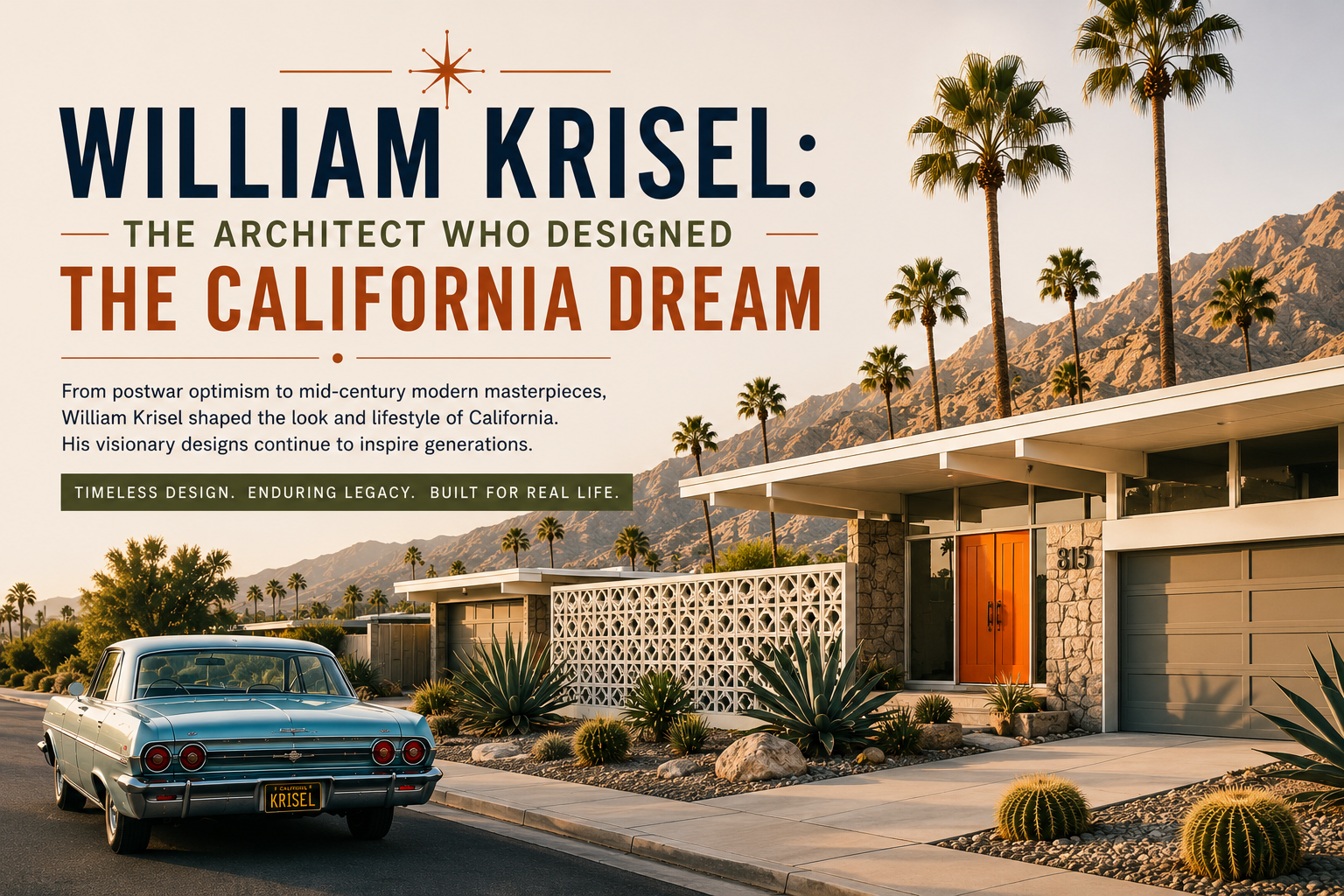
How One Visionary Architect Helped Shape Palm Springs, Influenced Eichler-Era Modernism, and Brought Great Design to the Masses
William Krisel belongs in a rare category of architect: the kind whose work shaped not just a few famous buildings, but the visual logic of ordinary life in California. The Getty’s finding aid for his papers describes him as an “architect for the masses,” and the Los Angeles Conservancy similarly frames his core achievement as bringing Modernism to middle-class buyers through affordable postwar tract developments rather than exclusive one-off commissions. Estimates of his total production vary by source, but they all point to unusual scale: the Conservancy notes that Krisel himself claimed more than 40,000 Modern homes nationwide, while Palm Springs sources credit him with more than 30,000 living units in Southern California alone.
That scale matters because Krisel’s influence is easiest to miss precisely where it is greatest. He helped normalize the things buyers now read as distinctly Californian: open planning, broad expanses of glass, carports and breezeways, deep overhangs, patios, clerestories, and houses arranged around light, climate, and lifestyle rather than ceremony. The National Park Service’s account of postwar “contemporary” housing describes these same traits as hallmarks of the era, but Krisel was one of the figures who translated them into real neighborhoods at merchant-builder scale.
The architect of everyday California
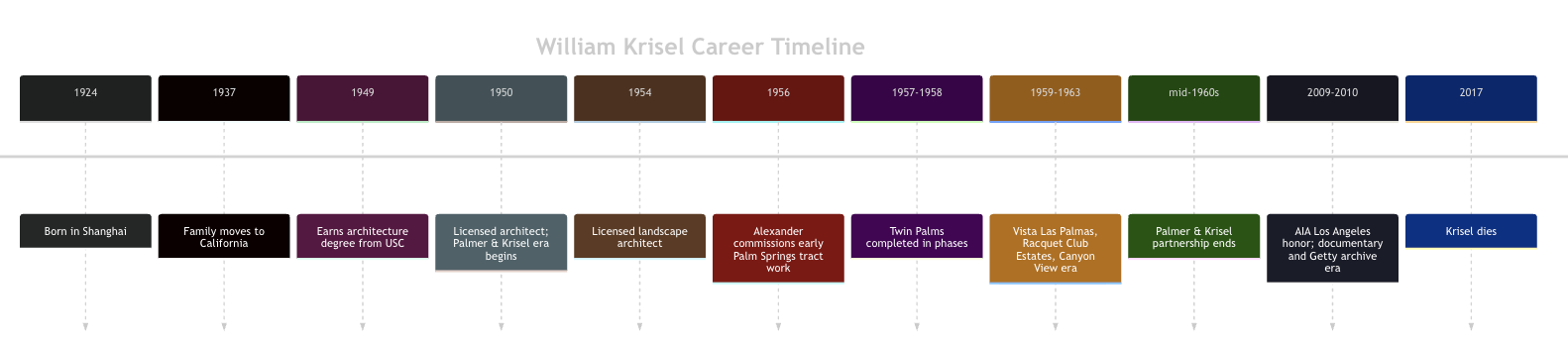
Krisel was born in Shanghai in 1924 to American parents working for the U.S. State Department, moved to Los Angeles in 1937 after the Japanese invasion of China, served in World War II as a Chinese-language interpreter, and graduated from the USC School of Architecture in 1949. He became a licensed architect in 1950 and a licensed landscape architect in 1954, a combination that helps explain why his projects often read as complete environments rather than isolated houses.
Between 1950 and 1966, he worked with Dan Palmer in the firm Palmer & Krisel. Long before Palm Springs made him famous, the partnership had already begun to refine a method for large-scale Modern housing. The Los Angeles Conservancy identifies Corbin Palms in Woodland Hills as a 1955 tract of 287 Modern homes, and the Getty archive notes that the project used four basic house plans with varied elevations, color schemes, landscaping, and siting. That is the essence of Krisel’s genius in one sentence: repetition without deadening sameness.
The postwar problem he solved
Krisel’s timing was perfect, but his solution was not inevitable. The National Park Service explains that the postwar suburban boom was driven by a severe housing shortage, favorable long-term mortgages for veterans, rising automobile ownership, new building technologies, and merchant builders capable of producing affordable homes at unprecedented speed. That was the national problem. Krisel’s answer was to prove that speed and affordability did not require architectural mediocrity.
His own account of the breakthrough is revealing. In an interview with the Eichler Network, Krisel recalled that George and Robert Alexander initially gave him a small chance to test his modern tract ideas in the San Fernando Valley. The houses sold before they were finished, cost less per square foot than the family’s stucco “dingbats,” and yielded higher profits. Krisel said Palmer & Krisel then developed their own windows, walls, and other standardized components after learning exactly what drove cost in a house and how to do it “better and cheaper.” In other words, Krisel did not simply style tract housing; he reengineered its economics.
That is why “tract modernism” is too often misunderstood. In Krisel’s hands, it did not mean disposable sameness. It meant disciplined planning, standardized components, controlled variety, and a modern domestic ideal delivered at volume. Palm Springs Life summarized the formula well: rotate a common plan, vary the rooflines, change the materials palette, and make the house look custom even when the construction logic is repeatable.
Palm Springs as the laboratory
Palm Springs is where Krisel’s ideas became a cultural image. The Getty describes Twin Palms as an Alexander development from 1957 that helped establish his reputation for elegant but affordable housing, while the Palm Springs Modern Committee notes that Krisel came to the desert at Bob Alexander’s request to design the tract first called Smoke Tree Valley and later renamed Twin Palms because each completed home came with a pair of palm trees.
The Los Angeles Times’ detailed profiles of Krisel’s Palm Springs work show how sophisticated these supposedly “tract” houses really were. Early Twin Palms homes were modest, roughly 1,600-square-foot single-story houses built on repeated post-and-beam plans, but facades were varied through different rooflines, flopped or skewed plan orientations, patterned concrete-block elements, breezeways, carports, pools, and air conditioning. In a separate 2016 interview, the paper added that Krisel could generate eight distinct appearances from this basic formula in Twin Palms, creating individuality without surrendering cost control.
This is also where Krisel’s signature vocabulary became inseparable from Palm Springs itself. Palm Springs Life argues that while Krisel did not invent the butterfly roof, he used it on such a large scale in Palm Springs that it became part of the city’s vernacular. The same article stresses that Twin Palms sold so quickly that the Alexander formula expanded into more than 1,200 homes across ten Palm Springs locations. Krisel’s desert language spread into projects such as Vista Las Palmas, Racquet Club Estates, Kings Point, Canyon View Estates, Valley of the Sun, and the Sandpiper condominium complexes.
Palm Springs also let Krisel move beyond the single-family tract into a broader lifestyle ecosystem. The Getty archive calls Ocotillo Lodge a destination resort designed to attract potential homeowners to the Coachella Valley. Palm Springs officially designated Ocotillo Lodge a historic district in 2024, noting that it was built in part to house buyers interested in the nearby Twin Palms tract and identifying its key features as glass walls, ribbon and clerestory windows, post-and-beam expression, concrete block screens, walkable internal paths, and Garrett Eckbo’s keyhole-shaped pool landscape.
At the upper end of the spectrum, Krisel also created the Alexander Residence, better known as the House of Tomorrow. Palm Springs Life describes the 1960 commission as a difficult hillside problem solved by setting four circular pods at different levels beneath a light, floating roof. The house later became a Class 1 Historic Site and, because Elvis and Priscilla Presley spent time there, a pop-culture landmark as well as an architectural one.
Krisel in the Eichler era
Krisel should absolutely be discussed in the same conversation as Eichler-era modernism, but the clearest evidence points to parallel revolutions rather than a simple one-way influence story. In his interview with the Eichler Network, Krisel said that A. Quincy Jones was a close friend and that both camps knew each other’s work through magazines. He also argued that in Southern California, Palmer & Krisel were early with modern tract houses, while “up north Eichler was much more important.” That is not a denial of connection; it is a reminder that California modernism had multiple centers of innovation.
The overlap in ideas is unmistakable. The California Preservation Foundation explains that Eichler Homes built more than 11,000 tract houses between 1949 and 1966 using notable architects, modular post-and-beam systems, open floor plans, internal courtyards, and full-height glazing that fused interior and exterior space. The City of San José’s current Eichler standards likewise describe those neighborhoods as unique to California and designed to take advantage of climate and sunlight. Krisel’s tract houses, especially in Palm Springs, pursued the same broad objective with a different regional accent: less atrium-centered than many Eichlers, more overtly desert-responsive, but just as committed to livability, light, and modern family life.
The National Park Service’s broader description of the postwar contemporary house helps connect the dots. Open floor plans, patios and terraces, carports, transparent walls, and indoor-outdoor integration were the dominant ambitions of modern domestic design in the 1950s. Eichler helped institutionalize those ambitions in Northern California; Krisel did so in Southern California and especially in Palm Springs. If your thesis is that Krisel helped shape the California Dream in the same historical moment as Eichler, the evidence strongly supports it. If your thesis is that he directly determined Eichler’s architecture, the evidence is thinner and should be framed more cautiously.
Why the market still rewards Krisel
Krisel’s relevance is not just historical. It is market-visible. In 2016, the Los Angeles Times reported that the smallest Krisel houses that once sold for about $19,000 were already “regularly” fetching more than $1 million, and by 2025 Palm Springs Life was still treating a Kings Point listing as a rare event precisely because Krisel-designed inventory there seldom comes up for sale. That same Palm Springs Life piece highlighted the features buyers still pay for: clerestory windows, glass walls, high ceilings, and seamless indoor-outdoor flow.
Preservation culture reinforces that demand. The Getty archive explicitly notes the “recent resurgence of interest” in Krisel’s work among homeowners. The Los Angeles Times reported that whole neighborhoods of Alexander/Krisel houses remain intact in Palm Springs and that his designs were not only being restored but reproduced. Palm Springs Modern Committee notes that Krisel himself participated in restorations of original homes and, beginning in 2008, collaborated on exact replicas updated to new materials and LEED-oriented standards.
The enthusiasm is visible right now in public programming. Modernism Week’s 2026 schedule included a Racquet Club Estates neighborhood tour focused on Krisel/Alexander homes, a six-home Sandpiper tour of Krisel-designed residences, and a Palmer & Krisel Ocotillo Lodge talk-and-tour centered on preservation and history. That is not nostalgia at the margins; it is an active regional economy of tours, restoration, and architectural identity.
The lasting California template
The strongest case for calling Krisel “the architect who designed the California Dream” is not that he designed every canonical Mid-Century house. It is that he made the dream reproducible. He showed that modern design could be profitable for developers, desirable to middle-class buyers, and flexible enough to create neighborhood identity rather than one-off spectacle. The OAC finding aid emphasizes his commitment to collaborating with developers to produce “great quantities of high-quality residences,” and the Los Angeles Conservancy stresses that he pursued affordability as a design challenge rather than a compromise.
That is why Krisel still feels current. The things buyers now describe as timeless—clean lines, daylight, relaxed circulation, family-centered planning, climate response, and direct connection to outdoor space—were not afterthoughts in his work. They were the point. For a property-focused audience, that is the real story: Krisel turned architecture into a neighborhood-scale lifestyle product without stripping it of rigor. He proved that design quality could survive the assembly line and even improve the economics of mass housing.
Seen from Silicon Valley, where Eichler neighborhoods still command cultural and preservation attention, Krisel’s importance becomes even clearer. The same state that now preserves Eichler districts in San José and celebrates modern tracts in Palo Alto also continues to tour, restore, and landmark Krisel neighborhoods in Palm Springs. That does not mean Northern and Southern California modernism were identical. It means both were part of the same larger California project: making modern living feel attainable, desirable, and local.
Open questions and limitations
A few numerical claims about Krisel vary across reputable sources. Authoritative organizations credit him with anywhere from more than 30,000 Southern California living units to more than 40,000 homes nationwide by his own count, and Palm Springs-specific totals also vary depending on whether a source is counting only Alexander tract houses, the broader Palm Springs area, or all Palmer & Krisel work in the Coachella Valley. For a polished blog, it is safest to write that Krisel designed tens of thousands of housing units and that Palm Springs sources credit him with roughly 1,200 Alexander homes and roughly 2,000 to 2,500 homes in the wider area, depending on the source.
The other important limit is interpretive: the evidence strongly supports placing Krisel beside Eichler in a common story about democratized California modernism, but it supports a parallel movement more clearly than a direct line of influence from Krisel to Eichler. If you keep that nuance, the argument gets stronger, not weaker.
Some architects leave behind landmarks. William Krisel left behind neighborhoods people still compete to buy into.
That is a very different kind of legacy—and arguably the more powerful one.
Krisel did not make his name by designing one-off trophies for the ultra-wealthy. He made it by doing something much harder: creating modern homes that were beautiful, repeatable, and affordable enough to reshape how ordinary Californians lived. Contemporary preservation and archive sources variously credit him with more than 30,000 living units in Southern California and more than 40,000 housing units nationally over the course of his career, a reminder that exact totals vary by source but his scale did not.
That scale is the whole point.
By the late 1950s, Krisel was not dabbling in mass-market housing; he was operating at industrial velocity. USModernist notes that Palmer & Krisel designed more than 30,000 homes throughout California, helped nearly double the size of Palm Springs by way of roughly 2,500 tract homes, and that Krisel was working for seven of the ten largest homebuilders in the country by 1957. In other words, this was not boutique modernism. It was a design system with reach.
Krisel didn’t just draw cool houses. He industrialized good taste.
That helps explain why architecture enthusiasts light up when his name comes up. The fandom is not theoretical. Getty houses his archive. Palm Springs preservation groups and Modernism Week still center his work. Twin Palms tours have sold out repeatedly, with hundreds of attendees in recent years, which is about as clear a signal as you can get that the market for Krisel’s ideas is still alive.
So what, exactly, made Krisel so potent?
First, he understood the postwar housing problem better than many more famous designers did. America needed homes quickly. Developers needed efficiency. Families wanted space, light, comfort, and a feeling of forward motion. Krisel’s answer was not to abandon architectural integrity in favor of speed. It was to use standardization intelligently. The Getty finding aid explicitly describes his role as bringing affordable, well-designed modern residences to middle-class families, and Palm Springs sources still describe Palmer & Krisel as the team that “brought modernism to the masses.”
Second, he grasped the subtle art of avoiding tract-house monotony. The National Register documentation for a Twin Palms residence is catnip for design nerds: all the homes shared a disciplined square footprint, but the tract still achieved variety through setbacks, rotating plans, four roof types, alternating entries, bundled model variants, and the rule that no two homes of the same type face one another. That is not cookie-cutter building. That is choreography.
Palm Springs became Krisel’s great proving ground. Modernism Week calls Twin Palms the desert’s first completed Modernist neighborhood and says it established concepts later emulated across Palm Springs and the Coachella Valley. The Twin Palms Neighborhood Organization goes even more directly, describing it as the first truly mid-century modern housing tract in Palm Springs, designed by William Krisel and built by the Alexander Construction Company. USModernist identifies roughly 90 homes in the broader Twin Palms effort, designed in stages beginning with commissions in 1956.
This is where the signature Krisel language gets legible: butterfly roofs, floating rooflines, clerestory windows, breezeways, carports, concrete screen or “Shadowall” walls, post-and-beam logic, and lots of glass aimed at lifestyle rather than formality. The Twin Palms nomination notes that even the mechanical systems were tucked below the slab to avoid ruining the roofline, while clerestories and full-height glazing did the work of pulling light deep into the plan. Visit Palm Springs and Palm Springs preservation sources still point to butterfly roofs, breeze-block walls, playful geometry, and climate-responsive indoor-outdoor continuity as essential Krisel traits.
In Krisel’s world, the house was never just a shell. It was a lifestyle device.
And that is why Palm Springs buyers still pay attention.
At the broad city level, Redfin reports Palm Springs’ median sale price at roughly $650,000 over the three months ending April 2026. Meanwhile, Redfin’s current “mid-century modern” inventory filter for Palm Springs shows active listings around a $710,000 median asking price. Those are not identical measures, and the keyword filter is not Krisel-specific, but the directional takeaway is useful: design-coded inventory sits above the middle of the market and remains highly marketable.
The preservation story reinforces the pricing story. Zillow’s 2026 feature research found buyers paying more for turnkey, customized, lifestyle-driven homes and less for fixer-uppers. Remodeled homes sold for 2.2% more than similar homes; turnkey homes commanded 2.9% more; fixer-uppers sold for 14% less. In a Krisel context, that does not mean “gut it and make it generic.” It means thoughtful, architecture-aware restoration can align preservation with buyer psychology.
The Eichler comparison belongs here, but it needs to be handled precisely. Krisel is not best understood as a principal architect within the Eichler production program; the consulted Eichler sources consistently foreground architects such as A. Quincy Jones, Frederick Emmons, Claude Oakland, and Anshen & Allen. The better framing is that Krisel and Eichler solved parallel California problems in different geographies. Eichler’s Bay Area modernism used post-and-beam strategies, glass, clerestories, and later atriums to humanize tract housing for the middle class. Krisel’s Southern California modernism used many of the same social values—good design for ordinary families, indoor-outdoor living, efficient repetition, individualized variation—but adapted them to desert light, mountain backdrop, and Alexander-style developer branding.
That comparison is especially relevant for Silicon Valley readers. Palo Alto’s official Eichler guidelines note that the city contains about 2,700 Eichlers across 32 mapped tracts and explicitly aim to “manage change” while retaining the character of those neighborhoods. Two Palo Alto Eichler neighborhoods—Green Gables and Greenmeadow—are listed on the National Register, and Greenmeadow’s nomination found 92% of buildings contributing after decades of occupation. That is not nostalgia; that is civic recognition that design quality compounds over time.
And yes, Silicon Valley buyers still chase the same DNA. As of early June 2026, Redfin showed roughly three mid-century listings in Palo Alto at a median list near $3.0 million and roughly three in Sunnyvale near $1.6 million; both cities’ broader markets remain fast and competitive. Again, those keyword-driven counts are imperfect proxies, but they underscore the obvious: scarce, design-forward housing stock commands attention in the Valley just as surely as it does in the desert.
That is where the Boyenga Team can make this story feel local instead of merely stylish. The team’s value proposition is not just opening doors; it is translating architecture into strategy—helping buyers see why authentic rooflines, intact glazing rhythms, neighborhood cohesion, and preservation context matter to long-term desirability. That positioning is credible, especially given Eichler Network’s listing of Eric & Janelle Boyenga among its preferred MCM realtors.
William Krisel still matters because he proved a radical point that the market keeps relearning: ordinary housing does not have to be architecturally ordinary. When design is disciplined, livable, and repeated at scale, it stops being a luxury and starts becoming a regional identity.
That is the California dream Krisel drew—not the fantasy version, but the built one.
Ready to buy a home with real architectural pedigree?
Talk with the Boyenga Team about Mid-Century Modern and design-forward neighborhoods in Silicon Valley—especially if you want more than square footage and granite clichés.
Own a Krisel-era, Eichler, or architecturally distinctive home?
Ask the Boyenga Team for a listing evaluation that prices the design story, preservation quality, and neighborhood cachet—not just the bedroom count.
Want to tour the neighborhoods that actually explain California living?
Book a curated neighborhood tour with the Boyenga Team and compare the design logic of Silicon Valley Eichlers with the broader Mid-Century principles Krisel helped put into the bloodstream of California housing.
Requested mermaid timeline
The dates below synthesize Getty, TCLF, Palm Springs Modern Committee, and preservation sources. One milestone is left deliberately broad because consulted sources vary on the exact end date of the Palmer & Krisel partnership.
Buyer Checklist and Market Tables
Checklist for buyers chasing Krisel-era or Eichler-era design
Read the roofline before you read the square footage. In Krisel territory, look for butterfly, flat, or low-slope roof forms, breezeways, clerestories, carports, and disciplined façade geometry. In Eichler territory, look for post-and-beam structure, broad overhangs, glass walls, and atrium or court logic.
Check authenticity, not just aesthetics. Sensitive updating is great; roofline distortion, incompatible doors, clumsy infill, and visible add-ons can erode design integrity and, by extension, market appeal. Palo Alto’s guidelines and the Greenmeadow nomination are useful proxies for what MCM buyers tend to reward.
Buy the neighborhood as hard as you buy the house. Cohesion matters. Krisel and Eichler both understood that a good house performs even better inside a strong visual community. Preservation guidelines, active neighborhood organizations, and historic-district recognition are not just cultural niceties; they are value signals.
Prioritize turnkey restoration over vague potential. National Zillow data suggests buyers are rewarding thoughtfully updated homes and penalizing projects. In Mid-Century stock, that usually means keeping the design language intact while modernizing systems intelligently.
Krisel vs. Eichler — comparison table
William Krisel
Best known for Palm Springs and the Southern California desert
Closely associated with George Alexander Construction Company
Designed modern homes for middle-class buyers at subdivision scale
Used repeating plans but changed rooflines, elevations, entries, and site placement
Famous for butterfly roofs, breezeways, clerestories, Shadowall block, carports, and desert glass
Best understood as Eichler’s Southern California parallel
Buyers still value Krisel homes for Palm Springs pedigree, preservation culture, tourism appeal, and iconic rooflines
Eichler Program
Best known for the Bay Area, especially Palo Alto and surrounding Silicon Valley tracts
Built by Eichler Homes
Also focused on modern design for middle-class buyers at subdivision scale
Used post-and-beam construction, standardized components, flexible plans, atriums, and courtyards
Famous for exposed beams, clerestories, floor-to-ceiling glass, low-slung overhangs, and indoor-outdoor living
Directly shaped the look and lifestyle of Northern California Mid-Century Modern neighborhoods
Buyers still value Eichlers for Silicon Valley scarcity, historic recognition, neighborhood cohesion, and lifestyle appeal
Market Insight Sidebar
Exposed beams can increase buyer engagement
Strong Mid-Century identity creates more buyer interest
Outdoor living features can support stronger pricing
Turnkey remodeled homes are more attractive to today’s buyers
Fixer-condition homes usually face more price resistance
Preservation-minded, move-in-ready homes tend to perform best with modern buyers
Note: Krisel is best framed here as Eichler’s Southern California parallel, not as a central architect of the Eichler production program; that direct role is unspecified in the consulted primary/preservation material.
Palm Springs snapshot: Redfin’s citywide median sale price is about $650,000, while Redfin’s active “mid-century modern” Palm Springs inventory sits around a $710,000 median list price. That is a rough signal, not an appraisal model, because keyword filters are imperfect and not Krisel-specific.
Why Architectural Homes Require Specialized Representation
At the Boyenga Team, we believe architecturally significant homes deserve more than traditional real estate marketing.
Eric and Janelle Boyenga have built a reputation as some of Silicon Valley's leading Mid-Century Modern and Eichler specialists, helping buyers and sellers understand the architectural, historical, and lifestyle value that often separates exceptional homes from ordinary properties.
Having represented hundreds of Mid-Century Modern homeowners and buyers throughout Silicon Valley, the Boyenga Team understands that buyers are often purchasing much more than square footage. They are investing in design pedigree, architectural integrity, neighborhood character, and a lifestyle rooted in thoughtful design.
Whether representing a preserved Eichler, a remodeled Mid-Century Modern ranch, a custom contemporary residence, or an architecturally significant estate, Eric and Janelle work to tell each home's story in a way that resonates with today's sophisticated buyers.
As Compass Luxury Advisors and recognized Mid-Century Modern real estate experts, the Boyenga Team combines deep architectural knowledge, innovative marketing strategies, and decades of Silicon Valley market experience to help clients maximize value while preserving what makes these homes special.
Thinking About Buying or Selling a Mid-Century Modern Home?
Whether you're searching for an Eichler, a preserved Mid-Century Modern gem, or an architecturally significant property anywhere in Silicon Valley, the Boyenga Team can help.
Our team specializes in helping buyers identify exceptional architectural homes and helping sellers position those homes to command the premiums they deserve.
If you own a Mid-Century Modern property and would like to understand its current market value, architectural significance, or buyer appeal, we'd be happy to provide a confidential consultation.
Contact Eric & Janelle Boyenga at Compass
✔ Mid-Century Modern Specialists
✔ Eichler Home Experts
✔ Luxury Home Advisors
✔ Silicon Valley Real Estate Experts
✔ Over $2.1 Billion Sold
✔ More Than 150 Eichler Homes Represented
Because extraordinary homes deserve extraordinary representation.