
The Quake-Ready Eichler: Seismic Safety, Slab Foundations & Mid-Century Resilience
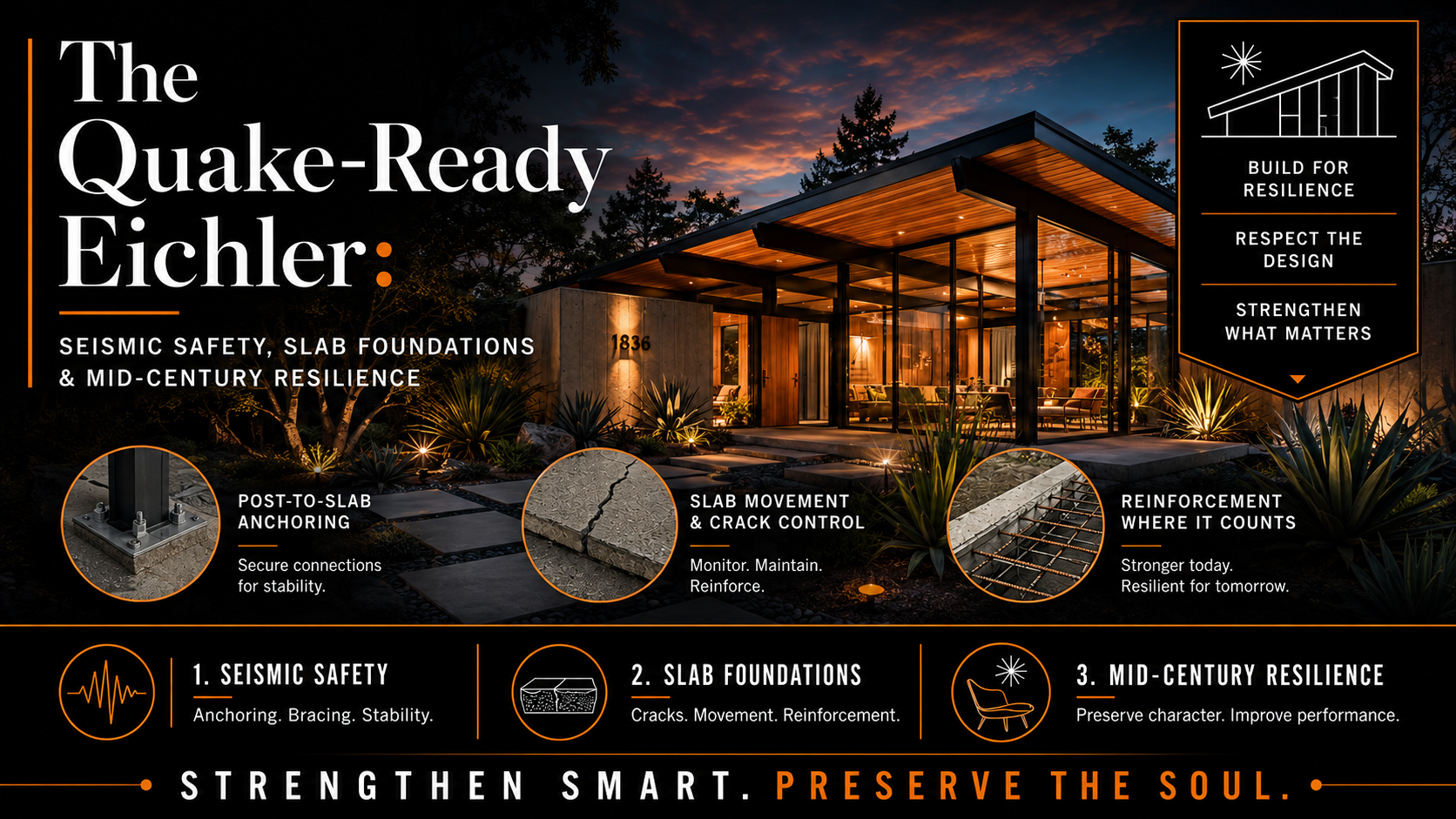
An Eichler on a quiet Bay Area morning can feel almost weightless.
Glass walls open to a private garden. Exposed beams stretch calmly across the ceiling. The atrium catches the first light of the day. A low roofline keeps the house grounded and horizontal. The floor plan flows without the formality of traditional rooms. The home feels light, open, and connected to nature.
That lightness is part of the magic.
But in the Bay Area, every homeowner also lives with another reality: earthquake country. The U.S. Geological Survey says the San Francisco Bay region has a 72% probability of at least one magnitude 6.7 or greater earthquake before 2043.
That does not mean Eichler owners should live in fear. It means they should live with awareness.
A quake-ready Eichler is not an Eichler that has been stripped of glass, beams, open space, or architectural grace. It is an Eichler that has been understood, inspected, documented, prepared, and maintained with seismic reality in mind.
The goal is simple:
Protect the people, protect the architecture, and protect the value of the home.
Why Seismic Readiness Belongs in Every Eichler Conversation
Most Eichler conversations begin with beauty: atriums, glass, rooflines, radiant heat, tongue-and-groove ceilings, indoor-outdoor flow, and the feeling of California modernism.
Seismic readiness is less romantic. But it is just as important.
For buyers, earthquake preparedness is part of due diligence. It affects inspections, insurance, repair budgets, long-term ownership, and confidence in the home.
For sellers, seismic readiness is part of presentation. A buyer who sees proper documentation, water heater bracing, permit records, and thoughtful maintenance feels more secure. A buyer who sees missing records, questionable remodels, unbraced equipment, or altered structural elements may hesitate.
For current owners, seismic readiness is part of stewardship. Eichlers are not just old houses. They are finite architectural assets. Preparing them for the future is part of preserving them.
Why Eichlers Need a Different Seismic Lens
Eichlers are not ordinary ranch homes. National Park Service documentation for San José Eichler tracts describes the homes as detached, one-story, open-plan residences with exposed post-and-beam construction, concrete slab foundations with radiant heating, low profiles, flat or minimal-pitch roofs, privacy-oriented street elevations, atriums or courtyards, clerestory windows, vertical-grooved siding, and floor-to-ceiling glass opening to private outdoor spaces.
Those features are exactly why buyers love Eichlers. They are also why seismic questions need to be handled carefully.
A typical earthquake-safety conversation might focus on raised foundations, crawlspaces, cripple walls, foundation bolting, and soft-story conditions. Some older California homes fit that pattern. Many Eichlers do not.
Many Eichlers are slab-on-grade homes. Many have exposed structural systems. Many use glass as a defining architectural element. Many have garage or carport configurations that are part of the original design. Many have been remodeled, expanded, converted, or altered over decades.
That means the right first step is not to assume a standard retrofit.
The right first step is to understand the actual house.
The Eichler Seismic Mindset
A quake-ready Eichler owner should think in four layers:
The structure: slab, beams, posts, roof, walls, openings, additions, and remodels.
The systems: water heater, gas lines, electrical, plumbing, solar, batteries, HVAC, and utility shutoffs.
The envelope: glass walls, sliders, skylights, doors, garage transitions, and roof penetrations.
The interior: furniture, artwork, shelving, appliances, storage, and emergency supplies.
This is where Eichler-specific guidance matters. The home’s strength, beauty, and risk profile are connected.
In an Eichler, the structure is also the design.
Slab Foundations: Why Common Retrofit Advice May Not Fit Every Eichler
Many California seismic-retrofit programs and public conversations focus on homes with raised foundations. The California Residential Mitigation Program describes its Earthquake Brace + Bolt retrofit as a way to strengthen raised-foundation, pre-1980 homes by bracing cripple walls and bolting the house to the foundation.
That is important — but it is not always directly applicable to a slab-on-grade Eichler.
The National Park Service documentation identifies concrete slab foundations with radiant heating as a character-defining Eichler feature in San José tracts. The practical implication is that a standard “brace and bolt” conversation may not be the right answer for many Eichlers because there may be no crawlspace or cripple wall to brace.
That does not mean a slab Eichler needs no seismic review. It means the review should be appropriate to the construction.
A qualified structural engineer or seismic specialist may evaluate:
Slab condition
Cracks or displacement
Signs of settlement
Additions or slab extensions
Connections between altered areas and the original structure
Beam and post continuity
Prior structural changes
Garage or carport modifications
Large openings added during remodels
Roof loads from solar, equipment, or additions
Drainage or soil conditions affecting the slab
For buyers, the key question is not “Has this home been brace-and-bolted?” The better question is:
What type of foundation does this Eichler have, and what seismic concerns are relevant to that structure?
Post-and-Beam Construction: Beauty, Structure, and Due Diligence
Post-and-beam construction is one of the signature Eichler features. Palo Alto’s Eichler design guidance describes Eichlers as identifiable by post-and-beam construction, striking roof forms with broad eaves, simple material palettes, internal courtyards, and full-height glazing that integrates interior and exterior space.
That structure creates the open plans buyers love. It also means posts, beams, and roof decking should be treated with respect.
During an inspection, buyers should pay attention to:
Exposed beams
Beam ends
Posts
Roof decking
Water staining
Pest damage
Dry rot or fungus damage
Cracks, checking, or notching
Altered openings
Removed posts or walls
Patio covers attached to structural members
Skylight openings
Solar or HVAC penetrations
Garage or carport changes
Atrium modifications
A stained beam may reflect an old roof leak that has been repaired. Or it may indicate an active moisture problem. A removed post may have been engineered properly. Or it may represent a structural concern. A garage conversion may be permitted and well done. Or it may be a red flag.
The point is not to assume the worst. The point is to ask the right questions.
Water Heater Bracing: A Small Detail Buyers Notice
Water heater bracing is one of the most practical and visible earthquake-safety items in a California home.
The California Seismic Safety Commission says new and replacement water heaters are required by law to be anchored or strapped to resist falling during earthquakes, and that home sellers must certify to buyers that water heaters are braced.
For Eichler buyers and sellers, this is a simple but important checklist item.
Ask:
Where is the water heater located?
Is it properly strapped or braced?
Are straps secured correctly?
Are flexible gas and water connections present where appropriate?
Is the water heater in a garage, utility closet, exterior closet, or interior space?
Is the installation permitted?
Is there documentation?
Does the inspection report call out bracing issues?
Has the water heater been replaced recently?
For sellers, this is an easy pre-listing item to verify. A missing or improper brace is not usually the biggest issue in an Eichler sale, but it can create unnecessary concern. For buyers, it is a useful indicator of how carefully the home has been maintained.
Small details can influence confidence.
Gas Lines, Utility Shutoffs, and Emergency Awareness
After a major earthquake, utility safety becomes important. An Eichler owner should know where the gas shutoff, water shutoff, electrical panel, and subpanels are located.
This is especially relevant for Eichlers because remodels may have moved, hidden, or added systems over time. A home may have original radiant heat equipment, a gas water heater, solar equipment, battery storage, an EV charger, mini-splits, or updated electrical panels.
A quake-ready homeowner should know:
Where the gas meter is
How to shut off gas safely when needed
Where the main water shutoff is
Where the main electrical panel is
Whether there are subpanels
Whether solar or battery systems have emergency shutoff procedures
Where water heater connections are
Whether flexible gas connectors are installed where appropriate
Whether emergency shutoff instructions are documented
For sellers, this information can be helpful to organize before listing. For buyers, it is part of learning how the home works.
Glass Walls and Sliding Doors: Living Safely With the Eichler Signature
Glass is part of the Eichler soul. Floor-to-ceiling glass, sliders, atrium walls, and rear façades are what make these homes feel open and alive. The National Park Service documentation identifies large expanses of glazing, clerestory windows, and sliding glass doors as character-defining features of Eichler housing.
Seismic planning should not treat glass as something to eliminate. It should treat glass as something to understand.
Buyers and owners should consider:
Are large glass panels original or replaced?
Are sliders functioning smoothly?
Are tracks secure and in good condition?
Are locks working?
Is tempered or safety glass present where required or expected?
Are large panes located near beds, seating areas, or play areas?
Are heavy objects placed near glass walls?
Are glass walls protected by thoughtful furniture placement?
Are replacement windows compatible with Eichler proportions?
Are atrium-facing sliders in good condition?
Are there cracks, loose frames, or water intrusion at thresholds?
Some owners may explore safety film, replacement glass, or selective upgrades, but those decisions should be made carefully. The best glass-related improvements preserve the transparency and proportions of the home.
An Eichler without glass loses part of its identity. A quake-ready Eichler respects the glass while reducing unnecessary risk.
Atriums and Courtyards: Open-Air Beauty, Seismic Practicality
The atrium is one of the most beloved Eichler features. It brings light, air, and sky into the heart of the house. It can also be a place where inspection, drainage, glass, structure, and safety come together.
A seismic-minded atrium review should include:
Atrium drainage
Paving condition
Trip hazards
Glass walls and sliders
Exterior lighting
Loose pots or heavy planters
Water features
Tall sculptures
Structural beams crossing atrium spaces
Evidence of altered beams or posts
Past atrium enclosure work
Roof drainage into or around the atrium
Plants touching siding or glass
A beautiful atrium should still be practical. Heavy planters that could move, fall, or block access may be worth repositioning. Tall sculptures or furniture near glass should be secured or relocated. Slippery paving, uneven concrete, or poor lighting may become more than aesthetic issues.
The best atriums are serene, intentional, and safe.
Roofs, Skylights, Solar, and Seismic Questions
Eichler roofs deserve attention in almost every due diligence conversation. They are important for insurance, drainage, energy upgrades, and now seismic awareness.
A roof may include:
Flat or low-slope roofing
Broad gable forms
Tongue-and-groove roof decking
Exposed beams
Deep overhangs
Skylights
Solar panels
HVAC equipment
Vents
Drainage systems
Past patches or penetrations
The National Park Service documentation identifies flat or broad gable roof forms, tongue-and-groove roof structure, deep overhanging eaves, and exposed beams as character-defining Eichler features.
From a seismic and structural standpoint, buyers should ask:
Has the roof structure been altered?
Were skylights added?
Were openings engineered?
Is solar installed?
Was solar permitted?
Does solar add load or create access issues?
Is roof-mounted equipment properly secured?
Are roof penetrations documented?
Are there signs of sagging or movement?
Is there water damage to beams or decking?
Is the roof near the end of its useful life?
For sellers, roof and solar documentation can reduce uncertainty. For buyers, the roof should be understood as both a system and an architectural element.
Remodels, Additions, and Seismic Red Flags
Many Eichlers have been altered over time. Some remodels are beautifully designed, properly permitted, and structurally thoughtful. Others may be less clear.
Seismic questions become especially important when a remodel has changed the original structure.
Potential red flags include:
Removed posts
Cut beams
Large new openings
Atrium enclosures
Garage or carport conversions
Additions that changed roof loads
Second-story additions
Unpermitted structural work
Skylights added without documentation
Solar or HVAC equipment added without clear records
Foundation or slab modifications
Wall removals
Patio covers attached to structural members
Fireplaces or chimneys altered without documentation
An unpermitted remodel is not automatically a deal-breaker. But it should be understood. Buyers should know what was done, whether it was inspected, whether it was engineered, and how it affects the home’s structure and value.
For sellers, permit records are powerful. They turn uncertainty into information.
The Garage and Carport Question
Garages and carports are often part of the Eichler street presence. They are not merely functional. They help define the façade, entry sequence, storage, utility zones, and sometimes structural rhythm.
A seismic review should consider:
Garage framing
Carport posts
Beam continuity
Converted garages
Added doors or openings
Storage loads
Tall shelving
Water heater location
Mechanical equipment
Battery or solar equipment
EV charger installation
Separation between garage and living areas
Garages are also where many homeowners store heavy items. Ready.gov recommends storing heavy and breakable objects on low shelves and considering improvements to address structural issues that could cause damage during an earthquake.
For Eichler owners, garage organization is part of earthquake readiness. Tall shelves should be secured. Heavy tools should be low. Chemical storage should be controlled. Access to utility shutoffs should be clear.
A beautiful Eichler can still have a dangerously disorganized garage. That is fixable.
Securing the Interior Without Ruining the Eichler Look
One of the best earthquake-safety improvements is also one of the most invisible: securing the things inside the home.
Ready.gov recommends storing heavy and breakable objects on low shelves and considering improvements that fix structural issues. For Eichler owners, this can be done without cluttering the home or compromising the design.
Interior safety ideas include:
Anchor tall bookcases discreetly
Keep heavy ceramics low
Use museum putty for small objects
Avoid heavy artwork above beds
Secure televisions
Use closed-loop hanging hardware for heavier art
Keep tall storage out of glass-heavy pathways
Avoid placing heavy furniture where it could fall into sliders
Secure garage shelving
Keep emergency supplies accessible
Place flashlights near beds
Avoid cluttering atrium exits or hallways
Eichler interiors are often open and minimal. That makes safety easier in some ways. The goal is not to add visual noise. The goal is to make the home safer quietly.
The best earthquake preparation is often invisible.
Earthquake Insurance: What Eichler Buyers Should Know
A standard homeowners policy is not the same as earthquake insurance. The California Department of Insurance states that homeowners, renters, and condominium insurance policies do not cover damage from natural disasters such as earthquakes, floods, and landslides, and that earthquake insurance can help pay for some earthquake-related losses.
For Eichler buyers, this should be part of the early ownership conversation.
Questions to ask:
Is earthquake insurance available?
What is the premium?
What is the deductible?
What is covered?
What is excluded?
Is loss-of-use coverage included?
Does the policy cover personal property?
Are there retrofit-related premium considerations?
Does the home’s foundation type affect underwriting or pricing?
Does the carrier need documentation?
Is the home’s replacement cost properly understood?
The California Earthquake Authority says homeowners with certain properly retrofitted foundation types may qualify for a premium discount of up to 25% on a CEA earthquake policy. That does not mean every Eichler will qualify automatically. Foundation type, retrofit details, documentation, and policy requirements matter.
Insurance does not make a home safer, but it can affect how an owner recovers.
What Sellers Should Document Before Listing
A quake-ready seller does not need to promise perfection. The goal is to reduce uncertainty.
Before listing an Eichler, sellers should gather:
Water heater bracing information
Water heater installation records
Structural engineer reports, if any
Seismic retrofit documentation, if any
Foundation or slab repair records
Roof repair or replacement records
Beam repair records
Pest repair records involving structural wood
Permit records for additions or remodels
Garage or carport conversion documentation
Atrium enclosure permits, if applicable
Solar installation records
Battery installation records
EV charger permits
HVAC or mini-split permits
Skylight installation records
Glass replacement records
Fireplace or chimney inspection, if applicable
Gas shutoff or automatic shutoff valve information, if applicable
Prior earthquake-related insurance claims, if relevant and disclosable
General inspection reports
Pest reports
Roof reports
Sewer and utility records
This documentation helps buyers understand what they are buying. It also helps the listing story feel more professional and trustworthy.
What Buyers Should Ask Before Removing Contingencies
A buyer should not treat seismic readiness as a single yes-or-no question. It is a set of observations.
Before removing contingencies, buyers should ask:
Is the home slab-on-grade or raised foundation?
Are there signs of slab movement?
Are beams and posts intact?
Were structural changes made?
Are permits available?
Was the atrium altered?
Was a garage or carport converted?
Were large openings added?
Are skylights original or added?
Is solar installed and documented?
Is roof-mounted equipment secured?
Is the water heater braced?
Are utility shutoffs accessible?
Are gas and water connections secure?
Are large glass panels in good condition?
Are sliders functioning properly?
Are there obvious interior hazards?
Would a structural engineer review be appropriate?
Does earthquake insurance make sense for this property?
What would the first 12 months of seismic preparation look like?
A good buyer does not need every answer before falling in love with an Eichler. But before closing, the buyer should understand the home’s structure, systems, and risk profile.
When to Call a Structural Engineer
Not every Eichler needs a structural engineer during escrow. But certain conditions justify a closer look.
Consider a structural review when there are:
Removed posts or beams
Large unverified openings
Sagging roof planes
Significant slab cracks or displacement
Evidence of settlement
Unpermitted additions
Atrium enclosures
Garage or carport conversions
Second-story additions
Major roof modifications
Significant water or pest damage to structural members
Retaining walls or slope concerns
Major remodels with unclear documentation
A structural engineer can help separate cosmetic concerns from meaningful structural issues. That clarity can be valuable for both buyers and sellers.
The Earthquake-Ready Eichler Maintenance Plan
Seismic readiness is not only about one retrofit or one inspection. It is an ongoing maintenance plan.
A practical annual review might include:
Check water heater straps
Review gas and water shutoff access
Confirm emergency supplies are current
Secure tall furniture
Inspect garage shelving
Check roof drainage
Review skylights and roof penetrations
Clear debris from roof and gutters
Inspect exterior siding and beam ends
Review cracks or movement in slab or hardscape
Check sliders and locks
Update home inventory for insurance
Review earthquake insurance options
Keep permit and repair records organized
This is not about making the home feel fragile. It is about keeping it resilient.
How Seismic Readiness Can Affect Resale Value
Seismic preparation may not always create a line-item dollar-for-dollar value increase. But it can strongly influence buyer confidence.
A buyer may not say, “I am paying more because the water heater is braced.”
But they may say:
“This home feels well maintained.”
“The seller has great records.”
“The remodels appear thoughtful.”
“The systems are documented.”
“The inspection package gives me confidence.”
“I understand what I need to do next.”
That confidence matters.
For Eichlers, confidence is especially important because buyers already know these homes require specialized ownership. A well-documented home feels like an opportunity. A poorly documented home can feel like a risk.
Seismic readiness supports value by reducing uncertainty.
The Preservation Question: How to Strengthen Without Overbuilding
One of the biggest concerns Eichler owners have is that safety upgrades might compromise the architecture.
That concern is valid. Eichlers can be damaged by clumsy improvements. A heavy-handed retrofit, exposed conduit, bulky equipment, poorly placed hardware, or generic remodel can weaken the home’s visual clarity.
The best improvements are:
Properly engineered
Quietly integrated
Well documented
Compatible with original materials
Respectful of exposed beams and rooflines
Sensitive to glass and atrium relationships
Minimal in visual impact
Clear in purpose
The goal is not to make an Eichler look like a fortress.
The goal is to make it more resilient while preserving the feeling of lightness.
A Narrative Example: Two Similar Eichlers, Two Different Buyer Reactions
Imagine two Eichlers in the same neighborhood.
Both have glass walls, atriums, exposed beams, and similar square footage.
The first has a disclosure package with roof records, water heater bracing documentation, permit history for the kitchen remodel, solar installation records, a pest report, and a note that a structural engineer reviewed a prior beam repair. The garage is clean, utility shutoffs are easy to locate, tall shelving is secured, and the atrium is staged simply.
The second has a beautiful living room but no roof records, no radiant heat documentation, a converted garage with unclear permits, an unbraced water heater noted in the inspection, a skylight added without paperwork, and heavy storage stacked high in the garage.
Both homes may be desirable.
But buyers will likely experience them differently.
The first home tells a story of stewardship. The second tells a story of unanswered questions.
That difference can affect offers, contingencies, negotiations, and buyer confidence.
The Quake-Ready Eichler Seller Checklist
Before listing, sellers should review:
Water heater bracing
Gas and water shutoff access
Electrical panel accessibility
Roof records
Skylight records
Solar and battery documentation
EV charger permits
Garage or carport changes
Atrium changes
Remodel permits
Structural reports
Pest reports
Beam repair records
Slab or foundation repair records
Drainage records
Insurance claim history, if relevant and disclosable
Emergency-access areas
Garage shelving and storage
Interior furniture hazards
Heavy artwork or shelving near beds and glass
Disclosure clarity
The seller’s goal is not to make the home flawless. The goal is to make the home understandable.
The Quake-Ready Eichler Buyer Checklist
Before buying, buyers should review:
Foundation type
Slab condition
Post-and-beam condition
Roof structure
Water heater bracing
Gas and water shutoffs
Utility connections
Glass-wall condition
Slider function
Atrium safety
Garage storage and equipment
Remodel permits
Addition permits
Solar and battery permits
Roof-mounted equipment
Structural reports, if any
Pest or wood-damage reports
Drainage conditions
Earthquake insurance options
First-year safety improvements
The buyer’s goal is not to eliminate all risk. That is impossible in any home. The goal is to understand the risk and plan intelligently.
Work With Eichler Real Estate Experts
Eichler homes require a different kind of representation. These are not ordinary Bay Area properties. They are architecturally significant mid-century modern homes where structure, design, systems, inspections, disclosures, and buyer psychology all intersect.
That is where Eric and Janelle Boyenga of the Boyenga Team at Compass bring specialized value.
EichlerHomesForSale.com identifies Eric and Janelle Boyenga with Compass as Eichler experts and provides direct Eichler contact information for buyers and sellers. Their Eichler buying services emphasize architectural authenticity assessments, helping clients understand original Eichler elements, modifications, historic value, and potential restorative needs. The Boyenga Team’s Compass Concierge page also describes pre-sale preparation work such as decluttering, painting, light construction, and staging to help highlight a property’s full potential.
For Eichler sellers, Eric and Janelle help prepare the story behind the home: roof records, radiant heat documentation, water heater bracing, remodel permits, inspection strategy, atrium presentation, architectural features, and buyer-sensitive disclosures. For buyers, they help evaluate what matters: whether the beams and posts are intact, whether remodels are documented, whether the slab and roof raise questions, whether an expert inspection is needed, and whether the home still preserves the qualities that make Eichlers special.
The right Eichler representation is not just about negotiating price.
It is about protecting confidence, architecture, and long-term value.
FAQ: Quake-Ready Eichlers
Are Eichlers unsafe in earthquakes?
Not automatically. Eichlers, like all homes in earthquake country, should be evaluated based on their actual structure, condition, maintenance, remodel history, foundation type, and systems. A slab-on-grade Eichler with well-documented maintenance may require a different analysis than a raised-foundation home or a heavily altered property.
Do Eichlers need Earthquake Brace + Bolt retrofits?
Some homes may qualify for brace-and-bolt programs, but many Eichlers have slab-on-grade foundations rather than raised foundations with crawlspaces and cripple walls. CRMP describes the EBB retrofit as bracing cripple walls and bolting raised-foundation pre-1980 homes to the foundation. Eichler owners should start by confirming the foundation type and consulting qualified professionals.
Is water heater bracing required in California?
California’s Seismic Safety Commission says new and replacement water heaters must be anchored or strapped to resist falling during earthquakes, and sellers must certify to buyers that water heaters are braced.
Should Eichler buyers get a structural engineer?
A structural engineer may be appropriate if the home has significant slab cracks, altered beams, removed posts, major additions, garage conversions, atrium enclosures, roof sagging, or unpermitted structural changes.
Does homeowners insurance cover earthquake damage?
The California Department of Insurance states that homeowners, renters, and condominium policies do not cover damage from natural disasters such as earthquakes, floods, and landslides; earthquake insurance is separate coverage that can help pay for some earthquake-related losses.
Can seismic upgrades hurt Eichler character?
Poorly planned upgrades can be visually intrusive. Thoughtful, engineered, well-documented improvements can support safety and value while preserving the home’s mid-century modern design.
What should sellers do before listing?
Sellers should gather documentation, verify water heater bracing, organize permits, review structural or remodel records, prepare inspections, clean up utility access, secure obvious interior hazards, and present the home with clarity.
What should buyers look for?
Buyers should review foundation type, slab condition, beams and posts, roof structure, glass walls, water heater bracing, utility shutoffs, remodel permits, garage/carport changes, earthquake insurance options, and whether specialist inspections are needed.
Call to Action
Thinking of buying or selling an Eichler? Work with Eric and Janelle Boyenga of the Boyenga Team at Compass — Eichler real estate experts who understand the architecture, inspection details, seismic questions, disclosures, and buyer concerns that shape today’s Eichler market.
Whether you are reviewing a slab foundation, water heater bracing, post-and-beam structure, glass walls, remodel permits, or earthquake insurance options, the Boyenga Team helps clients make informed decisions while preserving the mid-century modern soul of the home.
This article is for general educational purposes only and should not be treated as legal, insurance, engineering, construction, tax, appraisal, inspection, or seismic-retrofit advice. Earthquake risk, structural conditions, insurance eligibility, retrofit options, permitting requirements, and disclosure obligations vary by property and jurisdiction. Eichler buyers, sellers, and homeowners should consult qualified structural engineers, licensed contractors, inspectors, insurance professionals, local agencies, and real estate advisors before making property-specific decisions.