
The Eichler Appraisal Gap: Why Ordinary Comps Can Miss Mid-Century Modern Value
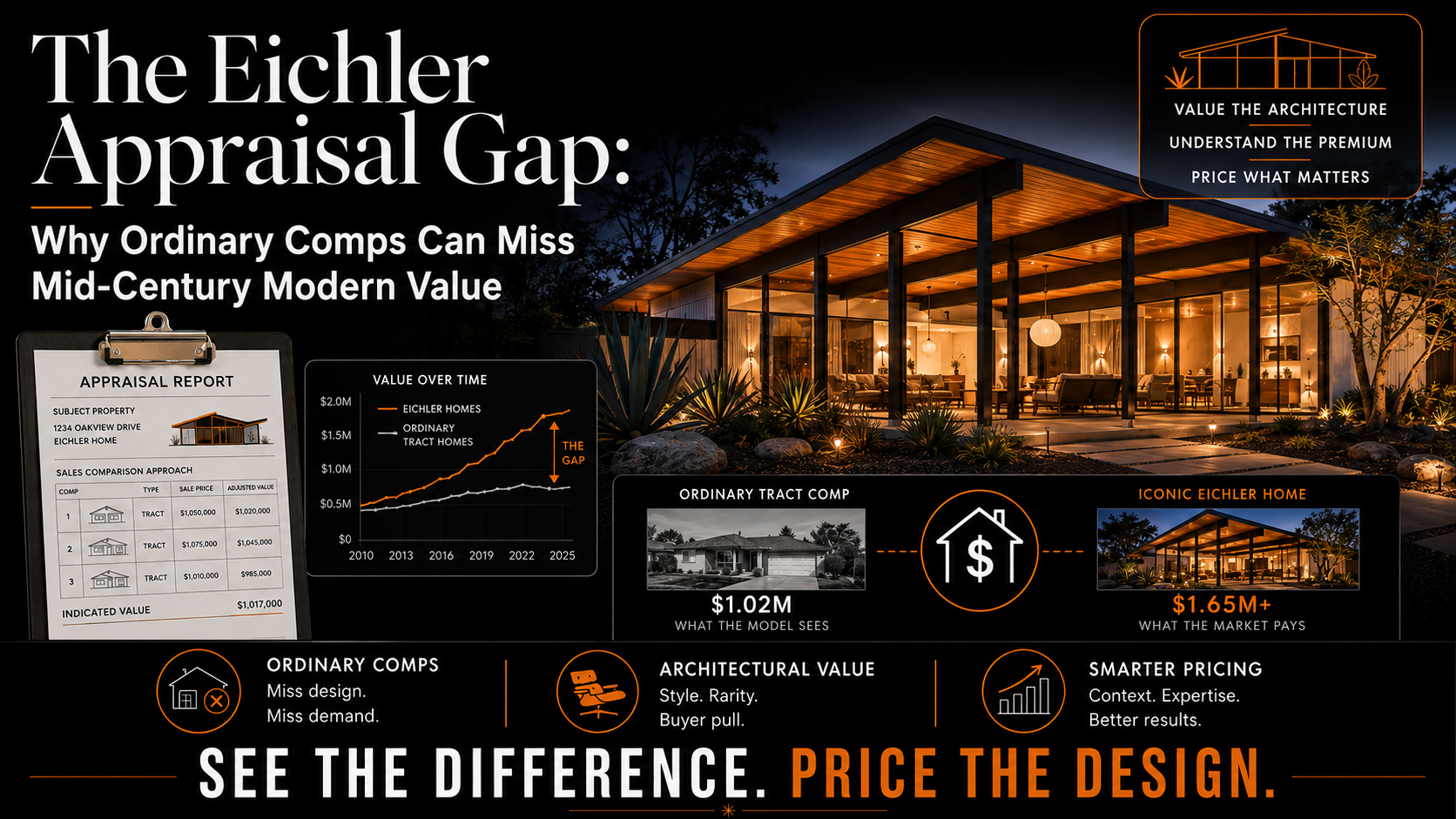
Two homes can sit on the same street, in the same school district, with the same bedroom count and nearly identical square footage.
One may be a conventional ranch home.
The other may be an Eichler.
On paper, they may look similar. In the market, they may not be similar at all.
That is where Eichler valuation gets interesting — and sometimes complicated. Eichlers are not valued only by square footage, lot size, bedroom count, and recent nearby sales. Those factors matter, of course. But an Eichler also carries architectural value: exposed post-and-beam construction, tongue-and-groove ceilings, radiant-heated slabs, floor-to-ceiling glass, atriums, clerestory windows, low rooflines, privacy-focused front elevations, and indoor-outdoor living.
National Park Service documentation for San José Eichler tracts describes these homes as one-story, open-plan houses with exposed post-and-beam construction, concrete slab foundations with radiant heat, flat or minimal-pitch roofs, privacy-oriented street elevations, atriums or courts, clerestory windows, vertical-grooved siding, and glass-oriented indoor-outdoor relationships.
Those features are not decorative extras. They are the reason buyers seek Eichlers out in the first place.
That creates a challenge: what happens when the closest comparable sale is not truly comparable?
For Eichler sellers, this can affect pricing strategy, offer review, appraisal preparation, and negotiation. For buyers, it can affect financing, appraisal contingencies, perceived value, and long-term confidence. For agents, it requires the ability to explain why an Eichler should not always be judged like a generic suburban home.
The nearest comp is not always the best comp — especially when the subject property is an Eichler.
Why Eichler Valuation Is Different
Traditional real estate valuation often begins with the familiar basics: location, square footage, lot size, bedroom count, bathroom count, condition, recent sales, and market timing. Those elements are still important in an Eichler sale.
But Eichler value has another layer.
An Eichler’s worth is shaped by how well the property still expresses the architecture buyers came to find. A home with intact beams, original ceilings, preserved atrium, strong indoor-outdoor flow, and tasteful updates may generate a different buyer response than a similar-sized home where those details have been removed or obscured.
This is the heart of Eichler valuation:
Eichler value is emotional, architectural, and practical at the same time.
The emotional layer is the feeling buyers get when they walk through the door: light, calm, openness, privacy, connection to the garden, and the sense of living inside California modernism.
The architectural layer is the integrity of the design: beams, glass, rooflines, atriums, clerestories, siding, proportions, and restraint.
The practical layer is the condition and documentation: roof records, radiant heat status, electrical upgrades, plumbing, permits, drainage, pest reports, remodel quality, and insurance-sensitive details.
A standard price-per-square-foot approach may miss all three.
What Appraisers Look For — and Why It Matters
Appraisers are not simply guessing. In a financed purchase, the appraisal is part of the lender’s risk review. Fannie Mae’s comparable-sales guidance says comparable sales should have similar physical and legal characteristics to the subject property, including site, room count, finished area, style, and condition. It also says the appraiser is responsible for selecting the best and most appropriate comparable sales and accounting for all factors that affect value.
That language is important for Eichlers because style and condition matter. A nearby non-Eichler ranch may provide useful neighborhood context, but it may not appeal to the same buyer pool in the same way. A heavily altered Eichler may not be equivalent to a carefully preserved one. A remodeled home may not be more valuable if the remodel erased the character that Eichler buyers value.
Fannie Mae also notes that comparable sales do not need to be identical; they should be competitive and appeal to the same market participants. If similar comparable sales are not available, the appraiser may need to expand the market-area search or use less-than-perfect comps with adequate explanation.
That is where Eichler expertise becomes valuable. A strong Eichler valuation should not simply pull the three closest sales. It should ask: Which sales would the same buyers have considered?
The Problem With Ordinary Comps
The closest sale is not always the most meaningful sale.
Imagine an Eichler in Sunnyvale with an intact atrium, original tongue-and-groove ceilings, restored mahogany paneling, updated electrical, documented radiant heat, and a newer low-slope roof. The house is modest in size, but architecturally strong.
Now imagine a nearby conventional ranch home with similar square footage, similar bedroom count, and a recent sale date. On a spreadsheet, it may look like a good comp. In real life, it may not capture the same buyer demand.
Eichler buyers are often looking for something specific. They may search by architecture first and neighborhood second. They may compare homes across Eichler tracts. They may value originality, restoration quality, or sensitive modernization more than a generic luxury remodel.
Ordinary comps can miss:
Architectural authenticity
Atrium value
Original ceiling and beam value
Glass-wall integrity
Indoor-outdoor flow
Eichler neighborhood identity
Design-sensitive remodel quality
Buyer willingness to pay for preserved character
Roof and radiant heat documentation
Emotional appeal in a limited-supply category
A conventional comp can help establish baseline neighborhood value. It does not always explain Eichler market value.
The Three Layers of Eichler Value
A strong Eichler pricing strategy should consider three layers: the market layer, the property layer, and the architecture layer.
1. The Market Layer
This is the traditional real estate analysis. It includes recent sales, active listings, pending sales, buyer demand, interest rates, inventory, neighborhood trends, school district, lot size, commute access, and timing.
For Eichlers, the market layer should include both immediate neighborhood sales and relevant Eichler sales in competing neighborhoods. In some cases, the best indicator may be a recent Eichler sale outside the immediate tract rather than a non-Eichler sale next door.
2. The Property Layer
This is the condition and systems analysis. It includes the roof, radiant heat, slab, electrical, plumbing, sewer, drainage, pest condition, permits, landscaping, glass, remodel quality, and inspection results.
A beautiful Eichler with a failing roof, unclear radiant heat, or undocumented remodel work may not command the same premium as one with strong architectural features and strong documentation.
3. The Architecture Layer
This is the Eichler-specific layer. It includes what buyers came for: beams, ceilings, atrium, glass walls, clerestories, low roofline, privacy, original materials, indoor-outdoor flow, and a design language that still feels intact.
This layer is harder to quantify, but it can be the difference between a home that sells like an ordinary property and one that inspires competitive demand.
Price Per Square Foot Can Be Misleading
Price per square foot is easy to understand, which is why people use it. But it can be misleading for Eichlers.
A smaller Eichler with exceptional originality, strong updates, and a beautiful atrium may sell for more per square foot than a larger, heavily altered home. A home with preserved ceilings and beams may generate more enthusiasm than a larger home with generic drywall finishes. A clean, well-documented roof and radiant system may matter more than a few extra square feet.
Price per square foot does not measure:
Quality of light
Architectural integrity
Atrium experience
Restoration quality
Buyer emotion
Privacy
Indoor-outdoor flow
Original materials
Roof confidence
Remodel sensitivity
Neighborhood Eichler identity
That does not mean price per square foot is useless. It can be a reference point. But for Eichlers, it should not be the strategy.
The better question is:
What would an informed Eichler buyer pay for this specific home, in this condition, with this architecture, in this market?
What Eichler Buyers Actually Pay For
Eichler buyers tend to value a mix of originality, thoughtful updates, and ownership confidence. Many buyers are willing to pay for homes that preserve the mid-century modern soul while solving practical ownership concerns.
Features that often strengthen Eichler value include:
Exposed Beams and Tongue-and-Groove Ceilings
These are among the most recognizable Eichler elements. They create warmth, rhythm, and visual continuity. Covering them, boxing them in, or replacing them with generic drywall can reduce the home’s architectural appeal.
Atriums and Courtyards
An intact atrium can be a major emotional driver. It shapes the entry sequence, brings light into the home, and reinforces privacy. A neglected atrium can be revived; a removed or poorly enclosed atrium is harder to explain.
Floor-to-Ceiling Glass
Glass walls are central to the Eichler experience. They make the garden part of the living space and create the indoor-outdoor lifestyle buyers expect.
Clerestory Windows
Clerestories add daylight while preserving privacy. They are small features with large impact.
Radiant Heat
Working or well-documented radiant heat can be part of the Eichler appeal. If it has been replaced or abandoned, buyers need a clear explanation and a strong alternative comfort strategy.
Low Rooflines
The roofline is part of the identity. A roof that is well maintained, properly documented, and visually consistent helps protect both value and buyer confidence.
Original or Restored Materials
Wood paneling, vertical siding, globe lights, built-ins, and period-sensitive details can all support value when they are in good condition and presented well.
Design-Sensitive Modernization
Buyers often appreciate updated kitchens, bathrooms, electrical systems, plumbing, solar, heat pumps, and landscaping — as long as those updates do not make the home feel generic.
Privacy and Landscape Design
Eichlers depend on privacy. A strong landscape, atrium, fence, and garden plan can increase the emotional and practical value of the home.
Original vs. Remodeled: Which Is Worth More?
This is one of the most common Eichler valuation questions.
The answer is: it depends on the remodel.
A thoughtfully remodeled Eichler can be extremely valuable. Buyers often appreciate modern kitchens, updated bathrooms, improved lighting, electrical upgrades, roof improvements, heat pumps, solar, and water-wise landscaping. But the remodel has to respect the architecture.
A remodel adds value when it makes the home easier to live in without making it less Eichler.
A remodel can hurt value when it:
Covers original ceilings
Boxes in beams
Removes or encloses the atrium poorly
Replaces vertical siding with incompatible materials
Blocks clerestory windows
Adds heavy traditional trim
Uses generic luxury finishes
Removes glass-wall transparency
Creates chopped-up floor plans
Installs visually intrusive HVAC equipment
Ignores the low roofline
Fails to document permits and work
An original Eichler in need of updates may still attract strong interest if the bones are intact. A remodeled Eichler may command a premium if the work is sensitive, permitted, and well documented. A heavily altered Eichler may sell well to some buyers, but it may lose the passionate Eichler audience.
This is why “remodeled” does not automatically mean “more valuable.”
The Eichler Premium: Real, But Not Automatic
There is often a market premium for well-presented Eichlers because supply is limited and buyer passion can be intense. But the Eichler premium is not automatic.
The premium is strongest when the home has:
Preserved character-defining features
A desirable Eichler neighborhood or tract
Strong indoor-outdoor flow
Intact atrium or courtyard design
Updated systems with permits
Roof documentation
Radiant heat documentation or a clear replacement strategy
Sensitive remodels
Good inspections
Privacy landscaping
High-quality photography and marketing
A compelling architectural story
The premium weakens when the home has:
Poor roof condition
Unknown roof age
Unclear radiant heat status
Active water intrusion
Poor drainage
Pest or fungus damage
Unpermitted additions
Incompatible remodels
Removed atriums
Covered ceilings
Generic finishes
Weak presentation
Lack of documentation
Eichler value is not just about being an Eichler. It is about being an Eichler that buyers can understand, trust, and emotionally connect with.
Appraisal Gaps: Why They Can Happen
An appraisal gap occurs when the appraised value comes in below the contract price. This can happen with many types of homes, but unique architectural properties can be more vulnerable when there are limited truly comparable sales.
Fannie Mae requires at least three closed comparable sales in the sales comparison approach, with additional comparable sales allowed as support. It also states that the best and most appropriate comparable sales may not always be the most recent sales.
That matters for Eichlers because the best comparable might not be the house down the street that sold last month. It might be an Eichler sale in a nearby tract from six months ago. Or it might be a carefully selected set of sales that includes one close neighborhood sale, one similar Eichler sale, and one sale showing buyer demand for architecturally significant mid-century modern homes.
A gap can happen when:
There are few recent Eichler sales
The appraiser relies heavily on non-Eichler comps
A unique restoration is hard to quantify
The home has an unusually strong buyer response
The market moved quickly after the last comparable sale
The property has features that are valuable to buyers but hard to adjust
The listing agent did not organize supporting documentation
The buyer offered based on scarcity and emotion, while the appraisal relies on closed data
An appraisal gap does not always mean the buyer overpaid. It means the appraised value did not match the contract price under that appraisal’s analysis.
Appraisal Independence: Support the Value Story the Right Way
A value packet can help explain an Eichler, but it must be handled appropriately. Appraiser independence rules are designed to protect the objectivity of the appraisal process. Fannie Mae’s Appraiser Independence Requirements state that no person may influence or attempt to influence the development, reporting, result, or review of an appraisal through coercion, inducement, intimidation, bribery, or similar conduct. The same guidance allows a party to request additional information or correction of factual errors, but not to improperly pressure an appraiser.
That is an important distinction.
The goal is not to pressure the appraiser.
The goal is to provide accurate, relevant, well-organized information that helps the property be understood.
Appropriate information may include:
Accurate square footage information
Permit records
Roof documentation
System updates
Comparable sales
Architectural feature summary
Inspection reports
Improvements list
Renovation documentation
Eichler-specific market context
Neighborhood context
Clarification of factual errors, if any
The strongest strategy is professional, factual, and respectful.
Seller Strategy: Build an Eichler Value Packet
For sellers, one of the best ways to protect value is to prepare a clear, organized Eichler value packet before going to market.
This packet is not just for buyers. It can help buyer agents understand the home, help buyers feel confident, help lenders and appraisers see relevant facts, and help reduce uncertainty during escrow.
A strong Eichler value packet may include:
1. Eichler-Specific Comparable Sales
Include nearby Eichler sales and relevant Eichler sales in competing neighborhoods. Explain why they are comparable: architecture, condition, lot, tract, upgrades, preservation, roof, atrium, remodel quality, or buyer appeal.
2. Neighborhood Sales for Context
Non-Eichler sales can still matter. They help establish local land value, school-district demand, and neighborhood pricing. But they should be framed as context, not the entire story.
3. Architectural Feature Summary
List the home’s Eichler features:
Atrium or courtyard
Exposed beams
Tongue-and-groove ceilings
Floor-to-ceiling glass
Clerestory windows
Radiant heat
Original siding
Preserved roofline
Original built-ins
Indoor-outdoor flow
Privacy landscaping
Period-sensitive restoration details
4. Improvements List
Document upgrades clearly:
Roof replacement or repairs
Electrical panel upgrade
Plumbing improvements
Sewer work
Radiant heat service
Boiler replacement
Kitchen remodel
Bathroom remodel
Flooring
Solar
Battery
EV charger
Heat pumps or mini-splits
Landscaping
Drainage improvements
Pest repairs
5. Permits and Final Records
Fannie Mae guidance on additions without required permits says that if an appraiser identifies an unpermitted addition, the appraiser must comment on the quality and appearance of the work and its impact, if any, on market value.
For Eichler sellers, that makes permit documentation important. If work was permitted and finaled, show it. If some work was older or undocumented, be prepared to disclose and explain what is known.
6. Roof and Radiant Heat Documentation
These two items are especially important for Eichlers. Buyers often ask about them immediately. A seller with roof records and radiant heat records creates more confidence than a seller who says, “We think it’s fine.”
7. Professional Photography and Floor Plan
Eichlers are visual homes. The marketing should show the architecture clearly: the atrium, beams, glass, light, ceiling planes, garden views, and indoor-outdoor connections.
8. Pre-Listing Inspection Reports
A pre-listing inspection package can help buyers and appraisers understand the home’s condition. It can also reduce anxiety and make offers stronger.
9. Historic or Design Context, if Relevant
Some Eichler neighborhoods have preservation or design considerations. The City of San José notes that its Eichler Neighborhood Objective Design Standards were created to guide exterior changes and maintain historic character, and currently apply to properties in the Fairglen Additions historic district listed in the San José Historic Resources Inventory.
If a property is in a historically significant tract or subject to design standards, that context should be handled accurately and carefully.
Buyer Strategy: How to Evaluate Eichler Value
Buyers should not rely only on price per square foot. The right question is whether the price reflects the home’s true architectural, physical, and market position.
Before writing an offer, buyers should ask:
Is this a true Eichler or an Eichler-style home?
How much original character remains?
Are the beams exposed?
Are tongue-and-groove ceilings intact?
Is the atrium preserved?
Are the glass walls and clerestories intact?
Has the roof been documented?
Is radiant heat working, repaired, or abandoned?
Were remodels permitted?
Does the kitchen support or fight the architecture?
Are bathrooms updated sensitively?
Is the landscape private and intentional?
Are there pest, drainage, or slab concerns?
How does this home compare with recent Eichler sales?
How does it compare with non-Eichler neighborhood sales?
Is the price based on scarcity, condition, design integrity, or all three?
Could there be an appraisal issue?
If there is an appraisal gap, what is my strategy?
A strong offer is not just aggressive. It is informed.
Why Architecture Belongs in the Pricing Conversation
Some homes are primarily valued as utility: location, size, bedrooms, condition.
Eichlers have utility, but they also have identity.
The architecture affects demand. The design creates an emotional response. The lifestyle has a following. The rarity matters. The neighborhood context matters. The preservation quality matters.
That does not mean every Eichler should be priced above every non-Eichler. It means the pricing conversation should recognize that Eichler buyers are responding to more than square footage.
The architecture belongs in the pricing conversation because the architecture is part of the product.
A glass wall is not just a window.
An atrium is not just a patio.
A beam is not just a structural member.
A radiant slab is not just a heating system.
A preserved Eichler is not just an old house. It is a piece of California modernism that people still want to live in.
Pricing Mistakes Eichler Sellers Make
Mistake 1: Pricing Only by Square Footage
Square footage can be useful, but it does not capture originality, architecture, light, privacy, or buyer emotion.
Mistake 2: Comparing Only to Generic Ranch Homes
Nearby ranch homes may be relevant, but they may not reflect Eichler-specific demand.
Mistake 3: Assuming Every Remodel Adds Value
A costly remodel can hurt if it erases the Eichler character. Design-sensitive modernization matters more than generic newness.
Mistake 4: Underpricing Original Features
Some sellers underestimate the value of original ceilings, beams, paneling, atriums, and glass walls. Buyers may see those as irreplaceable.
Mistake 5: Overpricing Deferred Maintenance
An Eichler premium is harder to defend if the roof is uncertain, radiant heat is undocumented, drainage is poor, or pest issues are significant.
Mistake 6: Ignoring Documentation
A seller may know the roof was replaced or the radiant heat was serviced, but buyers need proof. Documentation turns claims into confidence.
Mistake 7: Weak Architectural Marketing
Eichlers need to be marketed as architecture, not just as inventory. Poor photography, generic copy, and cluttered staging can leave value on the table.
Pricing Mistakes Eichler Buyers Make
Mistake 1: Treating All Eichlers as Equal
An original, preserved, well-documented Eichler may be very different from a heavily altered one.
Mistake 2: Overvaluing Generic Remodels
New finishes are not always better. Buyers should evaluate whether the remodel fits the architecture.
Mistake 3: Undervaluing Originality
A home that needs updates but has intact architecture may have long-term potential that a stripped remodel does not.
Mistake 4: Forgetting Systems
Roof, radiant heat, electrical, plumbing, drainage, and pest condition all affect value.
Mistake 5: Ignoring Appraisal Risk
If financing is involved, buyers should understand whether the contract price is well supported by closed sales.
Mistake 6: Focusing Only on the House, Not the Tract
Eichler neighborhood identity, privacy, streetscape, and community can influence value.
The Role of Presentation in Eichler Value
Presentation matters in all real estate, but it matters especially with Eichlers because the architecture depends on clarity.
A cluttered Eichler can feel small.
A dark Eichler can feel tired.
A poorly staged atrium can feel like wasted space.
A neglected garden can weaken indoor-outdoor flow.
A generic furniture plan can hide the architecture.
A thoughtfully prepared Eichler does the opposite. It lets buyers feel the structure, light, rhythm, and connection to the outdoors.
Strong presentation includes:
Clean atrium staging
Minimal, warm, modern furniture
Clear sightlines through glass
Light that emphasizes beams and ceilings
Trimmed landscaping
Clean roof and gutters
Simple entry sequence
Professional twilight photography
Floor plan clarity
Copy that explains architecture and systems
For Eichlers, presentation is not decoration. It is valuation support.
Appraisal Strategy for Eichler Sellers
Sellers cannot control the appraisal outcome, but they can control preparation.
A strong seller strategy includes:
Price the home using both Eichler-specific and neighborhood data.
Prepare inspections early.
Gather documentation before launch.
Create a clean improvements list.
Highlight character-defining features.
Avoid unsupported claims.
Market the architecture clearly.
Review offers for appraisal-contingency strength.
Understand buyer financing.
Be ready with factual support if questions arise.
The best approach is not to “convince” an appraiser. It is to make sure the relevant facts are easy to see.
Appraisal Strategy for Eichler Buyers
Buyers using financing should think about appraisal risk before writing the offer.
A strong buyer strategy includes:
Review recent Eichler sales.
Compare similar architectural homes, not only nearby generic homes.
Understand how much of the price is supported by closed data.
Discuss appraisal contingencies with your agent and lender.
Know whether you can cover a potential gap.
Ask whether the seller has strong documentation.
Consider the strength of the roof, radiant heat, permits, and inspections.
Avoid paying a premium for poor-quality remodels.
Decide whether architectural rarity justifies the price.
Work with an Eichler-savvy agent who can help evaluate value.
The right buyer does not ignore the appraisal. The right buyer understands it as one part of the transaction.
What Makes a Strong Eichler Comparable Sale?
A strong Eichler comp is not always perfect, but it should help explain buyer behavior.
Useful comparison factors include:
Same or similar Eichler tract
Similar architectural model
Similar square footage
Similar lot size
Similar condition
Similar atrium configuration
Similar roof condition
Similar radiant heat status
Similar remodel quality
Similar preservation level
Similar privacy and landscaping
Similar school district or neighborhood appeal
Similar market timing
Similar buyer pool
Sometimes a non-Eichler comp is still useful, especially for location or land-value context. But an Eichler-specific comp often does a better job explaining architectural demand.
What Makes an Eichler Less Comparable?
A sale may be less comparable if it differs significantly in:
Architecture
Style
Condition
Lot utility
Roof status
Remodel quality
Permit history
Neighborhood buyer pool
School district
Privacy
Historic designation or design restrictions
System documentation
Level of originality
Market timing
Financing concessions
Distressed-sale context
Fannie Mae guidance also notes that appraisers must consider differences such as condition and stigma when using foreclosures or short sales as comparables.
For Eichlers, the same principle applies broadly: the story behind the sale matters.
The Eichler Value Packet: Suggested Table of Contents
For a seller, a value packet can be organized like this:
1. Property Overview
Address, model if known, square footage, lot size, bedroom/bath count, year built, tract, neighborhood, and major features.
2. Architectural Summary
Atrium, beams, ceilings, glass walls, clerestories, siding, radiant slab, original materials, roofline, indoor-outdoor flow.
3. Improvement Summary
Roof, electrical, plumbing, radiant heat, kitchen, baths, flooring, solar, HVAC, landscaping, drainage, pest repairs.
4. Permit Summary
Copies of permits, final inspections, city records, plans, and contractor documents.
5. Inspection Summary
General inspection, roof report, pest report, sewer scope, radiant heat documentation, system records.
6. Comparable Sales
Recent Eichler sales, competing architectural sales, and neighborhood non-Eichler sales for context.
7. Market Context
Buyer demand, inventory, neighborhood trends, and Eichler scarcity.
8. Photography and Floor Plan
Professional visuals that communicate design and flow.
9. Disclosure Support
Clear, honest explanation of known issues, repairs, and upgrades.
A packet like this does not guarantee an appraisal outcome. But it can make the property easier to understand.
Family Trusts, Estates, and Eichler Valuation
Many Eichlers have been owned for decades. Some come to market through family trusts, estates, or long-term owners who may not realize how the Eichler market has changed.
This creates a special valuation challenge. Family members may see the home as an older property needing updates. Buyers may see it as a rare architectural opportunity. On the other hand, a family may assume “Eichler” automatically means premium pricing even if the roof, radiant heat, drainage, or pest condition needs major work.
A balanced valuation is essential.
Trustees, heirs, and families should ask:
What original features remain?
What systems need documentation?
What repairs should happen before listing?
Which items should be left for buyers?
What is the likely buyer pool?
Are there recent Eichler-specific sales?
Would staging help buyers understand the home?
Is the home more valuable as preserved architecture than as a generic remodel candidate?
How should disclosures and inspections be prepared?
The Boyenga Team’s about page notes their experience with family trusts and transitions, including supporting families through complex transactions and geographic distance.
That experience matters because selling a long-held Eichler is often both financial and emotional.
How the Boyenga Team at Compass Helps Eichler Clients
Eichler valuation requires more than pulling three nearby sales. It requires market knowledge, architectural understanding, buyer psychology, documentation strategy, and the ability to tell the property’s story clearly.
That is where Eric and Janelle Boyenga of the Boyenga Team at Compass bring a specialized advantage.
EichlerHomesForSale.com describes the Boyenga Team as the #1 Compass real estate team in Silicon Valley and identifies Eric and Janelle as trusted Eichler Home Sales Experts with specialized knowledge in mid-century modern and restorative construction. The site also notes that they have guided clients through Eichler home sales for more than two decades and are known for data-driven strategy, pre-listing preparation, project management, digital marketing, and client care.
For sellers, Eric and Janelle help determine how to position the home before it goes live. That may include evaluating original features, reviewing prior remodels, organizing roof and radiant heat records, recommending pre-listing inspections, preparing a value story, advising on staging, and identifying which improvements are worth making.
For buyers, the Boyenga Team helps evaluate whether a price reflects true Eichler value or simply surface-level market excitement. Their Eichler buying services emphasize Eichler-specific property evaluation, architectural authenticity assessments, data-driven market analysis, preservation-versus-modernization guidance, and referrals to Eichler-specific contractors and resources.
In practical terms, the Boyenga Team helps clients answer the questions that matter:
Is this home priced like an Eichler because it truly has Eichler value?
Are the comps architecturally relevant?
Does the remodel help or hurt?
Is the roof uncertainty affecting value?
Is the radiant heat documented?
Could there be an appraisal issue?
What should be highlighted in the marketing?
What should buyers understand before writing an offer?
What should sellers prepare before listing?
With Eichlers, expert representation is not just about negotiating a number. It is about protecting an architectural asset.
Seller Checklist: Preparing an Eichler for Valuation
Before listing, sellers should gather and review:
Recent Eichler-specific comparable sales
Relevant non-Eichler neighborhood sales
Roof installation invoice
Roof warranty
Roof maintenance records
Radiant heat records
Boiler service history
Electrical permits
Plumbing permits
Sewer records
Solar and battery documents
EV charger permits
HVAC or mini-split records
Kitchen and bath remodel permits
Flooring specifications
Window replacement documentation
Pest inspection
Pest repair records
Drainage repair records
Landscape improvements
Original feature list
Architectural photos
Floor plan
Historic district or design-standard information, if relevant
The goal is to make value visible.
Buyer Checklist: Evaluating Eichler Value
Before writing an offer, buyers should consider:
Is the home a true Eichler?
How intact is the architecture?
Are the beams, ceilings, atrium, glass, and clerestories preserved?
Does the home still have indoor-outdoor flow?
Is the remodel design-sensitive?
Are roof records available?
Is radiant heat working or clearly replaced?
Are electrical and plumbing upgrades documented?
Are permits available?
Is there a pest report?
Is there a roof report?
Are there drainage concerns?
How does the home compare with recent Eichler sales?
How does it compare with nearby non-Eichler sales?
Is the price supported by closed data?
Could there be an appraisal gap?
Do I have a plan if the appraisal comes in below contract?
Does the home justify its premium through condition, architecture, and location?
A good Eichler purchase is not just emotional. It is informed.
FAQ: Eichler Appraisals and Value
Why can ordinary comps miss Eichler value?
Ordinary comps may match square footage, bedroom count, or location, but fail to reflect Eichler-specific buyer demand for atriums, beams, glass walls, ceilings, radiant heat, low rooflines, and architectural integrity.
Does every Eichler sell for a premium?
No. Eichler premiums depend on location, condition, originality, design integrity, documentation, roof condition, radiant heat status, remodel quality, and buyer demand.
Is a remodeled Eichler worth more than an original Eichler?
Not automatically. A sensitive remodel can add value. A generic remodel that removes Eichler character may reduce appeal to design-focused buyers.
Can a non-Eichler be used as a comp?
Yes, a non-Eichler may be useful for neighborhood context, especially when recent Eichler sales are limited. But it may not fully capture architectural demand.
What causes an Eichler appraisal gap?
An appraisal gap can happen when the contract price reflects buyer demand, scarcity, or architectural value that is not fully supported by available closed sales or selected comparables.
Can an agent influence the appraisal?
No one should improperly influence an appraiser. The appropriate approach is to provide accurate property information, relevant market data, documentation, and corrections of factual errors if needed, while respecting appraiser independence.
What documents help support Eichler value?
Roof records, radiant heat records, permits, inspection reports, remodel documentation, solar records, pest reports, floor plans, architectural feature summaries, and relevant Eichler comps can all help.
Should sellers get inspections before listing?
Often, yes. Pre-listing inspections and documentation can reduce uncertainty, help buyers understand the home, and support a stronger value story.
Call to Action
Thinking of buying or selling an Eichler? Work with Eric and Janelle Boyenga of the Boyenga Team at Compass — Eichler real estate experts who understand how architecture, condition, documentation, buyer demand, comparable sales, and appraisal strategy come together in today’s Bay Area market.
Whether you are pricing a preserved Eichler, evaluating a remodeled one, preparing a family home for sale, or trying to understand whether a premium is justified, the Boyenga Team helps clients move forward with clarity, confidence, and respect for the mid-century modern soul of the home.
Suggested Internal Links
Eichler homes for sale, Bay Area Eichler homes, Silicon Valley Eichler homes, Palo Alto Eichler homes, Sunnyvale Eichler homes, San Jose Eichler homes, Mountain View Eichler homes, Los Altos Eichler homes, Eichler buyer guide, Eichler seller guide, Eichler home inspection guide, Eichler restoration vs remodel guide, Eichler roof guide, Eichler radiant heat guide, Eichler landscaping guide, Eichler ADU guide, Eichler home insurance guide, Contact the Boyenga Team
Suggested Image Ideas and Alt Text
Hero image: Eichler living room with exposed beams, glass walls, and private garden view
Alt text: Eichler appraisal guide for mid-century modern home value and comparable sales
Section image: Eichler atrium with glass walls and warm modern staging
Alt text: Eichler atrium value in mid-century modern real estate appraisal
Section image: Close-up of tongue-and-groove ceiling and exposed beams
Alt text: Eichler exposed beams and original ceilings as architectural value features
Section image: Flat-roof Eichler exterior with privacy-focused front elevation
Alt text: Eichler exterior with low roofline and privacy-oriented mid-century modern design
Section image: Eric and Janelle Boyenga of the Boyenga Team at Compass
Alt text: Eric and Janelle Boyenga, Eichler real estate experts at Compass
SEO Keywords
Eichler appraisal, Eichler appraisal guide, Eichler home value, Eichler valuation, Eichler comps, Eichler comparable sales, Eichler appraisal gap, Eichler price per square foot, Eichler market value, Eichler resale value, Eichler property value, Eichler premium, Eichler mid-century premium, Eichler architectural premium, Eichler appraisal strategy, Eichler pricing strategy, Eichler listing price, Eichler seller strategy, Eichler buyer strategy, Eichler real estate value, Eichler architectural value, Eichler design integrity, Eichler original features, Eichler character defining features, Eichler remodel value, Eichler restoration value, Eichler renovated value, Eichler preserved value, Eichler appraisal packet, Eichler value packet, Eichler seller documentation, Eichler roof records, Eichler radiant heat records, Eichler permits, Eichler remodel permits, Eichler appraisal contingency, Eichler financing, Eichler buyer due diligence, Eichler seller preparation, Eichler listing strategy, Eichler architectural marketing, Eichler home marketing, selling an Eichler, buying an Eichler, Eichler homes for sale, Eichler homes for sale Bay Area, Eichler homes for sale Silicon Valley, Eichler homes for sale Palo Alto, Palo Alto Eichler homes, Eichler homes Palo Alto, Eichler homes for sale Sunnyvale, Sunnyvale Eichler homes, Eichler homes Sunnyvale, Eichler homes for sale San Jose, San Jose Eichler homes, Eichler homes San Jose, Eichler homes for sale Mountain View, Mountain View Eichler homes, Eichler homes Mountain View, Eichler homes for sale Los Altos, Los Altos Eichler homes, Eichler homes Los Altos, Eichler homes for sale Cupertino, Cupertino Eichler homes, Eichler homes Cupertino, Eichler homes for sale Santa Clara, Santa Clara Eichler homes, Eichler homes Santa Clara, Eichler homes for sale San Mateo, San Mateo Eichler homes, Eichler homes San Mateo, Eichler homes for sale Marin, Marin Eichler homes, Eichler homes Marin, Eichler homes for sale Walnut Creek, Walnut Creek Eichler homes, Eichler homes Walnut Creek, Eichler real estate, Eichler Realtor, Eichler real estate agent, Eichler listing agent, Eichler buyer agent, Eichler seller agent, Eichler real estate expert, Eichler real estate experts, Eichler specialist, Eichler specialists, Eichler Realtor Bay Area, Eichler Realtor Silicon Valley, Eichler specialist Bay Area, Eichler specialist Silicon Valley, Compass Eichler Realtor, Compass Eichler specialist, Boyenga Team Eichler, Boyenga Team Compass, Eric Boyenga Eichler, Janelle Boyenga Eichler, Eric and Janelle Boyenga, Property Nerds Eichler, Boyenga Team real estate, Boyenga Team Eichler experts, Eric Boyenga Compass, Janelle Boyenga Compass, EichlerHomesForSale.com, Joseph Eichler homes, Joseph Eichler real estate, California modern homes, California modern real estate, Bay Area mid-century modern homes, Silicon Valley mid-century modern homes, mid-century modern appraisal, mid-century modern home value, mid-century modern comps, mid-century modern valuation, mid-century modern premium, mid-century modern comparable sales, mid-century modern appraisal gap, mid-century modern real estate value, mid-century modern Realtor, mid-century modern real estate expert, architectural home appraisal, architectural home value, unique property appraisal, unique home comps, custom home appraisal, design home appraisal, Eichler atrium value, Eichler glass walls value, Eichler post and beam value, Eichler radiant heat value, Eichler flat roof value, Eichler original ceiling value, Eichler indoor outdoor living value, Eichler neighborhood value, Eichler buyer confidence, Eichler seller confidence, Eichler value analysis, Eichler comparative market analysis, Eichler CMA, Eichler market analysis, Eichler appraisal support, Eichler appraisal documentation, Eichler listing documentation, Eichler pre-listing documentation, Eichler roof documentation, Eichler radiant heat documentation, Eichler permit documentation, Eichler appraisal risk, Eichler loan appraisal, Eichler lender appraisal, Eichler sale price, Eichler offer price, Eichler offer strategy, Eichler negotiation strategy, Eichler property evaluation, Eichler architectural evaluation, Eichler authenticity, Eichler architectural authenticity, Eichler preserved features, Eichler remodeled features, Eichler original atrium, Eichler original ceilings, Eichler exposed beams, Eichler tongue and groove ceiling, Eichler floor to ceiling glass, Eichler clerestory windows, Eichler radiant slab, Eichler low roofline, Eichler privacy landscaping, Eichler indoor outdoor architecture, Eichler remodel appraisal, Eichler renovation appraisal, Eichler restoration appraisal, Eichler original condition value, Eichler remodeled condition value, Eichler market premium, Eichler tract value, Eichler neighborhood comps, Eichler appraisal comparable strategy, Eichler real estate guidance, Eichler seller representation, Eichler buyer representation, Silicon Valley Eichler valuation, Bay Area Eichler valuation, Palo Alto Eichler value, Sunnyvale Eichler value, San Jose Eichler value, Mountain View Eichler value, Los Altos Eichler value, Cupertino Eichler value, Santa Clara Eichler value, San Mateo Eichler value, Marin Eichler value, Walnut Creek Eichler value, Compass Silicon Valley Eichler, Bay Area Eichler experts, Silicon Valley Eichler experts, Eichler real estate experts Silicon Valley, Eichler real estate experts Bay Area
Optional Footer Disclaimer
This article is for general educational purposes only and should not be treated as legal, lending, appraisal, tax, construction, inspection, or financial advice. Appraisal outcomes, lending requirements, comparable-sale selection, market value, property condition, and transaction strategy vary by property and circumstance. Buyers and sellers should consult qualified appraisers, lenders, inspectors, real estate professionals, and other appropriate advisors before making property-specific decisions. SEO Page Title
Eichler Appraisal Guide: Comps, Value & Mid-Century Premiums
Character count: 65
Page Information / Meta Description
How much is an Eichler really worth? Learn why ordinary comps can miss mid-century modern value, how appraisals work, and what buyers and sellers should document. The Boyenga Team at Compass helps Eichler clients price, evaluate, and market architectural homes with confidence.
Character count: 286
Suggested URL Slug
eichler-appraisal-guide-comps-value-mid-century-premium
Recommended Blog Excerpt
An Eichler is not just a house with three bedrooms, two baths, and a certain amount of square footage. It is an architectural asset shaped by glass walls, exposed beams, atriums, radiant heat, low rooflines, privacy, indoor-outdoor living, and design integrity. That is why ordinary neighborhood comps can sometimes miss the true value of a thoughtfully preserved or carefully modernized Eichler. This guide explains how buyers, sellers, agents, and appraisers should think about Eichler value — and why the right documentation, pricing strategy, and architectural storytelling matter.