
Property Nerds / Silicon Valley architecture
Eichler &
Related Home Styles
Atomic Ranch, Modern, Contemporary and Modern Farmhouse homes: four ways to explore light, space and indoor–outdoor living beyond the Eichler.
Architecture is more useful when you can explain what you love about it. Start with rooflines, room connections and materials—then see how the home works on an ordinary day.
Our buyer-service focus here is Palo Alto, Mountain View, Los Altos, Sunnyvale and San Jose. This is an architectural guide, not a live inventory feed. Examples do not establish current availability.
The Architecture Decoder
Four silhouettes.
Four starting points.
Choose a roofline to explore the details. These original diagrams simplify visual ideas; they are not floor plans or drawings of a specific property.
Compare the decisions
The style is the beginning.
| Style | Read first | Investigate at the showing |
|---|---|---|
| Atomic Ranch | Horizontal scale and garden access | How additions affect the original layout and daylight |
| Modern | Geometry, glazing and structural expression | Shading, privacy and maintenance of special assemblies |
| Contemporary | How forms and materials work together | Whether open spaces also provide quiet and storage |
| Modern Farmhouse | Roof forms, entry and interior connections | How the plan works beyond the exterior styling |
Read the house before the label.
Listing descriptions use these terms loosely, and a remodeled home may borrow from more than one style. Our working definitions help you compare actual features. An Eichler is a home developed by Joseph Eichler’s company; an Eichler-like appearance alone does not establish that history.
01 / LOW, LONG & CONNECTED
Atomic Ranch
The mid-century ranch sensibility: relaxed scale, horizontal lines and rooms that reach into the garden.
Look for the underlying structure
Here, “Atomic Ranch” is shorthand for a mid-century ranch aesthetic, rather than a formal builder or model designation. Look for low rooflines, a broad street presence, large windows and a close relationship between living rooms and outdoor space. Period character can also live in modest details: cabinet proportions, a brick fireplace or the rhythm of windows.
A ranch can share an Eichler’s single-level appeal without its post-and-beam expression, atrium or extensive glass walls. Treat those as features to verify, not assumptions that come with the label.
The Property Nerd showing test
- Trace the route from kitchen to patio. Is it direct, or does circulation cut through a seating area?
- Compare original room proportions with later additions. Does the addition interrupt daylight or garden access?
- Look at original materials before deciding that every older finish should be replaced.
- Ask for records of roof, window and mechanical work; the style label says nothing about condition.
Seller lens: Show the relationship between the living area, roofline and garden. Pair broad room photos with the details that give the home its identity.
Practice reading architectural details →02 / FORM, MATERIAL & LIGHT
Modern Homes
A design approach organized around clear forms, purposeful space and the relationship between architecture and its site.
Modern is more than a construction date
For this guide, Modern describes a design language: simple volumes, limited applied ornament, deliberate glazing and materials that contribute to the overall composition. A modern home may be historic or newly built. Flat roofs and white walls alone do not tell the whole story.
Eichlers belong within the broader conversation about residential modernism. When comparing another modern home with an Eichler, study how the plan handles privacy, structure, daylight and outdoor rooms rather than expecting the same construction system.
The Property Nerd showing test
- Look through the major sightlines. What is framed—a garden, a neighbor’s window or a blank fence?
- Ask how glass is shaded at different times of day.
- Check where storage, laundry and everyday equipment fit into the clean composition.
- Have qualified professionals review roof drainage, glazing details and any unusual assemblies.
Seller lens: Explain the organizing idea of the home. A clear plan, a purposeful photo sequence and documentation of significant improvements are more informative than a list of luxury adjectives.
Read an Eichler atrium as an outdoor room →03 / TODAY’S DESIGN, MANY EXPRESSIONS
Contemporary Homes
A broad category for homes expressing current design ideas—often combining open spaces, varied materials and flexible rooms.
Identify the specific design choices
Contemporary is a changing description, not one fixed historic style. A home described this way might use sculptural rooflines, large sliding doors, warm wood, metal accents or a mix of familiar and modern forms. Some contemporary homes are also modern; the categories overlap.
The useful question is what the design provides. Does an open plan support the way you live? Can a flexible room actually close for quiet work? Are generous windows balanced with privacy? New-looking finishes do not establish when the structure or systems were built.
The Property Nerd showing test
- Test acoustic separation between gathering spaces and bedrooms.
- Check furniture placement, usable wall space and circulation around large doors.
- Distinguish cosmetic updates from documented structural or system improvements.
- Ask for maintenance information on specialized finishes and installed equipment.
Seller lens: Make flexibility visible with a floor plan and accurate room descriptions. Explain documented improvements without turning possible future uses into promises.
Explore documented renovation presentations →04 / FAMILIAR FORMS, CLEANER DETAIL
Modern Farmhouse
Traditional roof forms and a welcoming entry, interpreted with simpler detailing and more open interior connections.
Look beyond the black-and-white palette
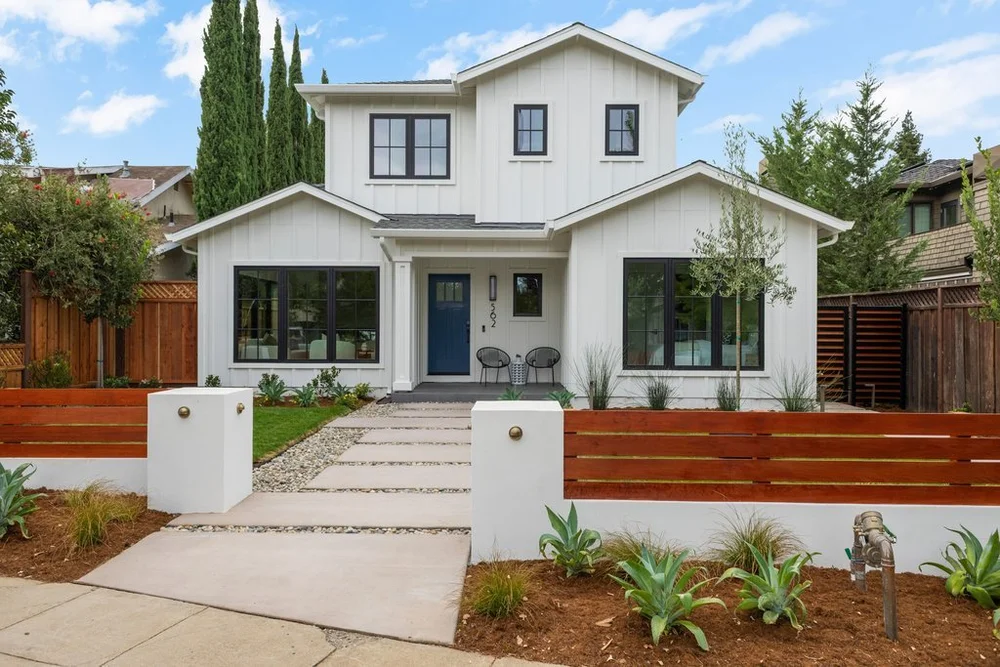
Modern Farmhouse often combines gabled roof forms, a porch or covered entry, vertical siding and restrained trim with contemporary windows and open gathering areas. These are visual clues, not a test that every home must pass. Paint color alone does not define the architecture.
The Los Altos example above makes the relationship easy to read: stepped gables, vertical white siding, dark window frames and a sheltered doorway. Its appeal is different from an Eichler’s exposed structural rhythm, while still inviting a conversation about light and garden connections.
The Property Nerd showing test
- Separate the exterior styling from the actual floor-plan benefits.
- Study stairs, bedroom placement and the daily path between kitchen, laundry and outdoor space.
- Check how porch depth and roof overhangs affect daylight.
- Ask for documented construction and improvement history; a farmhouse look does not establish age.
Seller lens: Show the arrival sequence, material details and daily-use spaces. Explain why the layout works, not just which finishes are on trend.
View the 562 Palm Avenue architectural feature →Turn a style preference into a better shortlist.
Choose three things you can point to
“Modern” is a starting point. “Single-level living, a private outdoor room and daylight in the main living space” is a much more useful brief. Bring three favorite photos and identify the feature in each—not simply the overall mood.
Compare the same questions
For every candidate, compare room connections, daylight, privacy, storage, condition and documented changes. Keep the city and practical requirements consistent so a dramatic photograph does not distract from what you need.
Bring this to a showing
Your Property Nerd field checklist
Check off the questions you have investigated. These checks are for this visit only; they are not saved or sent to the team.
ERIC & JANELLE BOYENGA / PROPERTY NERDS
Find your version of Silicon Valley modern.
Tell the Boyenga Team your preferred cities, architectural priorities and must-have spaces. We’ll help turn that brief into a focused home search and questions worth asking at a showing.
Request a local home shortlistMeet your Eichler experts →Selling a distinctive home? Explore our preparation and marketing process.
Homes@Boyenga.com · 408.373.1660
Questions worth asking
Are all mid-century ranch homes Eichlers?
No. Architectural resemblance does not establish who developed a home. Verify builder and architect information through reliable property records and archival sources.
Can Modern and Contemporary describe the same home?
Yes. This guide uses Modern for a design language and Contemporary for an expression of current design. Listing terminology varies, so compare the actual plan, materials and construction history.
Does this page show homes currently for sale?
No. This is an architectural comparison guide. Ask the Boyenga Team for a current shortlist focused on Palo Alto, Mountain View, Los Altos, Sunnyvale and San Jose. Availability and property details must be checked individually.
How should I prepare a distinctive home for sale?
Start with the features that make it distinctive, collect improvement records, and discuss a preparation scope before changing original materials. Explore our seller process and renovation examples, then arrange a property-specific consultation.
Further reading: National Park Service: understanding 1950s ranch interiors. Style descriptions are editorial comparison tools; they do not authenticate a property’s builder, architect or condition.