
The Invisible Eichler: Indoor Air Quality, Wildfire Smoke & Fresh-Air Modernism
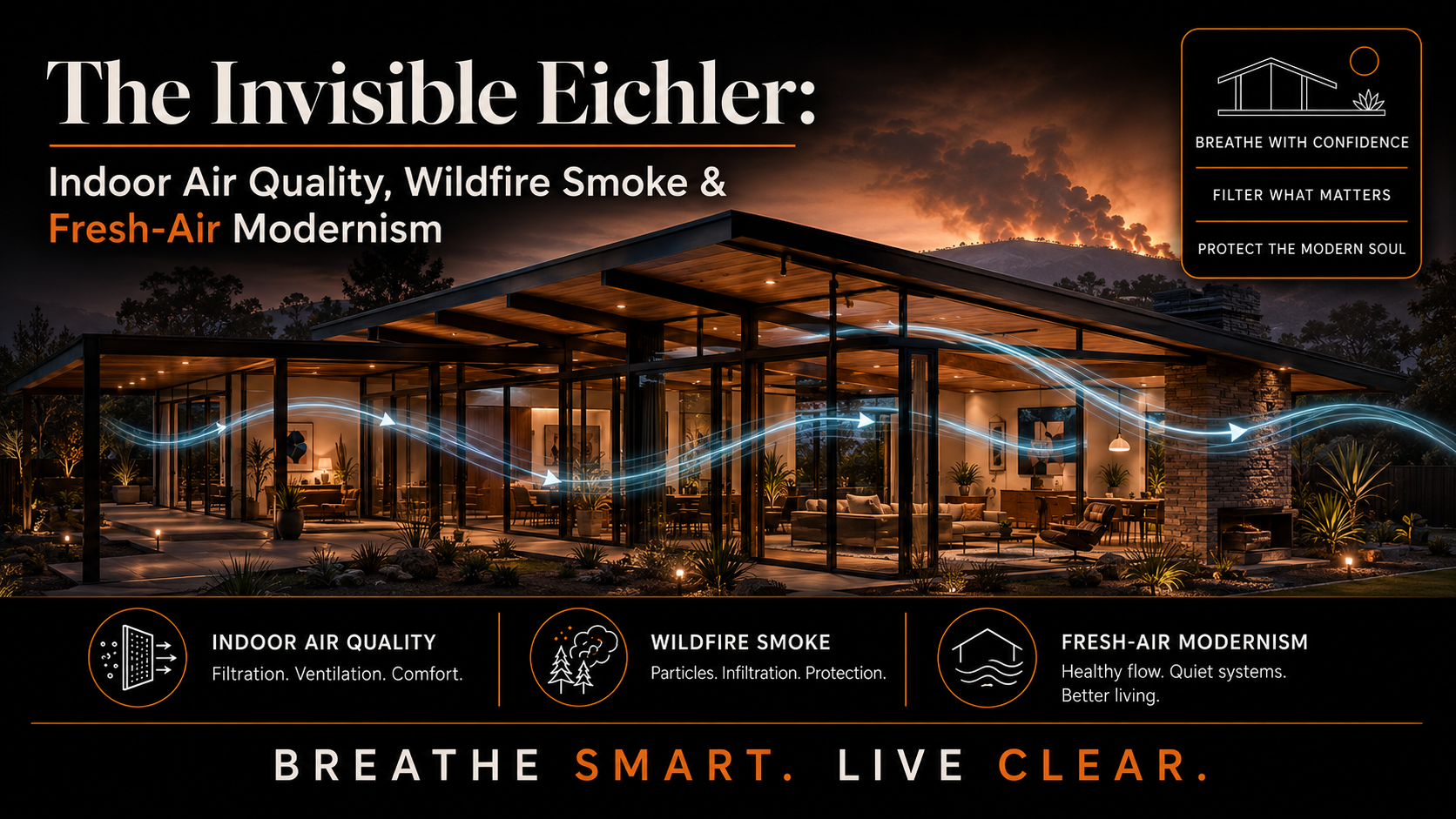
Eichler homes are famous for what you can see: glass walls, exposed beams, radiant-heated slabs, atriums, low rooflines, private gardens, and open plans that make everyday living feel connected to light and nature.
But one of the most important parts of an Eichler is something you cannot see at all.
Air.
Fresh air moving through an atrium. Morning light warming a glass-walled living room. Sliders open to a private garden. A bedroom wing that feels connected to trees, sky, and weather. A home that seems less like a sealed box and more like a calm indoor-outdoor pavilion.
That is the beauty of Eichler living.
But in modern California, air has become more complicated. Wildfire smoke, pollen, dust, heat events, poor outdoor air quality, remodel materials, older sliders, aging weatherstripping, and limited ductwork can all affect how an Eichler feels and performs. EPA notes that wildfire smoke can enter homes through open doors and windows, mechanical ventilation, and small openings, joints, cracks, and gaps around closed windows and doors; EPA also identifies fine particles in smoke as the biggest health threat from wildfire smoke.
That creates a uniquely Eichler question:
How do you preserve fresh-air modernism while creating a healthier, smoke-ready, more comfortable home?
The answer is not to turn an Eichler into a sealed, generic box. The answer is to understand when the house should breathe, when it should filter, and how to create cleaner indoor air without losing the architectural spirit that makes Eichlers so special.
Why Air Is Part of Eichler Architecture
Eichlers were not designed as sealed-off houses. They were designed around openness, privacy, and the daily pleasure of moving between indoors and outdoors. National Park Service documentation for San José Eichler tracts describes Eichler homes as one-story, open-plan houses with exposed post-and-beam construction, concrete slab foundations with radiant heating, low heights, flat or minimal-pitch roofs, deep overhangs, privacy-oriented street elevations, vertical-grooved siding, clerestory windows, atriums or courts, and glass-oriented indoor-outdoor relationships.
Those features are not incidental. They are the reason Eichlers feel different.
The atrium is not just a patio. It is an outdoor room that brings sky and air into the center of the plan. The sliders are not just doors. They are part of the circulation system. The glass walls are not just windows. They make the garden part of the interior. Radiant heat is not just heating. It allows comfort without the visual presence of bulky ductwork and registers.
In other words, Eichler architecture was designed around fresh-air living.
But today, that fresh-air lifestyle needs a second layer: air-quality awareness.
The smartest Eichler homes now have two modes:
Open-air mode: sliders open, atrium alive, garden connected, natural ventilation working.
Clean-air mode: windows and doors closed, smoke kept out, filtration running, indoor particle sources reduced, and one or more rooms prepared for better air quality.
A modern Eichler should know how to do both.
The Eichler Air Paradox
The best Eichlers blur the line between inside and outside. That is exactly what buyers love. But during wildfire smoke or poor outdoor air-quality days, the outside is not always something you want inside.
EPA explains that during wildfire events, outdoor smoke can make indoor air unhealthy too, because smoke can infiltrate homes even when residents are indoors. EPA recommends steps such as keeping windows and doors closed, using portable air cleaners or high-efficiency filters, using recirculation mode where applicable, and avoiding indoor activities that create additional particles.
For Eichler homeowners, this does not mean abandoning indoor-outdoor living. It means becoming more intentional.
On a clear spring day, an Eichler can breathe beautifully.
On a smoky August afternoon, the same home should be able to shift into protection mode.
That is the Eichler air paradox:
The house was built to bring nature in. Today, smart owners need to know when to welcome nature — and when to filter it first.
Why Wildfire Smoke Matters for Eichler Owners
Wildfire smoke is not just an outdoor problem. EPA notes that smoke is made of a complex mixture of gases and fine particles, and that fine particles can affect the eyes and respiratory system whether a person is outdoors or indoors.
Eichlers can be especially sensitive to smoke management because many have:
Large sliding glass doors
Original or older aluminum-framed windows
Atriums and courtyards
Clerestory windows
Older weatherstripping
Radiant heat instead of ducted forced air
Add-on mini-splits rather than central HVAC
Flat or low-slope roof penetrations
Garage-to-house transitions
Original fireplaces or gas appliances
Extensive glass-wall connections to patios and gardens
None of these features means the home is “bad” for air quality. They simply mean that an Eichler needs a thoughtful plan.
A conventional house with modern central HVAC may rely heavily on ducted filtration. A more original Eichler may need room-by-room filtration, portable air cleaners, better seals, careful weatherstripping, and a clean-air room strategy.
This is where Eichler-specific thinking matters.
The Smoke-Ready Eichler: A Practical Framework
A smoke-ready Eichler does not need to lose its character. The goal is to create a plan that can be activated quickly when the AQI changes.
A strong smoke-ready plan has five parts:
Know when outdoor air is unhealthy.
Reduce smoke entry.
Filter indoor air.
Reduce indoor particle sources.
Create at least one cleaner-air room.
CARB’s Smoke Ready California guidance recommends checking local AQI, staying indoors with windows and doors closed when air quality reaches dangerous levels, running central air systems continuously when available, closing fresh-air intakes or using recirculation mode, installing MERV 13 or higher filters where the system can handle them, using CARB-certified air cleaners, and avoiding indoor pollution sources such as candles, gas stoves, and vacuuming during smoke events.
For an Eichler, the framework should be adapted to the home’s systems and architecture.
A home with central ducted HVAC may have one strategy. A home with radiant heat and no ducts may have another. A home with mini-splits may have another. A home with original sliders and atrium doors may need extra attention to sealing and room-by-room filtration.
The best plan is specific to the house.
Step One: Know Your Air Quality Before Opening the House
Eichler owners often open sliders and atrium doors out of habit. That is part of the lifestyle. But on smoke days, pollen-heavy days, or poor-AQI days, it is worth checking outdoor conditions first.
CARB’s Smoke Ready California page points residents to air-quality tools such as California Smoke Spotter, EPA’s AirNow Fire and Smoke Map, and local air districts for current smoke and AQI information.
For Eichler owners, this can become part of the daily rhythm:
Morning coffee in the atrium? Check AQI first.
Open sliders after sunset? Check whether smoke has settled.
Let the house flush out after a hot day? Do it when outdoor air is actually cleaner.
This is not about living anxiously. It is about using information to preserve the best part of Eichler living: the ability to connect with the outdoors when the outdoors is healthy.
Step Two: Reduce Smoke Entry Without Ruining the House
Smoke enters through obvious openings, like open sliders and doors, but also through small gaps. EPA identifies open windows and doors, mechanical ventilation, and small cracks, joints, and gaps as ways outdoor air and smoke particles can enter a home.
In an Eichler, common air-entry points may include:
Sliding glass door tracks
Worn weatherstripping
Gaps at original doors
Atrium-facing sliders
Clerestory window seals
Skylight seals
Garage-to-house doors
Utility penetrations
Bathroom fans
Kitchen exhaust systems
Fireplace dampers
Mini-split line-set penetrations
Old remodel penetrations
Cracks around window frames
Poorly sealed exterior outlets or wall openings
The solution is not to over-seal the house blindly. Eichlers need ventilation, and older homes need careful moisture management. The goal is to reduce uncontrolled leakage while preserving intentional ventilation.
Good improvements may include:
Replacing worn door weatherstripping
Tuning or repairing sliders
Cleaning and repairing slider tracks
Sealing obvious gaps around penetrations
Checking garage-to-living-area doors
Repairing skylight leaks or gaps
Closing fireplace dampers when not in use
Improving seals around window AC or portable AC vent kits
Evaluating whether exhaust fans are drawing smoky air into the home
Small fixes can make a meaningful difference, especially when paired with filtration.
Step Three: Understand the Eichler HVAC Reality
Many Eichlers do not have conventional ducted forced-air systems. That is part of their architectural identity. Radiant heat allowed Eichlers to feel open and uncluttered, without the visual interruption of ductwork.
But radiant heat does not filter air.
That matters during smoke events. A home with radiant heat may feel wonderfully comfortable in winter, but it may not have a built-in filtration pathway. A home with mini-splits may have heating and cooling, but mini-split filters are generally not a substitute for high-efficiency smoke filtration. A home with central HVAC may be able to use higher-efficiency filters, but only if the system can accommodate them.
EPA recommends choosing a MERV 13 filter, or the highest rating the system fan and filter slot can accommodate, when increasing HVAC filtration; EPA also recommends consulting an HVAC professional to determine what filter level will work for a specific system.
That nuance is important. A MERV 13 filter is not simply a universal swap. Some systems can handle it; others may struggle with airflow. An HVAC contractor should evaluate system capacity, filter fit, static pressure, fan performance, and maintenance needs.
For Eichler owners, the real question is:
What kind of comfort system does the home have, and how does that system handle air cleaning?
The answer determines the clean-air plan.
Eichlers With Radiant Heat and No Ductwork
Many classic Eichlers rely on radiant heat. These homes may have no ductwork at all. That can be wonderful from an architectural standpoint, but it means filtration usually needs to be room-based.
For a radiant-heat Eichler, the clean-air strategy often includes:
Portable air cleaners in key rooms
One dedicated clean-air room
Weatherstripping and slider maintenance
Careful sealing of obvious gaps
Avoiding indoor particle sources during smoke events
Using fans only in ways that do not draw smoke inside
Planning future heat pump or ventilation upgrades thoughtfully
This is one of the most Eichler-specific indoor air-quality issues. Buyers should not assume “no central HVAC” is a defect. But they should understand how the home will perform during smoke season, heat events, and allergy season.
For sellers, documenting portable air-cleaning setups, recent weatherstripping, mini-split installations, or other comfort upgrades can help buyers understand the home’s livability.
Eichlers With Mini-Splits or Heat Pumps
Ductless mini-splits can be a strong solution for Eichlers because they add heating and cooling without major ductwork. But from an indoor air-quality perspective, buyers should understand what mini-splits do and do not do.
Mini-splits recirculate and condition indoor air. They often have washable or replaceable filters, but those filters may be designed primarily to protect the equipment and catch larger particles, not to provide whole-home smoke filtration. A mini-split can help keep the home cool with windows closed during smoke events, which is valuable, but it may still need to be paired with portable air cleaners.
A smart Eichler mini-split air-quality plan may include:
Portable HEPA or CADR-rated air cleaners in bedrooms and living areas
Clean filters in mini-split heads
Condenser and line-set penetrations sealed properly
Condensers placed away from primary outdoor living spaces
Avoiding noisy equipment near bedrooms or atriums
Using mini-splits to maintain comfort while windows stay closed
The biggest mistake is assuming that cooling equals filtration. Comfort and air cleaning are related, but they are not the same.
Eichlers With Central HVAC
Some Eichlers have central HVAC from prior remodels. In those homes, filtration strategy may be easier, but only if the system is designed and maintained properly.
Buyers and owners should ask:
Does the system have a fresh-air intake?
Can the intake be closed during smoke events?
Can the system run in recirculation mode?
What filter size and MERV rating can the system handle?
Does the filter fit tightly?
Is the return path clean and sealed?
Are ducts leaky or poorly located?
Are there permits and service records?
Does the system serve all rooms effectively?
Does ductwork compromise ceilings, beams, or Eichler architecture?
EPA recommends learning whether a central HVAC system has a fresh-air intake and, if it does, learning how to close it or set the system to recirculate; EPA also recommends making sure filters fit snugly and are replaced as recommended.
For Eichlers, central HVAC should also be evaluated architecturally. A system that works technically but required dropped ceilings, boxed beams, or awkward soffits may affect design integrity. A well-planned system can improve comfort without overwhelming the home.
The Eichler Clean-Air Room
One of the most practical ideas for Eichler owners is the clean-air room.
EPA defines a clean room as a room set up to keep smoke and particle levels as low as possible during wildfire smoke events. EPA recommends that the room be free from particle-generating activities such as cooking or smoking, that doors and windows be kept closed, and that a portable air cleaner can be used to make that room cleaner than the rest of the home.
For an Eichler, the clean-air room should be chosen thoughtfully.
Good candidates may include:
A primary bedroom
A child’s bedroom
A home office
A den
A guest room
An interior room with fewer exterior openings
A room where vulnerable family members can rest comfortably
Less ideal choices may include:
Rooms with multiple leaky sliders
Rooms opening directly to the atrium
Kitchens
Rooms with fireplaces
Rooms with heavy exterior leakage
Rooms that become too hot when closed
The clean-air room should be comfortable enough to spend time in. It should have a properly sized air cleaner, working outlets, doors and windows that close well, and minimal indoor particle sources.
For Eichler aesthetics, the air cleaner does not need to dominate the room. It can be placed discreetly, but it should not be hidden so tightly behind furniture that airflow is blocked.
How to Set Up a Clean-Air Room in an Eichler
A practical clean-air room setup might look like this:
Choose one room that can be closed off.
Check the room’s windows, sliders, and door seals.
Use a portable air cleaner sized for the room.
Keep extra filters ready before smoke season.
Keep the door closed during smoke events.
Avoid candles, incense, frying, vacuuming, and other particle sources.
Use air conditioning or fans in a way that does not draw in smoke.
Keep the room comfortable, calm, and usable.
Check filters frequently during prolonged smoke events.
Re-open and ventilate the home when outdoor air improves.
CARB similarly recommends focusing on one cleaner-air space, closing windows and doors without blocking exits, filtering the air, using a certified portable air cleaner continuously on high when needed, avoiding indoor particle sources, staying cool, and using damp cleaning to trap settled dust and particles.
This is not a remodel. It is a readiness strategy.
Every Eichler can have one.
Portable Air Cleaners: What Eichler Owners Should Know
Portable air cleaners can be one of the most practical tools for Eichler homes, especially those without ducted HVAC. EPA advises choosing a portable air cleaner intended for the room size, and says effective choices may be designated HEPA, CADR-rated, or described by the manufacturer as removing most particles below 1 micrometer; EPA also advises against using air cleaners that generate ozone.
CARB adds an important California-specific point: indoor air cleaners sold in California must be CARB-certified, and CARB maintains a list of approved devices that have been tested and shown to emit little or no ozone.
For Eichler owners, the key selection factors are:
Room size
CADR rating
HEPA or equivalent particle filtration
CARB certification
Noise level
Filter availability
Filter replacement cost
Energy use
Visual fit with the home
Placement that allows good airflow
Whether multiple smaller units are better than one large unit
A portable air cleaner should not be selected only by appearance. But appearance matters in an Eichler. The best choice is a unit that works well, runs quietly enough to use consistently, and does not visually clutter the architecture.
Where to Place Air Cleaners in an Eichler
Placement matters.
A portable air cleaner should generally be placed where people spend time, with enough clearance for air intake and output. EPA recommends placing air cleaners in rooms where people spend more time, such as living rooms or bedrooms, replacing filters regularly, and following the manufacturer’s maintenance instructions.
In an Eichler, good locations may include:
Primary bedroom
Children’s bedrooms
Living room
Home office
Family room
Guest room used as a clean-air room
Be careful with:
Corners that block airflow
Behind sofas
Inside cabinets
Right next to open sliders
Near cooking areas
Near dusty entry zones
Near water features or moisture
In atriums or exterior spaces
A clean-air device should be treated like a functional part of the home, not an afterthought.
DIY Air Cleaners: Temporary Tool, Not Permanent Design Solution
DIY air cleaners, often built with a box fan and MERV 13 filters, can be useful when commercial air cleaners are unavailable or unaffordable. EPA states that DIY air cleaners can serve as a temporary alternative to commercial air cleaners, but recommends them only when products of known performance are not available or affordable; EPA also notes that well-built DIY designs can reduce airborne particles, though performance depends on design and assembly quality.
CARB’s Smoke Ready California page notes that DIY air cleaners can be made with box fans and MERV 13 filters, and emphasizes using newer UL- or ETL-marked box fans, MERV 13 or higher filters, tight filter placement, and replacing filters when dirty or odorous.
For Eichler owners, DIY units can be a useful backup, but they are not usually the best permanent solution. They can be visually bulky, noisy, and less predictable than tested portable air cleaners. If used, they should be assembled safely and treated as a practical emergency tool rather than a design object.
Indoor Particle Sources: The Smoke-Day Mistake Many People Make
During wildfire smoke, many homeowners focus only on keeping outdoor smoke out. That is important, but indoor particle sources matter too.
EPA recommends avoiding activities that create additional fine particles indoors during smoke events, including smoking and vaping, using gas, propane, or wood-burning stoves and furnaces, spraying aerosols, frying or broiling food, burning candles or incense, and vacuuming unless using a HEPA-filter vacuum.
CARB gives similar guidance, advising residents to avoid activities that increase indoor pollution, including burning candles, using gas stoves, and vacuuming during wildfire smoke conditions.
For Eichler homes, common indoor particle sources may include:
Gas cooking
Wood-burning fireplaces
Candles
Incense
Scented products
Aerosol sprays
Frying or broiling
Dusty rugs
Open doors from garage areas
Construction dust
Poorly cleaned remodel areas
Pet dander
Vacuuming during smoke days
Fireplace ash
This is especially relevant for open-plan Eichlers. A cooking event in the kitchen can affect the living room, dining area, and atrium-facing spaces quickly.
A smoke-day routine might mean simple meals, no candles, no fireplace, limited vacuuming, and continuous filtration in the rooms where people spend the most time.
Gas Cooking, Induction, and the Eichler Kitchen
Many Eichler kitchens have been remodeled over time. Some have gas ranges. Some have electric ranges. Some owners are exploring induction as part of broader electrification.
This blog is not about telling every Eichler owner to remove gas appliances. But it is important to understand that cooking can affect indoor air quality, especially during smoke events when opening windows may not be wise.
For Eichler buyers, kitchen ventilation should be part of due diligence:
Does the kitchen have an exterior-vented range hood?
Is the hood used regularly?
Does it create backdrafting or pressure issues?
Is there makeup air concern in a tighter home?
Does cooking smoke spread through the open floor plan?
Is induction feasible with the current electrical panel?
Was kitchen ventilation updated during a remodel?
For sellers, a clean, functional, well-documented kitchen ventilation setup can be a subtle but meaningful selling point.
Fireplaces and Eichler Ambiance
Some Eichlers have original fireplaces that contribute to the home’s atmosphere. A fireplace can be beautiful, but it should be evaluated as part of the air-quality plan.
Buyers should ask:
Is the fireplace wood-burning, gas, decorative, or nonfunctional?
Has the chimney been inspected?
Does the damper close properly?
Is there evidence of smoke staining?
Does the fireplace draft well?
Does it affect indoor air quality?
Are there local restrictions on wood burning?
Has the fireplace been modified?
On smoke days, burning wood indoors is counterproductive. Even outside of wildfire season, a fireplace should be used responsibly and maintained properly.
For an Eichler, the goal is to preserve the architectural presence of the fireplace while understanding its air-quality implications.
Moisture, Mold, and the Indoor Air Connection
Indoor air quality is not only about smoke. Moisture matters too.
Eichlers can have moisture-sensitive areas: flat roofs, skylights, atriums, slab edges, bathrooms, kitchens, sliding doors, and wood siding. Water intrusion can lead to odors, staining, material deterioration, and potential mold concerns. EPA’s mold guidance emphasizes that mold problems should be cleaned up and moisture sources eliminated, and that preventing mold growth depends on controlling moisture.
For Eichler buyers and sellers, indoor air quality should be evaluated alongside:
Roof history
Skylight leaks
Atrium drainage
Bathroom ventilation
Kitchen ventilation
Slab moisture
Irrigation overspray
Window condensation
Musty odors
Past leak disclosures
Drainage around patios and sliders
A home can have excellent filtration and still have an air-quality problem if moisture is not controlled.
For sellers, musty odors should never be masked with heavy fragrance. Buyers notice. The better approach is to identify the source, repair the issue, clean thoroughly, and present the home honestly.
Remodel Materials and the Healthy Eichler
Many Eichlers are remodeled over time. Kitchens, bathrooms, floors, roofs, insulation, cabinetry, windows, paint, and lighting may all be updated. Those updates can improve comfort and resale value, but materials and installation methods can affect indoor air.
EPA’s remodeling guidance notes that home improvement and energy-efficiency projects should minimize pollution from new materials and from disturbing existing materials, and that residents should watch for signs of inadequate ventilation such as stuffy air, condensation, or mold and mildew.
For Eichler remodels, healthier material choices may include:
Low-VOC paints
Low-odor finishes
Carefully selected flooring adhesives
Formaldehyde-compliant composite wood products
Proper ventilation during and after construction
Dust containment during demolition
HEPA cleaning after remodel work
Avoiding unnecessary fragrance products before showings
Choosing cabinetry and flooring with emissions documentation
Allowing new materials to off-gas before occupancy or listing
This is especially important in Eichlers because open plans and large glass areas can make odors and dust feel more noticeable. A freshly remodeled home should not smell like chemicals when buyers walk in.
Air Quality and Eichler Flooring
Flooring is one of the biggest Eichler design choices. It also affects indoor air.
Many Eichlers have slab foundations and radiant heat, so flooring choices must be compatible with the heating system and moisture conditions. From an air-quality perspective, owners should consider:
Adhesive emissions
Flooring off-gassing
Dust from demolition
Moisture under flooring
Area rugs and dust accumulation
Cleaning product choices
Compatibility with radiant heat
Whether flooring traps odors or allergens
Hard surfaces such as tile, concrete, cork, terrazzo-inspired materials, and certain engineered products can work well in Eichlers when selected carefully. But the best flooring is not just attractive. It should be durable, maintainable, compatible with the slab, and appropriate for indoor air goals.
Weatherstripping and Sliders: Small Details, Big Difference
Original Eichler sliders are part of the architectural experience. But older sliders can leak air, rattle, stick, or allow dust and smoke to enter more easily.
A practical Eichler air-quality tune-up may include:
Cleaning slider tracks
Replacing worn rollers
Repairing or replacing weatherstripping
Adjusting door fit
Checking locking mechanisms
Sealing gaps at thresholds
Reviewing exterior drainage near sliders
Inspecting door-to-atrium transitions
Repairing torn screens
Evaluating whether replacement sliders preserve proportions
These are not glamorous upgrades, but they can improve comfort, smoke readiness, and daily livability.
For sellers, tuned sliders make a strong impression. Buyers physically experience them during showings. A smooth, tight slider feels cared for. A sticky, leaky slider raises questions.
Skylights, Clerestories, and Leaky Edges
Eichlers often use light from above and high windows to create privacy and drama. Clerestories and skylights can be wonderful, but they should be inspected and maintained.
Air-quality and comfort issues may arise from:
Failed skylight seals
Poor skylight flashing
Gaps around clerestory windows
Condensation
Dust accumulation
Heat gain
Water staining
Old repairs
Poorly sealed remodel work
A skylight leak is usually discussed as a roof issue, but it is also an indoor environmental issue. Water intrusion can create odors, stains, damaged wood, and potential mold concerns. A clerestory gap can allow smoke infiltration.
For buyers, skylights and clerestories should be evaluated as both design features and envelope components.
Garage-to-House Air Quality
Many Eichlers have garages or carports integrated into the front elevation. If a garage is attached or connected to the living space, air separation matters.
Potential concerns include:
Gasoline odors
Stored chemicals
Paints and solvents
Car exhaust
Gaps around doors
Unsealed penetrations
Laundry equipment
Water heater or mechanical equipment
Poor ventilation
Garage conversions with unclear separation
A garage-to-house door should close well. Penetrations should be sealed. Stored chemicals should be minimized, especially before listing. If a garage has been converted to living space, buyers should evaluate permits, insulation, ventilation, and air separation carefully.
Air Quality Monitors: Useful, But Not a Substitute for Good Strategy
Many homeowners now use indoor air-quality monitors. These can be helpful, especially for tracking particulate levels during smoke events.
But monitors should be used wisely. They can help answer:
Does indoor particle level rise when sliders open?
Does the portable air cleaner reduce particles?
Which room performs best as a clean-air room?
Does cooking raise indoor particles?
Does vacuuming affect air quality?
Does wildfire smoke enter even when doors are closed?
A monitor does not solve the problem. It helps the owner understand the home.
For Eichler buyers, a seller who can explain filtration, clean-air strategy, and air-quality improvements may create extra confidence. For sellers, documented thoughtful upgrades can help turn an invisible feature into a marketable benefit.
Buyer Checklist: Indoor Air Quality Questions to Ask Before Buying an Eichler
Before buying an Eichler, especially in a wildfire-prone or smoke-affected region, buyers should ask:
Does the home have central HVAC, radiant heat, mini-splits, or a mixed system?
Is there any whole-home filtration?
If central HVAC exists, what filter rating can the system handle?
Does the HVAC system have a fresh-air intake?
Can it run in recirculation mode?
Are portable air cleaners used?
Which room would work best as a clean-air room?
Do sliders and exterior doors seal well?
Are skylights sealed and documented?
Are clerestory windows in good condition?
Is there a history of water intrusion or musty odors?
Are bathroom fans working?
Is kitchen ventilation exterior-vented?
Is there a gas range?
Is there a fireplace, and has it been inspected?
Is the garage well separated from the living space?
Have remodel materials been documented?
Were low-VOC paints or healthier materials used?
Are there pets, heavy fragrances, or odor-masking products present during showings?
How would the home perform during a smoke event?
What improvements would be needed in the first year?
The goal is not to scare buyers. It is to help them understand how the home lives.
Seller Checklist: How to Present a Cleaner-Air Eichler
Indoor air quality can be a subtle but powerful part of the listing story. Sellers do not need to overpromise health outcomes, but they can prepare the home so buyers experience it as fresh, clean, comfortable, and well cared for.
Before listing, sellers should consider:
Replacing HVAC filters
Cleaning mini-split filters
Servicing HVAC or mini-split systems
Gathering HVAC records
Gathering boiler/radiant heat records
Documenting portable air cleaners, if included or relevant
Repairing worn weatherstripping
Tuning sliders
Checking skylight seals
Repairing visible water stains, only after the source is addressed
Cleaning ducts, if the home has ductwork and it is appropriate
Cleaning fireplace areas
Avoiding candles, plug-in fragrances, and heavy scenting
Deep-cleaning soft furnishings
Reducing dust before photography
Cleaning atrium debris
Checking bathroom fans
Checking kitchen ventilation
Removing stored chemicals from garages
Documenting low-VOC or healthy remodel materials when available
A home that smells neutral and clean is far more appealing than a home that smells artificially scented. Eichler buyers tend to be sensitive to authenticity. Heavy fragrance can raise suspicion that something is being hidden.
How Indoor Air Quality Can Affect Eichler Resale Value
Indoor air quality is not always listed as a headline feature, but it affects buyer perception.
A buyer may not say, “This home has a better clean-air plan.”
They may say:
“This home feels fresh.”
“The sliders work well.”
“The remodel does not smell chemical.”
“The bedrooms feel comfortable.”
“The systems seem well thought out.”
“The seller has great documentation.”
“The house feels cared for.”
That matters.
A cleaner-air Eichler can support resale by improving:
Comfort
Buyer confidence
Smoke-readiness perception
System documentation
Remodel quality perception
Showing experience
Long-term ownership appeal
Trust in maintenance history
On the other hand, buyers may hesitate if they notice:
Musty odors
Heavy fragrance
Sticky or leaky sliders
Poor kitchen ventilation
Dirty mini-split filters
Unexplained ceiling stains
Water intrusion history
Garage odors entering living space
Smoke smell
Poorly documented remodel materials
No plan for a radiant-heat home without filtration
In a competitive Eichler market, these subtle impressions can influence how buyers feel about the property.
The Mid-Century Modern Design Challenge
Air-quality upgrades should not make an Eichler feel like a medical facility or a mechanical showroom.
The best improvements are quiet:
Discreet portable air cleaners
Well-sealed sliders
Clean filters
Thoughtfully placed mini-splits
Low-profile ventilation improvements
Simple material choices
Low-VOC finishes
Better exhaust fans
Cleaner garage storage
A prepared clean-air room
Smart but unobtrusive monitoring
The design principle is the same as with all Eichler upgrades:
Modernize the performance, not the soul.
A smoke-ready Eichler should still feel warm, open, calm, and connected to nature.
The Fresh-Air Modernism Roadmap
For homeowners who want to improve indoor air quality without over-remodeling, use this roadmap.
Step 1: Understand the Existing Systems
Identify whether the home has radiant heat, central HVAC, mini-splits, heat pumps, portable AC, window AC, or a combination. Understand what each system does for heating, cooling, ventilation, and filtration.
Step 2: Choose a Clean-Air Room
Pick one room that can be closed off, cooled or heated, and filtered. Make sure it has a properly sized air cleaner and good seals.
Step 3: Tune the Sliders and Doors
Repair weatherstripping, clean tracks, adjust rollers, and seal obvious gaps.
Step 4: Review Filtration
For ducted systems, ask an HVAC professional about filter compatibility. For non-ducted Eichlers, use portable air cleaners in key rooms.
Step 5: Reduce Indoor Pollutants
Avoid smoke-day activities that add particles indoors. Reconsider candles, incense, aerosols, frying, and fireplace use during poor-air events.
Step 6: Improve Ventilation When Outdoor Air Is Good
Eichlers should still breathe. Use clean-air windows of time to flush the home when outdoor air quality is good.
Step 7: Address Moisture
Fix leaks, drainage problems, bathroom ventilation issues, skylight concerns, and musty odors at the source.
Step 8: Choose Healthier Remodel Materials
Use low-VOC paints and finishes, carefully selected flooring and adhesives, and well-documented cabinetry or composite wood products.
Step 9: Keep Records
Document HVAC service, mini-split maintenance, air-cleaner models, filter sizes, weatherstripping work, skylight repairs, remodel materials, and ventilation upgrades.
Step 10: Preserve the Eichler Feeling
Every upgrade should support the architecture: clean lines, open space, glass, light, privacy, and indoor-outdoor living.
How the Boyenga Team at Compass Helps Eichler Buyers and Sellers
Eichler transactions require more than standard real estate advice. These homes have unique architecture, unique systems, and a unique buyer pool. The visible details matter — beams, glass, atriums, rooflines, siding, landscaping — but the invisible details matter too: comfort, air quality, filtration, odors, moisture, ventilation, smoke readiness, and system documentation.
That is where Eric and Janelle Boyenga of the Boyenga Team at Compass bring specialized value.
EichlerHomesForSale.com describes the Boyenga Team as Compass’s leading real estate team in Silicon Valley, with Eric and Janelle Boyenga serving as trusted Eichler Home Sales Experts with specialized knowledge in mid-century modern and restorative construction. The site also notes that they have guided clients through Eichler home sales for more than two decades and are known for a data-driven approach, pre-listing preparation, project management, digital marketing, and exceptional client care.
For Eichler sellers, Eric and Janelle help identify the details that shape buyer perception before the home goes live. That may include atrium presentation, roof documentation, radiant heat records, slider function, HVAC or mini-split maintenance, remodel documentation, lighting, landscaping, staging, odor control, and the subtle comfort factors that make a home feel cared for.
For Eichler buyers, the Boyenga Team helps evaluate how a home actually lives. Does the radiant heat work? How is cooling handled? Is there a smoke-season plan? Are sliders and skylights in good condition? Does the remodel feel healthy and design-sensitive? Are there moisture concerns? Is the home still authentically Eichler?
Their approach is not just about selling square footage. It is about helping clients understand architecture, systems, lifestyle, and long-term value.
Call to Action
Thinking of buying or selling an Eichler? Work with Eric and Janelle Boyenga of the Boyenga Team at Compass — Eichler real estate experts who understand the visible and invisible details that shape value, comfort, and buyer confidence.
From atriums, glass walls, radiant heat, flat roofs, sliders, landscaping, and preservation-minded design to indoor air quality, wildfire smoke readiness, filtration, inspections, disclosures, and market strategy, the Boyenga Team helps clients make smarter Eichler decisions.
For Eichler guidance, contact Eric & Janelle Boyenga / Compass through EichlerHomesForSale.com; the site lists Eichlers@Boyenga.com and 408-373-1660 for Eichler inquiries.
FAQ: Eichler Indoor Air Quality
Are Eichlers bad for indoor air quality?
No. Eichlers are not inherently bad for indoor air quality. In fact, their indoor-outdoor design can feel wonderfully fresh when outdoor air is clean. The key is having a strategy for smoke days, pollen days, heat events, moisture control, and filtration.
Do Eichlers need air purifiers?
Many Eichler owners benefit from portable air cleaners, especially if the home has radiant heat and no ducted HVAC. EPA recommends choosing a portable air cleaner sized for the room and avoiding devices that generate ozone.
What is the best room for a clean-air room in an Eichler?
The best clean-air room is usually a bedroom, office, or den that can be closed off, kept comfortable, and filtered. A room with fewer exterior openings, fewer leaky sliders, and good electrical access is usually better than a highly exposed glass-walled room.
Can mini-splits filter wildfire smoke?
Mini-splits may help keep the home cool with windows closed, but their built-in filters should not be assumed to provide the same smoke filtration as a properly sized HEPA or CADR-rated portable air cleaner. Buyers should review manufacturer specs and consider portable filtration.
What MERV filter should an Eichler use?
If the home has central HVAC, EPA recommends MERV 13 or the highest rating the system can accommodate, but owners may need an HVAC professional to confirm what the system fan and filter slot can handle.
Should Eichler owners keep windows closed during wildfire smoke?
Yes, when air quality is dangerous due to wildfire smoke, CARB recommends staying indoors with windows and doors closed.
Can an Eichler still have fresh-air living?
Absolutely. The goal is not to keep the home closed all year. The goal is to use the Eichler’s indoor-outdoor design when outdoor air is healthy and shift into clean-air mode when smoke or poor air quality makes that necessary.
Does indoor air quality affect resale value?
It can. Buyers may respond positively to homes that feel fresh, clean, comfortable, well-maintained, and well-documented. Air-quality improvements such as tuned sliders, clean HVAC records, filtration plans, low-VOC remodel materials, and moisture control can support buyer confidence.
How the Boyenga Team at Compass Helps Eichler Buyers and Sellers
Eichler transactions require more than standard real estate advice. These homes have unique architecture, unique systems, and a unique buyer pool. The visible details matter — beams, glass, atriums, rooflines, siding, landscaping — but the invisible details matter too: comfort, air quality, filtration, odors, moisture, ventilation, smoke readiness, and system documentation.
That is where Eric and Janelle Boyenga of the Boyenga Team at Compass bring specialized value.
EichlerHomesForSale.com describes the Boyenga Team as Compass’s leading real estate team in Silicon Valley, with Eric and Janelle Boyenga serving as trusted Eichler Home Sales Experts with specialized knowledge in mid-century modern and restorative construction. The site also notes that they have guided clients through Eichler home sales for more than two decades and are known for a data-driven approach, pre-listing preparation, project management, digital marketing, and exceptional client care.
For Eichler sellers, Eric and Janelle help identify the details that shape buyer perception before the home goes live. That may include atrium presentation, roof documentation, radiant heat records, slider function, HVAC or mini-split maintenance, remodel documentation, lighting, landscaping, staging, odor control, and the subtle comfort factors that make a home feel cared for.
For Eichler buyers, the Boyenga Team helps evaluate how a home actually lives. Does the radiant heat work? How is cooling handled? Is there a smoke-season plan? Are sliders and skylights in good condition? Does the remodel feel healthy and design-sensitive? Are there moisture concerns? Is the home still authentically Eichler?
Their approach is not just about selling square footage. It is about helping clients understand architecture, systems, lifestyle, and long-term value.
This article is for general educational purposes only and should not be treated as medical, legal, insurance, construction, HVAC, environmental, or indoor-air-quality consulting advice. Indoor air quality, wildfire smoke exposure, filtration needs, ventilation strategy, HVAC compatibility, building conditions, and health risks vary by home and household. Eichler buyers, sellers, and homeowners should consult qualified HVAC professionals, licensed contractors, indoor air-quality specialists, health professionals, local air districts, insurance professionals, and real estate advisors before making property-specific decisions.