
From the X-100 to the AI Era: Why Silicon Valley's Builders Are Choosing Eichlers
Quick answer: As AI companies like Anthropic and OpenAI expand across San Francisco and Mountain View, a new wave of engineers, researchers, and founders is shopping for Bay Area homes. Many are drawn to Eichler and mid-century modern houses, because the design values behind them (clarity, openness, light, and optimism about technology) mirror how this generation thinks. This guide covers the X-100, Eichler's "house of the future," the later and newly built Eichlers worth knowing, the neighborhoods closest to the new AI hubs, and what to know before you buy.
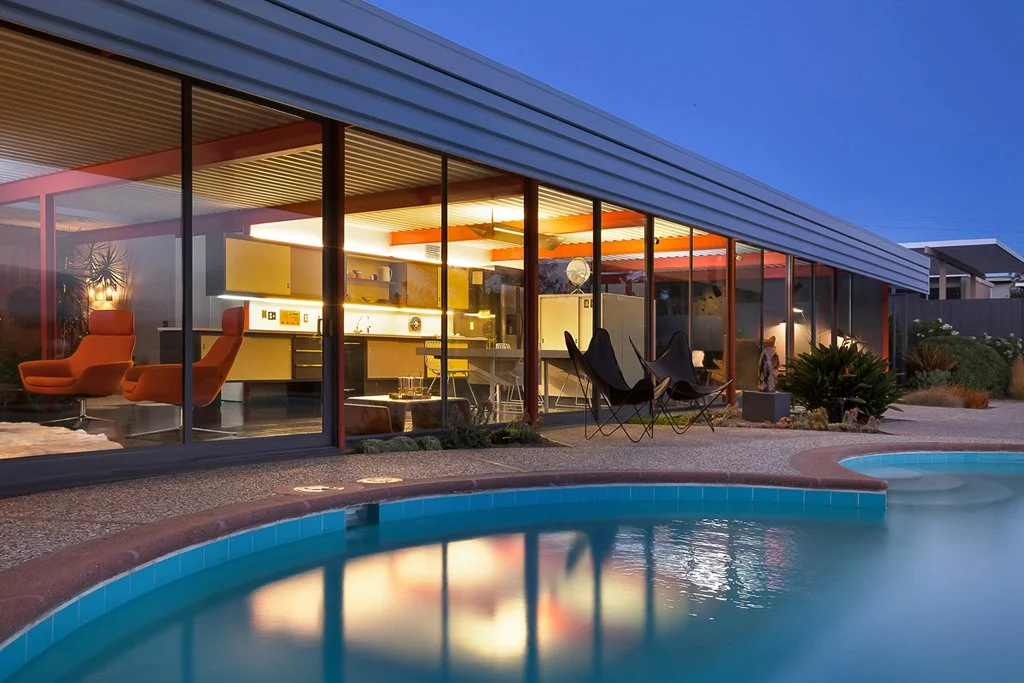
The Eichler X-100 in the San Mateo Highlands at dusk. Photo: Sabrina Huang, Boyenga Team
The future has always lived here
Silicon Valley is building the future again. This time it's artificial intelligence, and the companies leading it aren't just renting desks. They're putting down deep roots in the Bay Area.
Anthropic has turned a stretch of Howard Street in San Francisco's SoMa into one of the city's largest office footprints, with more than 900,000 square feet across several buildings. In early 2026 it leased an entire 25-story tower at 300 Howard Street for a planned 2027 move.
OpenAI has assembled more than a million square feet in San Francisco's Mission Bay, anchored at 1455 Third Street. In March 2026 it also leased a five-building, roughly 450,000-square-foot campus at 350–380 Ellis Street in Mountain View, its first major Silicon Valley home.
The growth is expected to continue. CBRE has projected that the Bay Area could add more than 50,000 AI-sector workers by 2030. That means thousands of people deciding where to live, what kind of home fits their life, and which neighborhoods feel right.
Many of them are discovering something we Property Nerds have known for decades: the homes that best match a future-facing mindset were designed nearly 70 years ago. They're Eichlers.
What is an Eichler home?
Eichler homes are the mid-century modern houses built by developer Joseph Eichler and his company, Eichler Homes, beginning in 1949. Eichler built roughly 11,000 homes, most of them in Northern California, and hired leading modernist architects such as Anshen & Allen, A. Quincy Jones and Frederick Emmons, and Claude Oakland to design them.
What made them radical was not luxury but ideas. Eichler believed good modern design should be available to ordinary families, not just wealthy patrons. His homes brought architect-level design to suburban tracts across the Peninsula and South Bay.
Classic Eichler features include:
Post-and-beam construction with exposed beams and tongue-and-groove ceilings.
Floor-to-ceiling glass facing private gardens rather than the street.
Open-air atriums in many later models, bringing sky and garden into the center of the house.
Radiant floor heating built into the concrete slab.
Low-slung rooflines (flat, gabled, or butterfly) and simple, honest materials.
Open, flowing plans that blur the line between kitchen, living, and dining space.
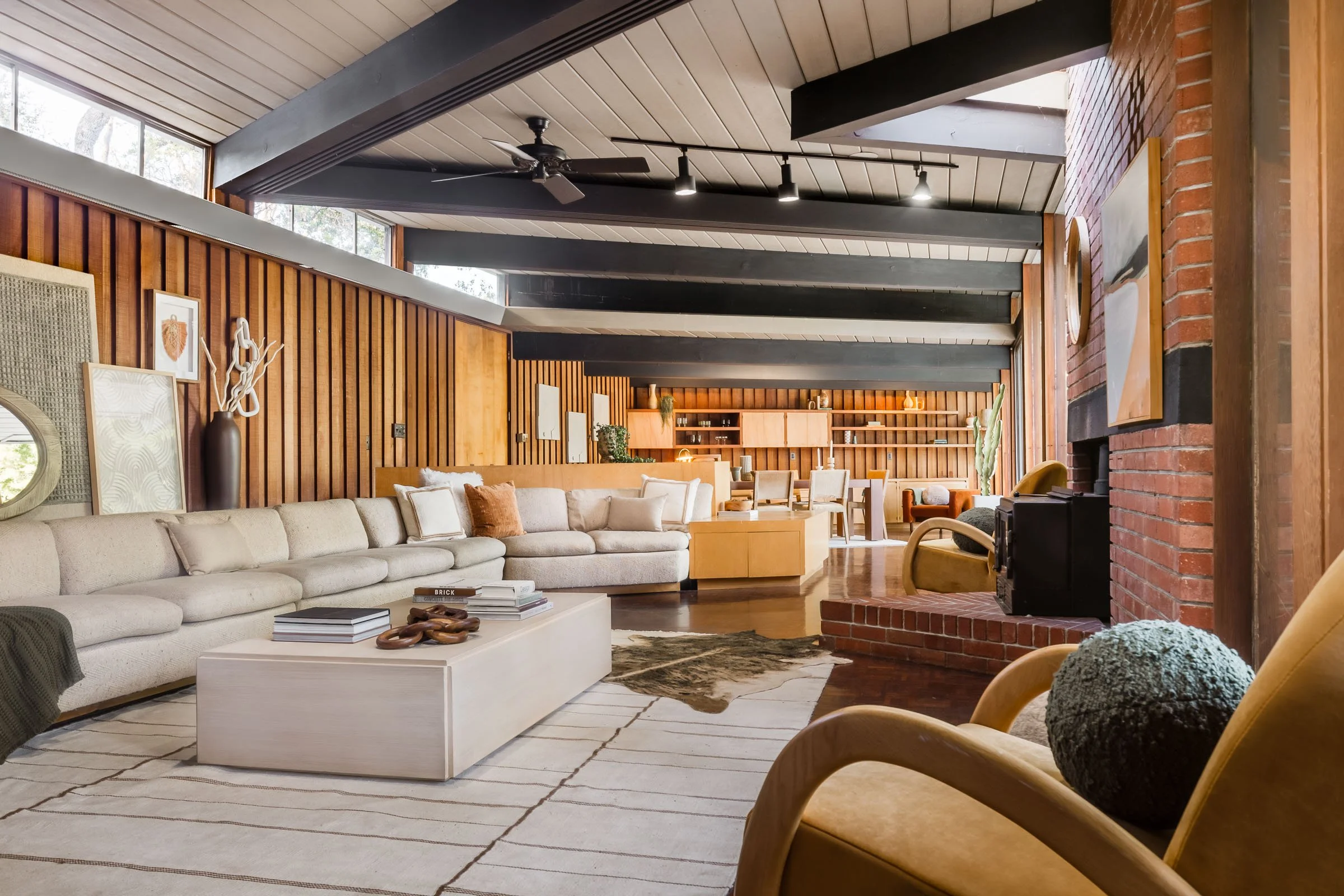
Post-and-beam ceilings and an open plan inside 19 Irving Avenue, Joseph Eichler's own home in Atherton. Photo: Boyenga Team
The X-100: Eichler's house of the future
If any single house explains why Eichlers resonate with today's technologists, it's the X-100.
In 1956, Eichler commissioned A. Quincy Jones and Frederick Emmons to design an experimental home in the San Mateo Highlands, a development Eichler began building in 1955. The result, at 1586 Lexington Avenue, was framed not in Eichler's signature wood but in exposed steel.
The X-100 was a prototype in every sense. It showcased advanced household appliances, some of them prototypes, and tested whether steel could be practical for future homes. Walls of glass open to a pool formed from intersecting circles, and the house sits on a ridge with sweeping views of the Santa Cruz Mountains.
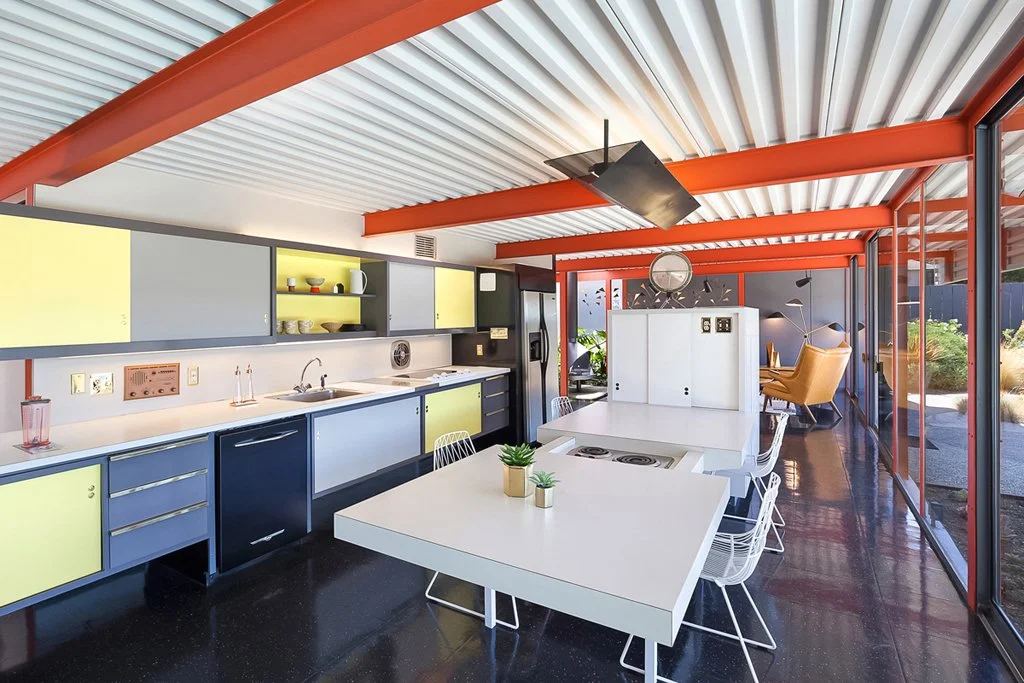
The X-100 kitchen, designed in 1956 to showcase advanced appliances. Photo: Sabrina Huang, Boyenga Team
It was also a brilliant piece of marketing. The Highlands were remote from highways at the time, and the X-100 gave buyers a reason to make the drive. When it opened to the public in 1956, as many as 150,000 people came to tour the "Steel House of the Future." It appeared in Sunset, Life, Arts & Architecture, and Popular Science. In 2016 it was listed on the National Register of Historic Places.
The X-100 asked the same question AI builders ask today: what if we designed for how people will live, not how they always have? The Boyenga Team has had the privilege of representing this landmark, and it remains the purest expression of why mid-century modern design still feels ahead of its time.
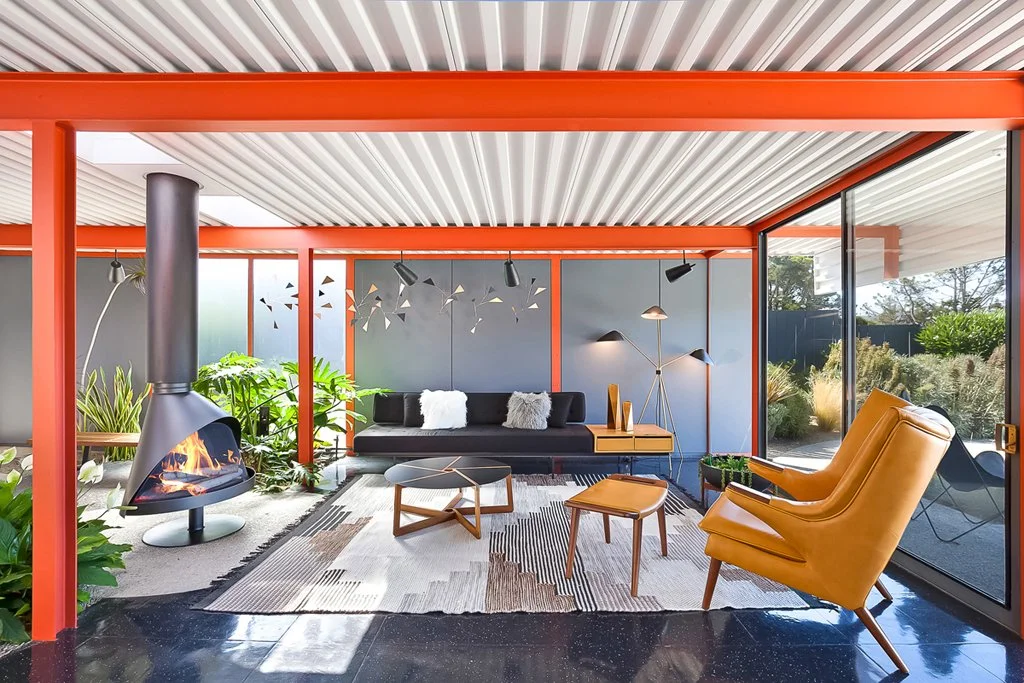
Exposed steel framing and glass in the X-100 living area. Photo: Sabrina Huang, Boyenga Team
Beyond the X-100: later Eichlers and the new modern
The X-100 was one house. Eichler's vision kept evolving into the 1970s, and today's architects are still building on it. For buyers, that means a wide range of options.
The atrium era
By the late 1950s and 1960s, many Eichler designs turned inward around open-air atriums: a private courtyard at the heart of the home, open to the sky. Sunnyvale's Fairbrae tract, built in the late 1950s, is one of the best places to see this generation of design, with wide streets and a neighborhood swim and racquet club.
The last Eichlers
Some of the newest Eichlers ever built are in Mountain View's Bell Meadows, a tract of 48 homes completed in 1972–1973 near Trophy Drive. They tend to be larger, often four-bedroom plans, and represent Eichler's design thinking at its most mature. For buyers who want authentic Eichler architecture with more space, they're worth knowing.
Eichler-inspired new construction
A new generation of architects is designing ground-up homes in the Eichler spirit. Klopf Architecture, which has restored more than 200 Eichler homes, has also built new homes such as its C-Through House in Palo Alto. These homes keep the glass walls, open plans, and indoor-outdoor flow while using today's materials, insulation standards, and technology.
Modernized originals
Many of the most sought-after Eichlers today combine original design with updated performance: new roofs and insulation, modernized radiant heating, updated electrical, and expanded glass walls that open whole rooms to the garden. A well-done remodel keeps the architecture's soul while making the house comfortable for decades to come.
For a buyer who wants mid-century character with modern performance, the choice isn't vintage versus new. It's finding the right point on that spectrum, and that takes someone who knows these homes inside and out.
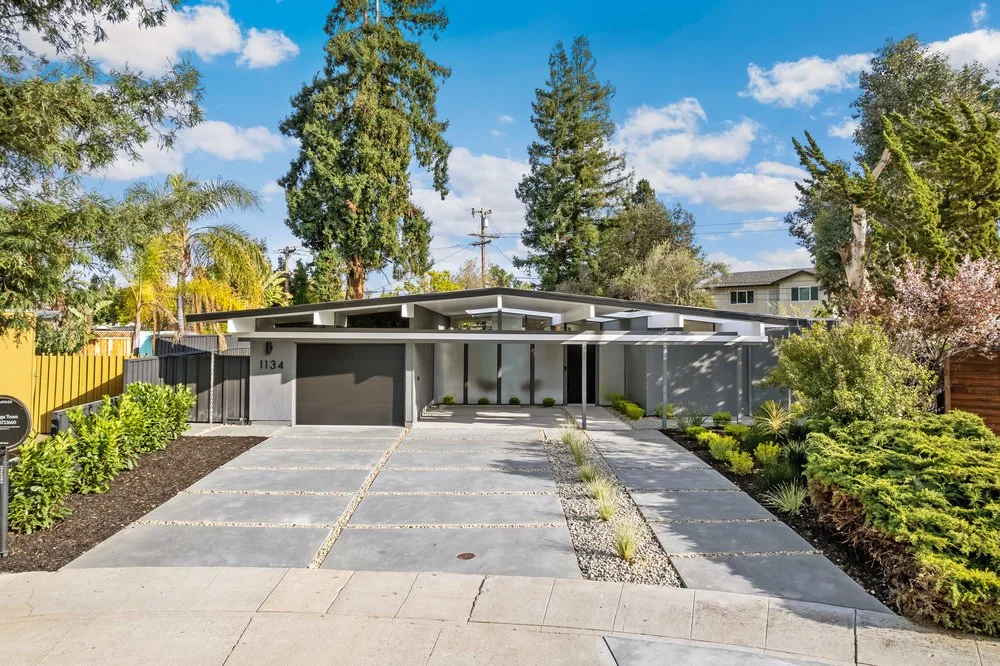
A classic Sunnyvale Eichler with its low-slung roofline and clean, modern facade. Photo: Boyenga Team
Why mid-century modern speaks to AI builders
The people building AI spend their days on first principles: stripping a problem to its essentials and rebuilding it better. Eichler and his architects did the same with the American house. Here's why the match feels natural.
Clarity over clutter
Eichlers are honest about how they're built. Exposed beams, simple rooflines, and clean planes reward people who appreciate elegant systems over decoration. Nothing is there just for show.
Open, flexible space
Open plans adapt to how people actually live and work now: a focused home office in the morning, a gathering space at night, and room to think in between. Many buyers also convert a bedroom or add a studio for deep-focus work.
Light and nature as a counterweight to screens
Floor-to-ceiling glass, atriums, and garden views make the outdoors part of everyday life. For people who spend long hours in front of monitors, that daily connection to light and greenery is a real quality-of-life upgrade.
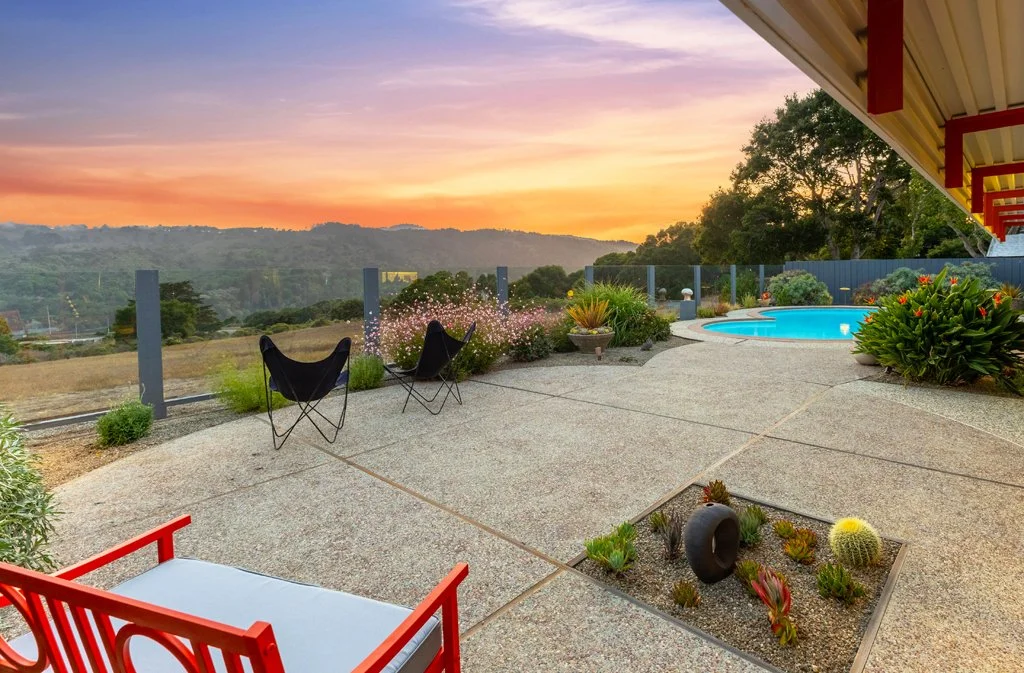
Indoor-outdoor living at the X-100, with views toward the Santa Cruz Mountains. Photo: Boyenga Team
Optimism built in
These homes were designed by people who believed technology and good design could make ordinary life better. The X-100 literally showcased the newest household technology of its day. That conviction sounds familiar in today's AI labs.
Design with a story
An Eichler is a piece of Silicon Valley history. The region's first modern homes went up alongside its first technology companies. For people shaping the Valley's next chapter, living in its first modern chapter carries real meaning.
In our experience, buyers drawn to the newest ideas are often the ones most moved by the boldest ideas of the past.
Where to look: Eichler neighborhoods near the AI hubs
The Bay Area's AI map now has two main centers: downtown San Francisco (SoMa and Mission Bay) and Mountain View. Classic Eichler neighborhoods sit within reach of both. Here are the ones we recommend exploring first.
San Mateo Highlands (San Mateo)
Home of the X-100 and roughly 650 houses Eichler began building in 1955. The Highlands sit on the Peninsula between San Francisco and Silicon Valley, with hillside lots, open-space views, and quick access to Interstate 280. For buyers splitting time between SF offices and the South Bay, it's one of the most central Eichler options.
Monta Loma (Mountain View)
The Fairview tract in Monta Loma holds about 200 Eichlers from 1954, alongside mid-century homes by Mackay and Mardell. It's a bikeable, community-minded neighborhood in north Mountain View, close to major tech campuses. (A young Steve Jobs lived in Monta Loma in the 1960s.)
Bell Meadows (Mountain View)
Some of the last Eichlers ever built, completed in 1972–1973. With larger floor plans and a quiet south Mountain View setting, Bell Meadows suits buyers who want authentic Eichler design with more room.
Fairbrae and Sunnymount Gardens (Sunnyvale)
Fairbrae is Sunnyvale's largest Eichler enclave, with a swim and racquet club and single-story overlay zoning that helps protect the neighborhood's character. Sunnyvale is also where the story began: Sunnymount Gardens holds the first Eichlers ever built, in 1949–1950.
Greenmeadow and Green Gables (Palo Alto)
Iconic South Palo Alto tracts close to Stanford, Palo Alto schools, and the Peninsula tech corridor. Greenmeadow is known for its community center and pool, and both neighborhoods are among the most recognized Eichler addresses anywhere.
Fairgrove (Cupertino)
229 Eichlers built in 1960–1961 in a highly sought-after school area, convenient to Cupertino and the broader South Bay.
Monta Loma in Mountain View, one of the Eichler neighborhoods closest to the area's major tech campuses.
Every buyer weighs commute, schools, lot size, and budget differently, and inventory in these tracts is limited. We're happy to walk you through which neighborhoods match your priorities.
What to know before buying an Eichler
Eichlers are wonderful homes, but they're not like other houses. Here's what we walk every buyer through.
Radiant heating. Original systems ran hot water through pipes in the slab. Find out whether the system is original, repaired, or replaced, and budget accordingly.
Roof and insulation. Flat and low-slope roofs need proper membranes, and many originals had little insulation. Foam or rigid-board roof upgrades dramatically improve comfort and efficiency.
Glass and energy. Walls of glass are the point of an Eichler. Upgraded dual-pane glazing improves comfort without losing the look.
Zoning and design guidelines. Many Eichler neighborhoods have single-story overlays or design guidelines. Know the rules before you plan a second story or major addition.
Remodel quality. Not all updates are equal. Sensitive remodels add value. Remodels that strip out the architecture can hurt it with design-minded buyers.
Competition. Well-kept Eichlers in strong neighborhoods often draw multiple offers. Preparation and local knowledge matter.
Why the Boyenga Team
Buying a mid-century modern home is a specialized decision. Eichlers have their own systems, their own history, and their own price dynamics, and the best ones rarely last long.
As the Property Nerds of Silicon Valley at Compass, Eric and Janelle Boyenga have built their practice around Eichler and mid-century modern homes. We've represented landmarks like the X-100 and Joseph Eichler's own home in Atherton. That focus means:
Deep product knowledge. We know the difference between original and updated radiant heating, which roof and insulation upgrades matter, and how to evaluate an atrium, a post-and-beam frame, or a steel-framed landmark.
Neighborhood fluency. From the San Mateo Highlands to Fairbrae and Bell Meadows, we know the tracts, the model types, and the local design guidelines.
Access. Our network of Eichler owners, architects, and specialists can surface opportunities before they reach the open market.
A data-driven approach. We bring analysis, not just enthusiasm, so you can make a confident decision in a competitive market.
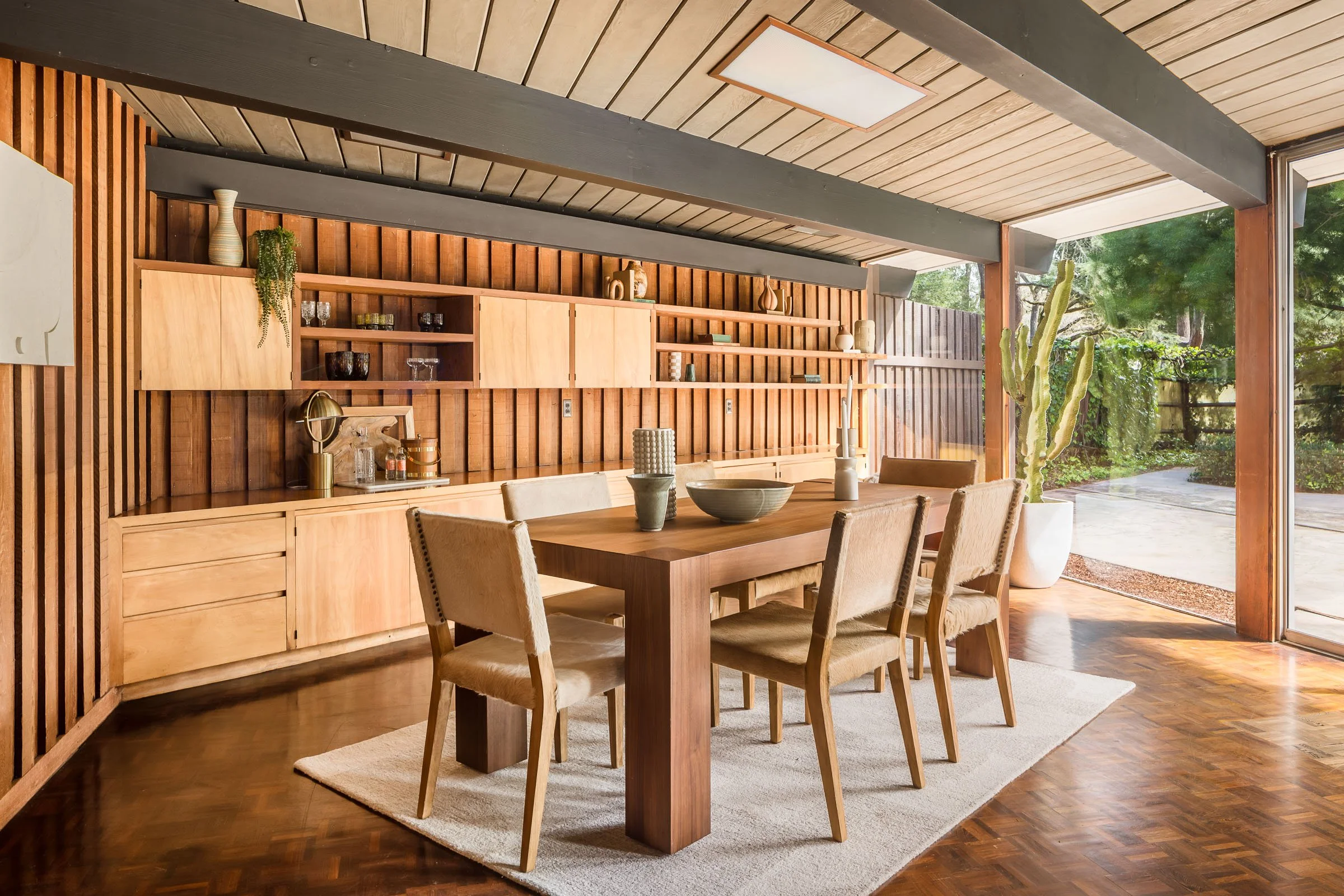
Warm wood and clean lines inside Joseph Eichler's Atherton home, represented by the Boyenga Team. Photo: Boyenga Team
Frequently asked questions
What is the Eichler X-100?
The X-100 is an experimental steel-framed Eichler home designed by A. Quincy Jones and Frederick Emmons and built in 1956 at 1586 Lexington Avenue in the San Mateo Highlands. It was Eichler's "house of the future" and was listed on the National Register of Historic Places in 2016.
Where are Eichler homes near Mountain View tech campuses?
Mountain View's Monta Loma and Bell Meadows, Sunnyvale's Fairbrae, Palo Alto's Greenmeadow and Green Gables, and Cupertino's Fairgrove are all Eichler neighborhoods within reach of Mountain View's major tech employers.
Are there Eichlers close to San Francisco?
Yes. The San Mateo Highlands, home of the X-100, is one of the largest Eichler neighborhoods on the Peninsula and sits between San Francisco and Silicon Valley.
Are Eichlers good homes for remote or hybrid work?
Many buyers find them ideal. Open plans, natural light, and garden views create calm, flexible spaces, and many owners convert a bedroom or add a studio for a dedicated office.
Are new homes still being built in the Eichler style?
Yes. Architects such as Klopf Architecture design new Eichler-inspired homes that combine mid-century design with modern materials and energy standards.
Find your house of the future
Whether you're relocating for a new role, finally ready to buy, or looking for a home that matches how you think, the Boyenga Team can help you find the right Eichler or mid-century modern home in Silicon Valley and on the Peninsula.
Contact the Boyenga Team at Compass to start your search, get a private consultation, or hear about off-market Eichler opportunities.