
Foster City Eichlers: About 200 Homes on Land Raised From the Bay
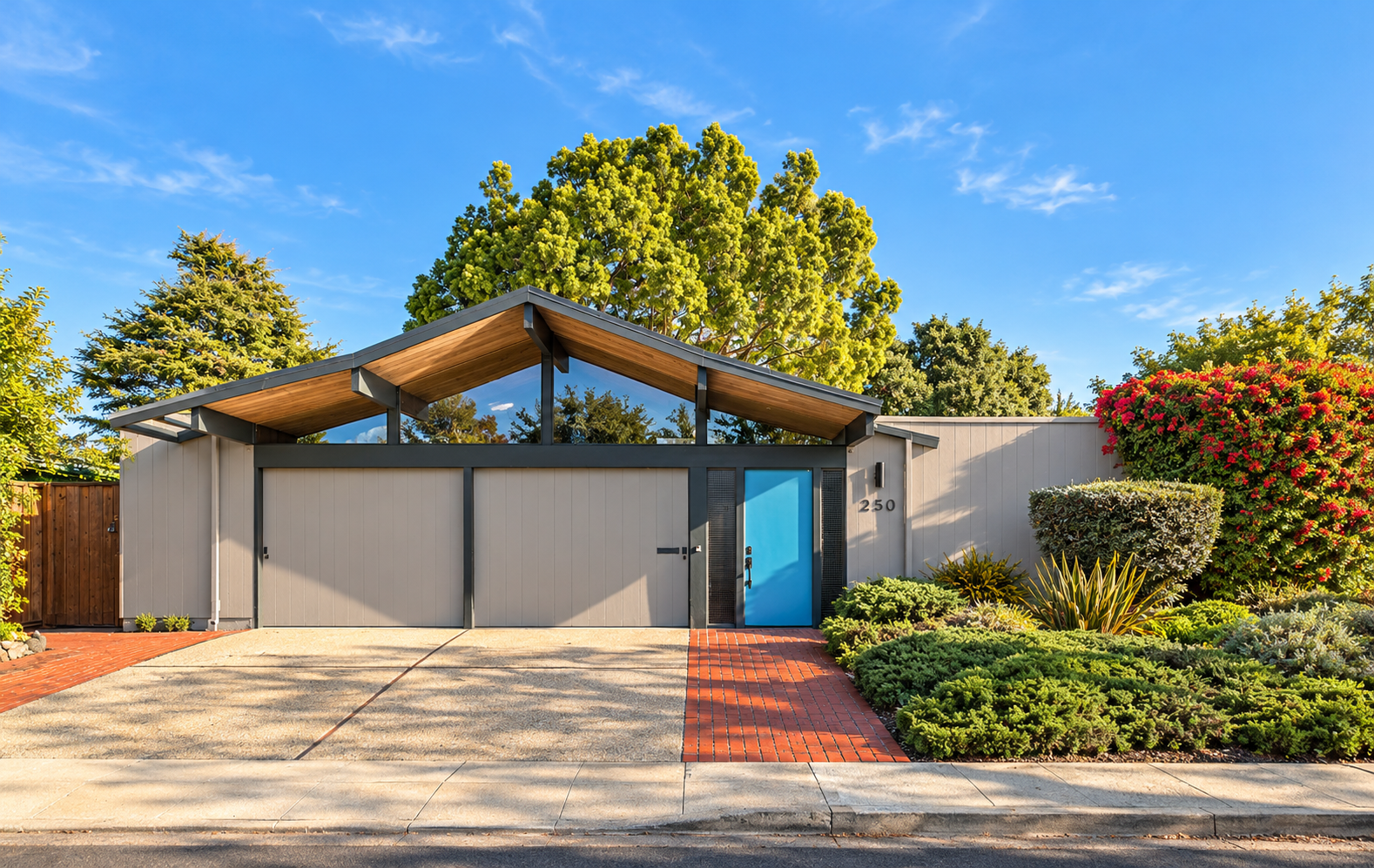
In 1960, the ground under Foster City was marsh and salt pond. By the early 1970s it was a town of more than 9,000 people, and Eichler Homes had put roughly 200 to 235 houses on it.
Those houses are the youngest Eichlers on the Peninsula in one sense: they stand on land that did not exist as buildable ground until the Foster family raised it with engineered fill. They are also some of the hardest to find. Instead of one tract, they sit in small clusters across three neighborhoods, Treasure Isle, Bay Vista and Marina Point, often a few to a block beside other builders' homes. Many buyers, and some owners, do not realize they are looking at an Eichler.
That is why Foster City gets its own City Eichler Guide.
A City Built From Scratch
Real estate developer T. Jack Foster and his sons acquired Brewer Island in 1960 and set out to build a complete, pre-planned city on it. They raised the low ground with engineered fill and dug a 218-acre lagoon system to drain it. The lagoons became the town's defining feature. The first residents moved in on March 7, 1964, when Charles Zerbe bought the first home for $23,500, and Foster City incorporated on April 27, 1971, with about 9,300 people.
T. Jack Foster Jr. wanted Eichler Homes among the founding builders. He admired the houses for their architecture, and Eichler's homes were among the first built in the new city. Construction ran from 1963 to 1968 by the Eichler Network's dating, at the same time as Eichler's Mills Estates tract in Burlingame.
The company changed hands partway through. In 1965, cash-flow problems tied to Eichler's San Francisco high-rises forced Joe Eichler to give up control of Eichler Homes, and the Foster City work continued under new ownership. The last houses went up on Mainsail Court in 1968, near the very end of the company's life.
Joe Eichler's policy of selling to any buyer regardless of race, adopted years before California's Rumford Fair Housing Act, also makes these homes part of the history of open housing on the Peninsula.
What Makes a Foster City Eichler Different
Eichler's in-house team adapted the California modern house to flat, sandy, bayside lots. Claude Oakland, the company's principal architect of the 1960s, and John Brooks Boyd, an Eichler staff architect, drew plans the original brochures described as designed specifically for the area. These are late-model Eichlers, and it shows:
- Bigger plans. Most are four bedrooms and two baths, with a multi-purpose room off the kitchen and a two-car garage in place of the earlier carport.
- Gallery or atrium. Some plans replace the open atrium with a covered, skylit gallery, better suited to Bay wind and fog. Others keep the atrium, and one model wraps interior rooms around it on all four sides.
- Courtyard models. A walled entry court sits in front of the house, with the glass wall facing it.
- Rooflines. Alongside the flat roof you'll find double gables and low peaks over the living room, which give the street a rhythm the earlier tracts lack.
- Outrigger beams. On the 1968 Mainsail Court homes, the central ridge beam extends past the eave and turns up at the end, like the outrigger of a Polynesian canoe. It is found nowhere else.
Foster City's planners mixed builders within each neighborhood, so the Eichlers appear in clusters: a row on one block, four more a few streets away. The Eichler Network once called them "forgotten by the Bay" for that reason. There is no formal Eichler association, but the city reviews exterior changes for consistency with the original design.
The Original Plans
Our archive holds four plan sheets from Eichler's own Foster City sales brochure. Two plan families appear: CC plans by Claude Oakland, and FB and FC plans by Oakland and Boyd.
- Plan CC-174, Claude Oakland. Four bedrooms, two baths and a multi-purpose room, with a central atrium and loggia and a hobby-and-laundry room at the front.
- Plan CC-294, Claude Oakland. Four bedrooms, two baths and a multi-purpose room around a larger atrium, with two bedrooms on each side and a hobby room by the entry.
- Plan FB-45, John Brooks Boyd. Four bedrooms, two baths, an atrium and a two-car garage. The bedrooms run down one side, with the atrium and kitchen at the center.
- Plan FC-23, Claude Oakland. The courtyard model: three bedrooms and two baths behind a walled entry court. The smallest of the four, and the one most often found on tighter lots.
If you own a Foster City Eichler and don't know your plan number, send us a photo of the street front and a rough sketch. We can usually match it.
Get the Full Property Nerds® Field Guide
The blog gives you the story, but the full guide goes deeper.
Download the complete Foster City Eichler Guide for the original brochure sheets for plans CC-174, CC-294, FB-45 and FC-23, a timeline from marsh to modern, a map of where the Eichlers sit, a fact file for Treasure Isle, Bay Vista and Marina Point, a diagram of the Mainsail Court outrigger beam, and the buyer's checklist for Eichlers on bayside fill.
Get the Full Guide →Neighborhood by Neighborhood
Foster City's Eichlers sit in three of the city's numbered neighborhoods, each with its own street-naming theme.
- Treasure Isle. Ship-named streets at the north end of town, closest to the San Mateo Bridge and Highway 92: Matsonia, Lurline, Pilgrim and Constitution drives, plus Clipper and Bounty. As one of Foster City's oldest neighborhoods, it has some of the earliest Eichlers in town.
- Bay Vista. Bird-named streets along the Bay: Gull Avenue, Crane Avenue, Egret Street and Sanderling Street, plus Beach Park Boulevard. This is the largest Eichler group in the city. Five homes front Beach Park Boulevard directly across from the levee and the Bay Trail, the closest any Foster City Eichler comes to the water. Original details survive here more than anywhere else in town: mahogany paneling, cork floors, globe lights and, on at least one restored home, the original teal front door.
- Marina Point. Schooner and Barkentine streets and Yawl and Mainsail courts: the tightest Eichler cluster in town and the last built. The Mainsail Court homes connect to Ketch Park by pedestrian paths, the kind of greenbelt planning Eichler used in his best tracts, and they carry the 1968 outrigger beams.
For the record, the schools serving Foster City Eichlers are Brewer Island or Foster City Elementary, Bowditch Middle, and San Mateo or Aragon High. Confirm the assignment for any specific address with the district.
What the Numbers Say
Foster City Eichlers trade at a discount to the Peninsula's marquee Eichler tracts and at a premium to conventional homes on the same streets. Across all three neighborhoods, typical homes run about 1,600 to 2,200 square feet.
The appeal is easy to state: a real Eichler at a lower price than Palo Alto or Menlo Park, with larger yards, newer infrastructure, and lagoons, bike paths and greenbelts close by. Gilead, Visa and Zoox are headquartered in town, and the San Mateo Bridge to the East Bay is at the door.
Because the homes are scattered and sell infrequently, we refresh neighborhood price ranges and recent sales from MLS data rather than publishing a single citywide figure. Ask us for the current numbers on any street.
The Property Nerd Questions
A Foster City Eichler asks the usual Eichler questions, plus a few that come with building on bayside fill:
- What is the flood zone? FEMA mapped the whole city as a floodplain, and the bayfront levee was rebuilt in the 2020s with steel-reinforced walls. Get the current zone letter for the lot and a flood-insurance quote before you bid.
- How is the foundation? The city sits on engineered fill. Ask for a foundation inspection and any prior soils or settlement reports, and look for cracking, out-of-level floors and doors that stick.
- What heats the house? Confirm the system. With forced air, check duct condition and furnace age; with radiant, pressure-test it.
- How old is the roof? Flat and low-slope foam or membrane roofs need the age, the material and any transferable warranty. Watch for ponding, and consider rigid foam over the roof deck to insulate without covering the ceilings.
- Are the beam ends sound? Check exposed beams, especially the Mainsail Court outriggers, for weathering and dry rot.
- Is the glass original? Single-pane glass loses heat to the Bay wind. Price dual-pane replacements that keep the original sightlines, and look closely at roofs, glazing and siding on the five Beach Park Boulevard homes.
- Were the atrium, additions or garage changed? Confirm permits, and remember exterior changes go through city design review.
- Which plan is it? Knowing CC-174 from FB-45 makes every future remodel easier.
For owners: restore rather than erase. Homes with original mahogany, cork, globe lights and beam ceilings sell for more than over-remodeled ones, and additions that keep the roofline and clerestory band read as original. Second stories rarely do.
The Series
Foster City joins the other City Eichler Guides: Los Altos, Burlingame, Cupertino, East Bay, San Francisco, Monte Sereno, Mountain View, Palo Alto, Redwood City, San Jose and Santa Clara.
The Boyenga Team at Compass
Eric and Janelle Boyenga lead Silicon Valley's #1 Eichler team. We have represented both ends of the Eichler story: Joseph Eichler's own first home at 19 Irving Avenue in Atherton, and the X-100 in the San Mateo Highlands. With more than 2,256 homes sold, $2.3 billion in volume and 28+ years in Silicon Valley, we bring data, design knowledge and a network of Eichler buyers to every sale.
Because Foster City Eichlers are scattered, many are sold as ordinary ranch houses and never reach the buyers who pay for design. We market them as Eichlers, with Eichler-to-Eichler comps, a restoration-value review and the story of the original plan, and we bring our list of mid-century buyers. Compass Concierge can front the cost of pre-sale work.
Download the Foster City Eichler Guide PDF
Foster City Eichlers do not come up often, and they are easy to miss. When they do, they deserve to be understood.
Whether you are thinking about buying, selling, renovating, preserving, or simply learning more about these bayside Peninsula Eichlers, the full Foster City Eichler Guide is designed to help you see the market like a Property Nerd®.
Download the Foster City Eichler Guide PDFThinking of buying or selling an Eichler in Foster City?
Talk with Eric & Janelle Boyenga, Silicon Valley's #1 Eichler team.
Contact the Boyenga TeamEichlers@Boyenga.com · 650.383.8606 · 408.373.1660
EichlerHomesForSale.com · Boyenga Team | Compass · DRE 01254725 / 01254724
Price ranges and sales are drawn from public sources and our own records, 2025–26, and are not appraisals. Information is deemed reliable but not guaranteed. Compass is a licensed real estate broker in California. Equal Housing Opportunity.